
Q&A: How Slowing Down Led to Blackwater Holylight’s Strongest Record ‘Not Here Not Gone’
INTERVIEW
INTERVIEW
☆ BY KIMBERLY KAPELA ☆
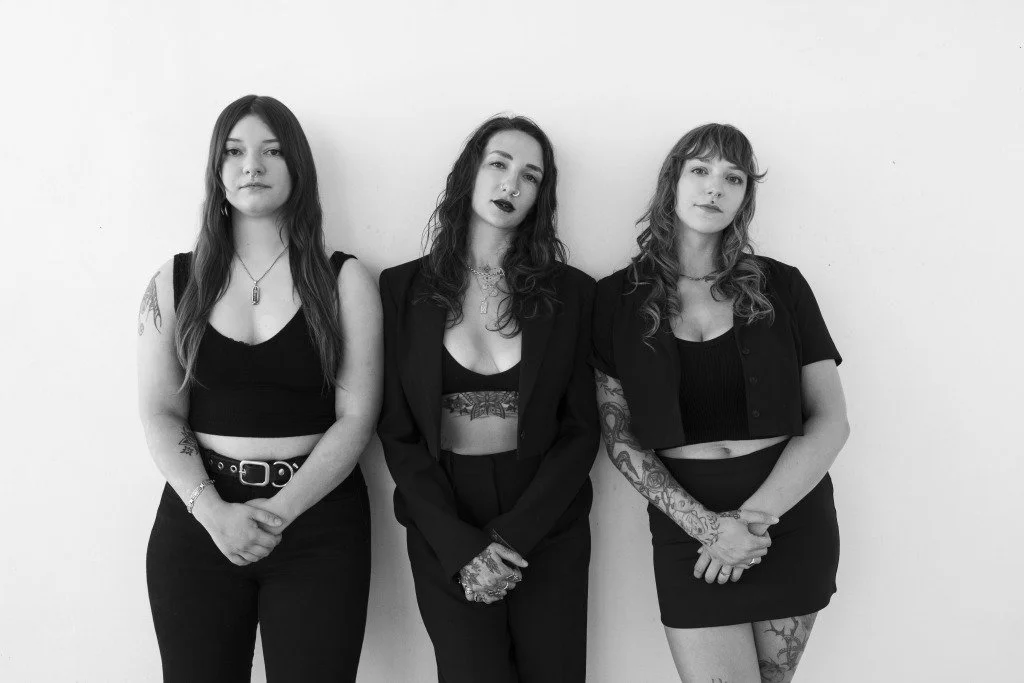
Photo Credit: Magdalena Wosinska
ONE FOOT IN, ONE FOOT OUT — On their forthcoming fourth full-length album, Not Here Not Gone, the women of Blackwater Holylight continue to refine the liminal space they’ve made entirely their own, where light and darkness don’t simply coexist, but actively bleed into one another. Across the record, menacing riffs form a dense foundation for beguiling melodies, towering shoegaze guitar walls dissolve into weightless synths, and heavy subject matter is carried by siren-like vocals that feel both soothing and unsettling. It’s music that moves with intention, offering empowerment in one moment and raw vulnerability the next.
That push and pull has long been central to Blackwater Holylight’s identity, but Not Here Not Gone sharpens the contrast to its most potent form yet.
“Some songs we’re the predator, and some songs we’re the prey,” says drummer Eliese Dorsay.
The album’s title perfectly encapsulates that state of in-between.
“It’s one foot in, one foot out,” vocalist and guitarist/bassist Sunny Faris explains. “It’s about how you can lose people in your life but still have their presence and energy around you.”
Yet Not Here Not Gone never insists on a singular interpretation. Especially on this record, the band’s intention has been to create a space rather than dictate a message. As Faris explains, their goal “has always been to create a space that promotes everyone to make their own meaning out of the songs that can promote their own healing.” That openness allows the album to function as a vessel, absorbing personal narratives from each listener while remaining deeply intimate at its core.
Lead single “Heavy, Why?” stands as the album’s emotional and sonic apex, a distillation of Blackwater Holylight’s ability to balance crushing weight with spectral beauty. The track interrogates heaviness itself, revealing the band’s deepening self-awareness and precision in shaping contrast into catharsis.
For Not Here Not Gone, the band made a conscious decision to slow down. Songs were allowed to unfold over years rather than weeks, shaped slowly as the band navigated new environments and new versions of themselves.
“If there were to be a theme to the album, it would be patience,” Faris says. “Some of these songs we’ve been working on for three years, just giving the songs time to breathe and develop while we were exploring a new place and new lives.” That deliberate pacing allows the album to unfold organically, giving each composition room to expand, contract, and reveal its emotional weight without urgency or excess.
Recorded at Sonic Ranch outside of El Paso, Texas, with producer Sonny Diperri, the band once again removed themselves from familiar surroundings to focus exclusively on their craft. The isolation proved transformative, pushing Blackwater Holylight beyond their comfort zone and deeper into their artistic instincts. The result is a record that feels both expansive and intimate—a fully realized statement that captures the band at their most patient, powerful, and perceptive.
Not Here Not Gone captures Blackwater Holylight at their most patient, powerful and perceptive.
Photo Credit: Magdalena Wosinska
LUNA: Thank you for talking to Luna. Our readers would love to get to know you and your music more.
For any readers who aren’t familiar with you yet, what inspires your artistic style and sound?
SUNNY: That's always a big question for us, because we all come from different backgrounds of music, what we've been into, bands that we've played with, and just our musical influences are weirdly different from our roots. As we've built the band, we have become more collective. I think for me personally, my biggest influences early on came from more of the psych scene, really back in the day listening to bands like Spiritualized and Galaxy 500.
As we've gotten more into the heavier realms, I'm honestly inspired by my friends. I feel like all of my favorite bands are bands that my friends play in and that I know and love — Nothing, The Body, Hell, Mizmor, Inter Arma and Sumac — all of these bands that we've gotten the pleasure of knowing and meeting and developing relationships with along the way are definitely the most inspiring for me, because I see how hard all of these people work and how dedicated they are to their craft, and it's so inspiring for me to be surrounded by people that work so hard at their musical projects. It's given me a lot of fuel to want to do the same, and just to have this example. So many people are trying to do what we're doing, and their music is all amazing.
LUNA: What kind of atmosphere or emotional space do you aim to create for your listeners?
SUNNY: I feel like I can speak for the rest of the girls on this one too, that the most important thing for me writing this record and past records, but especially this record, has always been to create a space that promotes everyone to make their own meaning out of the songs that can promote their own healing. I've had some people come up to us in the past at shows that have shared stories of, ‘I listened to this song that you made,’ ‘I was going through this hard thing in my life, and it really helped me through that time of my life.’ That's the exact environment that I want to create. I want to create a space where people can listen to our music and see what we create, and they can make meaning for themselves. It can be something that assists them through whatever they're going through in life, whether it be something really difficult, something really joyous, whatever it is, just to make them feel like they're not alone. Music really is the web that can keep everyone connected.
LUNA: Your newest single “Heavy, Why?” is a sneak peek into your upcoming record. What is the inspiration behind the track or the feeling that pushed this story to the surface?
SUNNY: It's my favorite song on the record. That song started off as a curiosity about the drumbeat that Eliese is playing in that song. The snare pattern was something that I had been hearing in some other music that I still listen to a lot and that I had been noticing in a few other bands. I really wanted to go to our practice space and fuck around with her on that drum part. It started off a conversation about her playing this beat, and then when I was jamming with her, the chorus of that song fell out. I started playing it and we built upon it. We took it to Michaela, and it expanded a little more. Then by time Sarah came in with the synth part, we had a bit more structure. Lyrically, it's about being disassociated from your body. The lyrics are very short and cryptic in that song. I wanted to keep it that way. I could have added more vocal sections and really expanded it, but I like that the snare pattern is the hook of this song. It's just these two little choruses that repeat because it creates this really fuzzy wall of sound that is that song. I didn't really want to fuck with that. It just fell out of us that way. That song, the way that it came out isn't our normal approach, but it was a really fun way of starting off as a drum idea and then building everything else around it.
LUNA: “Heavy, Why?” is accompanied by a music video which adds another layer of depth to the song’s themes. How was your experience filming it?
SUNNY: That video was super fun to make. It was freezing. We started recording it at 7 p.m. in Malibu, and we got done at 6 a.m. It was fully night shot, and we were in the water for a lot of it, and it was freezing. I was so cold the entire time. Our director Lorenzo worked with our manager and creative director Candace Lawler to come up with something really visually captivating. There's a bit of a storyline behind the video, but we just wanted to do something where if you pause it, anywhere you pause it would be a cool poster. Our director was amazing. He was just so good at telling us what to do. It was really fun for us to release control over it and just let our directors do their job, and trust that they were giving the song the visual representation that it needed.
LUNA: As you prepare to release your fourth full-length album, what initially inspired Not Here Not Gone, and what emotional or thematic ground did you feel compelled to explore this time around?
SUNNY: This record was different for us because we moved from Portland to LA shortly before our third record was released, Silence/Motion, and that album for us was the last record on our old label cycle. As soon as we released that, we didn't have contractually any more obligations to fill any records. For the first time in really the entirety of the band, we had space to sit down and be like, ‘okay, what do we want to do? How fast do we want to release something? What's our plan?’ And we really milked that time. We took a lot of time to write. We demoed songs, we recorded them, we scratched them, we demoed again.
We went in and out of trying to decide what was going to be the collection of songs for the record and all these things. Eventually, over the course of three years, we were ready to record. We signed with our current label, Suicide Squeeze, and their contract was an EP that we had the songs already recorded for because we'd been in and out of the studio. That came out pretty immediately upon signing with them, and then we decided to go record the record.
I think the theme of it was just to see what happens when we take our time and see what happens when we're ultra patient with the songs, when we disattach ourselves from things that don't really feel like they're working, when we invite new ideas in and just really let go of the ego elements too. We're just going to really step back here and enjoy being in a new place and enjoy the process of trial and error, instead of just going with all of our first ideas, which have been on the rest of the records. We really cycled through ideas and it felt really good and honored the music to be able to have the time to do that.
LUNA: I would love to touch more on the creative process behind the album. You worked with producer Sonny Diperri. What was it like bringing him into your creative process, and how did he influence the sound of the album?
SUNNY: He is an amazing engineer and producer. I love him. When we decided to do the record, and to do it with him, we had a meeting, and we all sat down, and he was like, ‘okay, this is how I work with bands. This is how I do with everyone. This is my process, so if you guys are down with this, then let's roll. Let's make the record.’ Then he proceeded to tell us about his pre production protocol that he has, which is just pretty ruthless rehearsal.
We were practicing multiple times a week for multiple hours writing this album. He would come into our practice space, and he would sit there with us while we were practicing, and he would have us play a song 10 BPMs faster, and then we would play it 10 BPMs slower, and then we would try rearranging it and taking out a chunk and moving things around. It was just playing the song every way that you could. We would down tune. We would take out a drum part. We would just do everything that we could to dissect and play the shit out of these songs so that by time we got to the studio, we could play them wasted, blindfolded and hanging upside down.
We were good, but the point is that we were just able to play them under any circumstance, which was awesome. Then when we got to the studio and started recording, we knocked out all of the bigger parts pretty quick, and it gave a lot of room for the more fun, textural shit. That's his entire thing. Let's get the guts taken care of and really rehearse so that we have time to do crazy sound loops. We've always gone into records being very well rehearsed, but I've never practiced like that for anything before. He was there for a lot of it, just cracking the whip.
LUNA: You intentionally slowed your creative pace for this record, embracing patience and long development cycles. What did giving songs that much time allow you to hear or understand that you might’ve missed before?
SUNNY: I think that there is a natural unfolding that songs go through in their process of existing. I think that for us, there's been a cycle on all of the records. You write the song, you practice it, then you go and you record it, and then there's the recording, and then you're on a tour cycle, and you play them live and all of those stages of songs blossom in a way that they didn't on the previous stage. Having the time for us really allowed each song to blossom so much more than our songs have in the past, because we haven't been playing them live. These songs still very much have a lot more life in them, but just to see what happens when you go through that cycle of writing, it really takes its own form, and sort of tells you what it wants. It feels like a more respectful approach to the craft.
LUNA: Do you have a personal favorite song on Not Here Not Gone — one that feels closest to your heart or most revealing of who Blackwater Holylight is right now?
SUNNY: “Heavy, Why?” is the only song off the record that we have been playing live. Overall, the most meaningful song to me is the last song on the record, “Poppy Fields.” It's a song that I wrote for my best friend who lost her house here in the fires in January. It's a really meaningful song to me, just about grief and loss. It's really for everyone that has ever lost something important to them, or had to let go of something important to them or to be in the face of something really, really tragic and horrific. It gives an ode to how terrifying that experience is and can be.
LUNA: How do you hope listeners — especially your femme audience — can connect with or find power in this new era of music from you? What emotions or messages do you want to leave with them?
SUNNY: I think that our message always has been and will be that if you are a femme or a woman and you want to get on stage and you want to be loud, you can fucking do it and that doesn't come without hurdles. I don't think that any musician, regardless of gender, is exempt from hurdles. It's always been about working with women. It's always been about being really vulnerable. It's always been about putting yourself in a space that's been so historically dominated by men, and that's starting to shift, and it has changed a lot since we started. But it always feels good for us to be on stage and to see any woman in the crowd that has a sparkle in her or their eye, and then come up to us afterwards and just express that they started playing an instrument because of us, or they want to start a band, or whatever it is. If you have an idea, chase it, do it, try it, just do it.
LUNA: What is fueling your fire right now that’s pushing you into this next chapter in your career?
SUNNY: I think that the fuel in my fire right now is just the prospect of being able to play all of this live. We've been working on it for so long, and we've been talking about all these tours for so long, and now they're just right around the corner. I'm really stoked to be able to get on stage and just perform and go into that next phase of the songs blossoming, and just see what happens once we start bringing them into the live element. I'm also continuously just fueled by my bandmates. They work so hard for this project, and they've grown up so much. We've all grown up so much in this project together, and we're all really grateful and stoked that we still get to be doing it. If it weren't for them, I wouldn't want to be doing it anymore either.
LUNA: How are you feeling in this current era of your career and what does the upcoming year look like that you would like to share with Luna?
SUNNY: I feel very stoked and a little bit overwhelmed. We don't have a ton of tour right now. We definitely have some stuff booked for sure. But the last two years have been relatively chill on tour for us because we've been writing the record, so now it's time to switch gears and go back to being on road mode. We have to put on the armor and get ready to go eat a lot of chips and be ready to hit it. I think it's getting excited for everything that we have coming up.
Photo Credit: Magdalena Wosinska
