
Q&A: Filmmaker and Forever Riot Grrrl Rhianon Jones talks Cora Bora
INTERVIEW
INTERVIEW
☆ BY EMMI SHOCKLEY ☆

Rhianon Jones on drums with The Del Toros. Portland, 2002.
IT’S BEEN ABOUT 20 YEARS SINCE RHIANON JONES LEFT PORTLAND—These days, Jones is known for her work in the film industry as a writer, producer, director and the founder of Neon Heart Productions. But in the early aughts, before any of her indie film success, Jones was playing in riot grrrl bands and charging through a particularly kinetic and increasingly unpredictable era of Portland’s music scene. In the writing of her most recent film Cora Bora, Jones returned to her stories of the city that shaped her and the scene that nearly broke her.
Neon Heart Productions is a boutique-sized yet heavy-hitting production company helmed by Jones and producer Tristan Scott-Behrends. They first exploded onto the scene with director Emma Seligman’s breakthrough feature, Shiva Baby, the micro-budget debut feature that gave rise to both Rachel Sennot and Molly Gordon. The company is known for a concentrated, women-led slate dominated by buzzy festival favorites that attract contemporary indie it-girls.
Cora Bora, stands as one of their most commercial comedies while staying true to Neon Heart’s artfully offbeat style. Cora Bora was written by Jones, directed by Hannah Pearl Utt, and stars an especially out-of-pocket and glorious Megan Stalter. The soundtrack prominently features original music by Miya Folick. The film is bold, mischievous, hilarious, and then all at once, startlingly heart-wrenching and honest.
Cora Bora follows Cora, a struggling, newly LA-based musician who returns to her hometown of Portland in a poorly planned attempt to win back her long-time, now long-distance, girlfriend, Justine (Jojo T. Gibbs). Cora is a bisexual, polyamorous, animal print-loving, combat boot-wearing, winged eye-linered trainwreck of a woman. She is both a joy and an absolute terror to behold. Her one-liners are brilliant and insane, her life choices are dubious at best, and her behavior would be infuriating if Stalter’s performance were not so much fun. What is perhaps most successful about this film is the slow, earnest reveal that Cora’s perceived ineptness is actually her own form of self-protection. Cora’s running from a tragedy, her guilt, and a city that fills her with grief.
Luna chats with Rhianon Jones about punk rock, indie filmmaking, writing through the real stuff, and what it means to be a Cora.
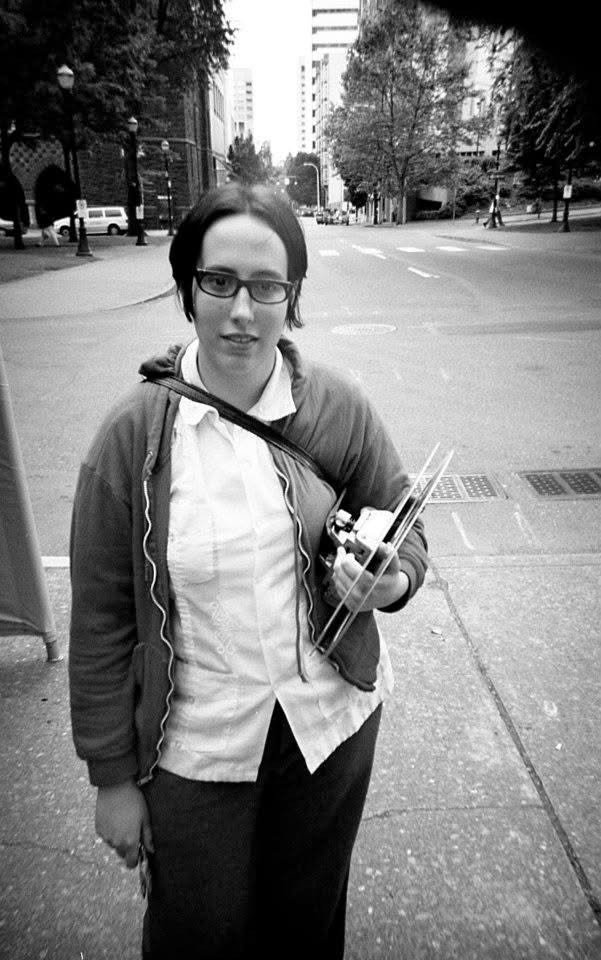
Rhianon Jones outside of the Northwest Film Center, Portland, 1998. Photo by Neilson Abeel.
LUNA: How much of the Cora Bora screenplay was inspired by your personal history?
JONES: The music stuff is what comes most from my life. I was very much in the punk and garage rock scene in Portland for a long time, playing drums and guitar in my various bands. There's a lot of really wonderful stuff about that scene. I don't think childhood me ever dreamt that I could get on stage with a guitar and a distortion pedal and make music. After the riot grrrl movement, things really opened up for women to play. I'm so grateful to have been 19 and seen all these fiercely feminist bands paving the way. I never questioned that I could play it, too, because of that path they blazed for us. I was in that scene for a while. It wasn’t the most physically healthy; there was a lot of drinking and doing drugs and stuff. I was in it until my late twenties.
LUNA: How much of the Portland that you knew in your twenties bleeds through into the film?
JONES: People who are familiar with the scene will probably pick up the [film’s] reference to The Exploding Hearts. That's a band that we used to play with in Portland. It wasn't just what happened to them, which, for people who don't know, they were in a terrible accident, and only a couple of people survived. That was right in the middle of multiple young people I knew in that scene, dying from various reasons. Some car accidents, some drug overdoses, suicide, cancer. Within a year and a half, I knew, like, 10 people who had all died from that scene. I was sort of looking at my life, and I realized that I was no different from anyone else. Also, right after the Exploding Hearts [accident] when I was on tour, we witnessed another awful accident where a family died on the road. We had just left Portland to go on tour, and this car flipped over and caught fire. It started a forest fire and we were trapped there for about twelve hours on the road. It was f*cking awful. By the time I came back from that little punk rock tour, my nerves were just so shattered.
In the original version of this script, I was trying to obfuscate the Portland-ness and make it more general. But when Hannah Pearl Utt and [her producing partner] Mallory Schwartz joined the project, they told me it should be Portland. I was so afraid of that. As a writer, I know I have a right to put that out there, but as a musician and a person from that scene, it felt scary to nominate myself as a spokesperson for that entire scene. But when the movie came out and played in Portland, I had a few people write to me from my old bands to say things like, “Thank you so much for saying that.” It was such a hard time, and we all acted like it was fine. It wasn't fine.
LUNA: When you started writing this script for Cora Bora, did you originally include this dark side?
JONES: No. Not at all. At Neon Heart, we do all kinds of films, including some pretty dark and provocative ones like Palm Trees and Power Lines, Give Me Pity, and Dead Lover. I wanted to make something with a broader appeal. For me, that’s like a bisexual, polyamorous lead character. Some people told me that it was still pretty niche, but to me, that felt like a blockbuster compared to some of the movies we do. So in the beginning, Cora Bora didn’t have that serious turn to it. But that’s a core part of the director, Hannah’s, filmmaking style. She wants the drama and the comedy sitting side by side as a sort of meta commentary on the absurdity of life. I think that’s why she was drawn to the character of Cora. Of everyone, she loves Cora the most. She says that she has multiple Coras in her life and she loves them all dearly. She has so much patience for them.
LUNA: I love that “Cora” has become an archetype. What makes someone a Cora?
JONES: Wild and open and provocative in their openness. The Cora friends in my life have always kept me on my toes with the choices they make and the way they navigate life. The movie is a tribute to them and their perspectives and their ability to keep things unexpected. But I don't think of myself as a Cora, per se. I'm more like the Manny Jacinto character, Tom. I am perpetually trying to fix people. I think the thesis of the film is that broken people need love, too. And broken people can love you back. And not to give up on them.
LUNA: How did the collaboration with Miya Frolick come to be?
JONES: Hannah and Mallory were friends with Miya, and they’d been wanting to work with her. At first, I thought she was too polished because I came from such scrappy punk rock bands. I didn’t understand how someone with such a beautiful voice who puts out such well-produced music was going to do this. I wrote the lyrics; they’ve always been included in the script, and then Miya wrote the music. I remember the first time Miya sent me the recordings of these songs, I was laughing and crying so hard. It was so funny to hear these ridiculous lyrics turned into these beautiful songs by this great musician.
LUNA: I didn’t know that Megan Stalter could sing before this film.
JONES: Meg has a really nice voice. It’s not show-tune quality, but it’s definitely show-girl quality. She's a theater kid by way of her high school experience. The moments when she's singing show her vulnerability. She brings a lot of heart to the songs, which I thought helped bring everything together.
LUNA: How did Meg join the project?
JONES: We’d been taking the project out, and people were asking, “Who the f*ck is gonna play Cora?” All at once, my team [director Hannah Pearl Utt and producers Tristan Scott-Behrends and Mallory Schwartz] and I thought of Meg. We took it to her just as she was starting to blow up, so the timing was perfect. Once we knew it was gonna be Meg, everyone suddenly wanted to be a part of the film.
LUNA: What’s your favorite song that came out of the film?
JONES: “Love is a Joke,” [a] song that Cora plays at the group love house. I’m humbled that I had anything to do with it, even just having written the words. The beauty comes from Meg’s voice and Miya’s tune. I felt lucky to have been a part of creating that song. It gets stuck in my head. It was very nice for me, as an ex-musician now, to get to be a part of that, and to have written the lyrics and created the world to some extent.
LUNA: Has songwriting always remained a part of your artistic practice?
JONES: It has. It’s big with my kids, too. I take out the guitar and we make up songs together. I always try to teach my kids that it’s accessible. You don't have to be able to rip scales on a piano. Three chords and the truth, maybe even two chords, can be your way into music. You can pick up a guitar, you can put on distortion so no one hears your mistakes, and you can just talk about your feelings. Your three chords and the truth might happen to be their truth as well, and that makes everyone feel less alone, which I think is more important now than ever in our living memory.
LUNA: Three chords and the truth. And a distortion pedal.
JONES: A pedal just to gloss it over.
LUNA: With Cora Bora widely available on Netflix now, what do you hope audiences will take away from the film?
JONES: If you'd asked me this a year ago, I might have had a different response. It would have felt like no big deal that it was on Netflix before, but now Netflix has gotten more conservative. With everything that’s going on right now against the queer community, I think that the normalization of Cora’s sexuality, and the sexuality onscreen in this film, is important. I think just having it on there, and having this unabashedly true-to-herself character represented, that feels important. Unrelated, but recently I’ve noticed more punk rock music coming out. I’ve been listening to Turnstile. This classic punk stuff is good fuel for a revolution.
Cora Bora is currently available to stream on Netflix.
