Q&A: Dela Kay Releases a Dark Meditation on Emotional Dependency with "Medicine"
INTERVIEW
INTERVIEW
☆ BY KIMBERLY KAPELA ☆
WHAT HAPPENS WHEN YOU BECOME SOMEONE’S TEMPORARY CURE? — That's the question Nashville alternative artist Dela Kay explores on her new single “Medicine.” Kay dives headfirst into the blurred boundaries between love, addiction, and emotional dependency, asking what happens when comforting someone slowly becomes sacrificing yourself.
Built upon cinematic electronics, crushing guitars, and a heavier alternative edge, “Medicine” captures the weight of becoming someone's temporary escape. The song sits within the uncomfortable gray area between support and self-destruction, where the desire to help someone can quietly evolve into enabling their pain.
Written alongside producer and songwriter Stefano Pigliapoco, “Medicine” marks a creative shift for Kay. Instead of approaching the song from her own perspective, she imagined herself as the substance itself, embodying the addictive force that another person continually returns to.
“It's easy to confuse being someone's comfort with being their cure,” Kay says. “This song explores what happens when you lose yourself trying to be both.”
The line between comfort and cure is often thinner than it seems. Instead of framing addiction as something purely chemical, Kay expands the conversation to include emotional dependence.
“I felt like I was a substance in a weird way because I've filled this gap for this person,” Kay reveals to Luna. “I wrote it from the perspective of me actually being the substance, as opposed to just me as myself being a pacifier for someone's addiction. There's a lot of fine lines between being someone's support system, and then also being like an enabler.”
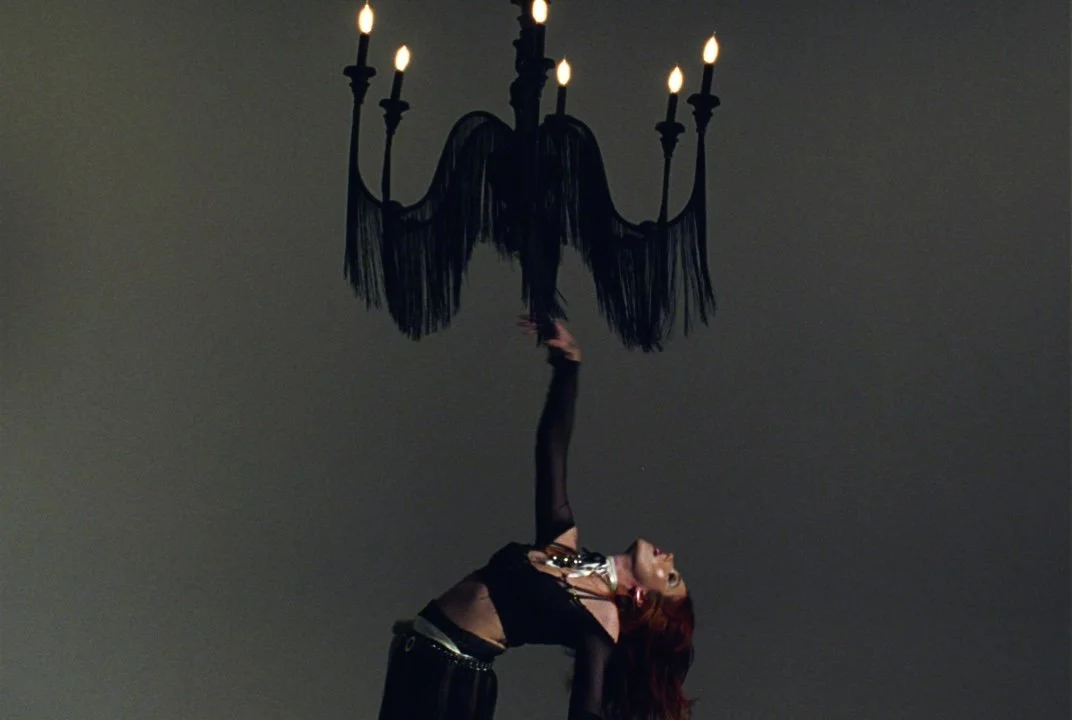
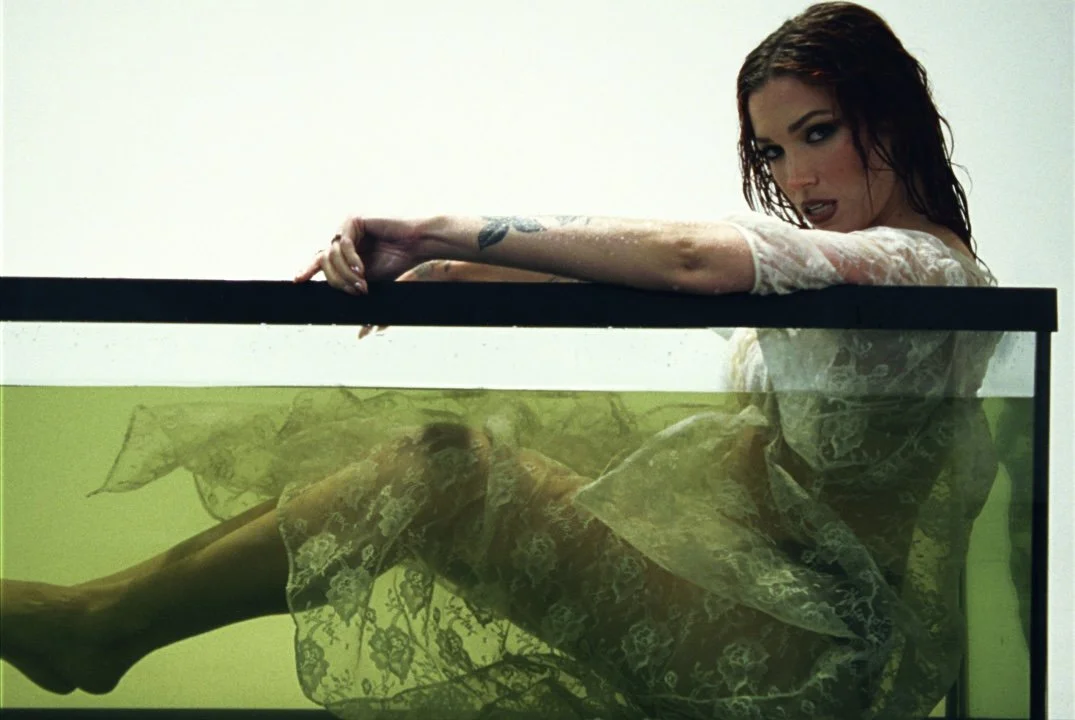
The accompanying music video, created with Nashville-based creative team Working Holiday, extends these themes into a surreal visual landscape. Scenes of submersion and isolation capture the song’s emotional pull.
“I've learned to give myself compassion and give myself the freedom to know that my experience is also valid, and I deserve to express how it made me feel and not feel bad about it, and giving it a place to live definitely helped me process it for sure,” Kay says. “Writing the song in a weird way was self love, because you're allowing yourself to experience something, but not let it define you or let it hold you hostage.”
LUNA: Welcome back and thank you for talking to Luna again. It's super exciting to have you back since the last time we talked last summer for your “Guilty Conscience” release. I would love to catch up and see how life has been treating you and what have you been up to since the last time we talked.
DELA KAY: Life has been crazy. I feel like everyone's like, what is happening in the world today right now? It feels crazy to be even doing music when so much is happening to wrap our brains around just creating stuff. Since “Guilty Conscience,” I wanted to take more time before releasing my next song. I spent a lot of time in Nashville since the holidays, so I was out there writing with a couple friends, and I was trying to figure out where I wanted to go with my sound because “Guilty Conscience” was definitely more indie-leaning. It still was in the alt lane, but it had a little tinge more of the indie-pop sound, and I didn't know if I wanted to do a bit more of that or go a little bit more emo, maybe dip my toe into hardcore land a little bit. I just spent time writing a bunch of songs and trying to figure out a little bit of a game plan and where I wanted to go. I was going through some things towards the end of the year that were a little traumatic and difficult.
One day in February, Stefano, my producer and co-writer, we did a Zoom write. “Medicine” was one of the fastest songs we have ever done. I was literally voice memoing, singing through my phone and then texting it to him. He was plugging it into his computer as we were getting it together. We locked everything in pretty quickly. I came back to LA a few months later for a brief trip, and I was like, “Do you think I should scream on this song?” And he was like, “Can you?” And I'm like, “I don't know. Should we try?” I went down like the YouTube rabbithole of screamo land, which was so entertaining, and started doing that and diving into that a bit more. I'm really excited, and I have a vision of where I want to go.
After this song, I’m looking for someone to help me learn how to scream properly, so I don't shred my vocal cords out. We had a lot of fun with it, and I'm glad that I know there's so much pressure. I feel that independent artists like to continuously put out stuff. Everyone's expecting something within four weeks. Everyone just wants a new song and part of me was a little nervous about waiting so long to put something out. I'm really glad I did because I think that I now have a more clear vision of where I want to go. I'm really happy with how everything turned out and it didn't feel rushed.
LUNA: “Medicine” explores the fine line between love, addiction and dependency. What personal observations or experiences inspired you to tackle those themes?
DELA KAY: I went through a difficult ending of a relationship at the end of the year, and it was a lot. When we started writing “Medicine,” we were talking about the idea of when someone has a substance abuse issue. A lot of times in recovery, they find themselves bored, or they feel like they take out that part of their life and they don't know how to fill it, and it sometimes can be filled with not good things, or they fill it with people, they fill it with distractions or with whatever that fills that void. From December to late February, we were talking about when we were writing it, it's like when you are filling the void in someone's life — whether they see it that way or not.
I think that for a long time, I thought I was being really supportive, and I felt like after the fact that I was enabling a lot, and at a certain point there was no accountability. I needed to set boundaries, and it was really hard because I think in a lot of situations people, when they're in that situation, it feels very difficult to officially step away and be like, “I cannot be around this,” but that's what I had to do. It was really difficult. There's definitely a lot of heavy emotions from it coming out of it, but I'm happy that it had a little place to be and a little room to live within the song. It's one of those things where I hope people relate to it, but also I'm so sorry if you relate because you know whether it has to do with addiction for other people or whether it's just maybe a toxic relationship. It never feels good to feel like you're just being used for someone's entertainment. You're just in the throes of it, in the waves, getting thrown around. It's nice letting that song live and letting it breathe, and then being able to look at it now months later and you can breathe a little bit easier.
LUNA: Rather than writing from your own perspective, you chose to write as the substance itself. What drew you to that narrative approach, and how did it change the way you wrote the lyrics?
DELA KAY: I felt like I was a substance in a weird way because I've filled this gap for this person, and I don't think it was necessarily intentional on their end, but I think when you are dealing with someone who's really struggling with that, and the behaviors that go along with that can be really difficult, and can leave someone feeling used a little bit. I was feeling very much like some weird little piece of a puzzle in this person's life. I felt like I was a substance to this person, or I was just a weird placeholder or something. That's how we started talking about it. What if we wrote it from the perspective of me actually being the substance, as opposed to just me as myself being a pacifier for someone's addiction. There's a lot of fine lines between being someone's support system, and then also being like an enabler.
LUNA: You co-wrote “Medicine” with producer Stefano Pigliapoco. What did each of you bring to the creative process, and how did your collaboration shape the final version?
DELA KAY: Stefano's a killer producer. All of his instincts, all the time, are always great. Initially when we started writing “Medicine,” I started feeling right off the bat, this is giving Evanescence vibes, more darker, and I was living in an EDM world. I like that ethereal, swirly, open vibe, especially in the beginning and in the verses. I sent him a voice memo of some melodies I had, and then he laid a bass track down, and then we hopped on the call to do the session. I feel that we do a really good job of jumping thoughts right after another. I feel like I'm really strong with melodies. I feel like we easily go through songs, even when we don't have words yet, we'll lay down the melody track from start to finish pretty immediately, and then from there listen to the melody and write to that. All of the drum fills and guitars, he's just slayed. I love Turnstile's new album and I like the feel of really live sounding tracks. Production-wise, I wanted to have a bit of that in there too. Elements with more delay and reverb, and giving it some space makes it feel live and you get a little glimpse of it. I think he did a really good job of that. I think moving forward with my music, I want to try to emulate that more too.
LUNA: “Medicine” has an accompanying music video that juxtaposes angelic imagery with gothic visuals and scenes of submersion. What inspired the video and how was your experience filming it?
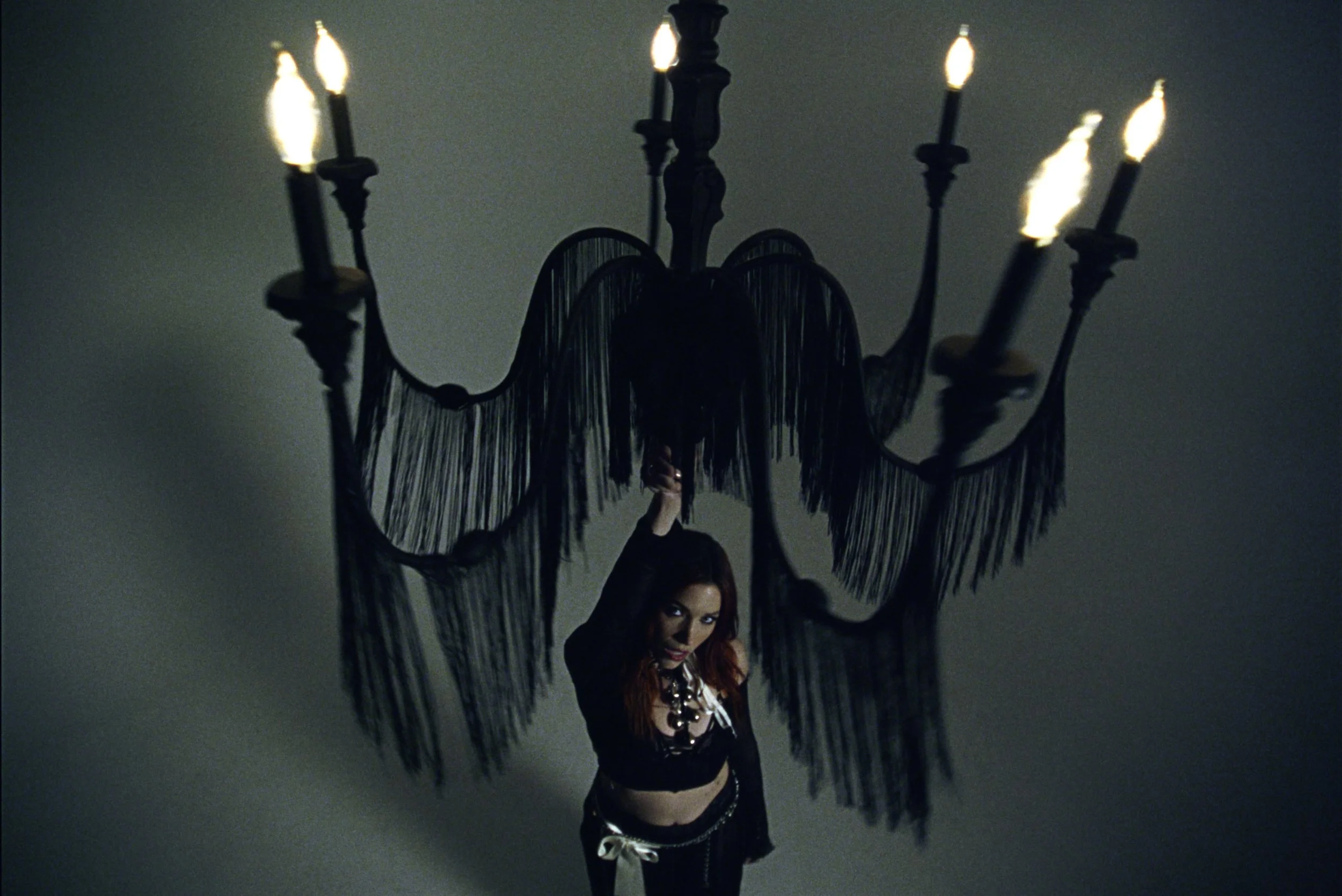
DELA KAY: Working Holiday is incredible. He had a color palette that had gothic elements and it was giving The Blair Witch Project. If we're talking about a substance, I didn’t want it to be super literal about alcohol, for example. That was at least the substance in my dynamic. I didn’t really want to have bottles. I'm writing from my experience, but I'm also not trying to be triggering to anybody either. I wanted it to feel swirly, but not go so literal. I really feel like water. I see water or an element that’s taking you, or things that are spinning, almost like a tornado. We found this gothic chandelier on Facebook Marketplace. It was so much fun and so exciting shooting everything, especially the shots. I think the first shots we did were underneath the chandelier and spinning it around. I grabbed onto the chandelier and spun it around. I got so dizzy.
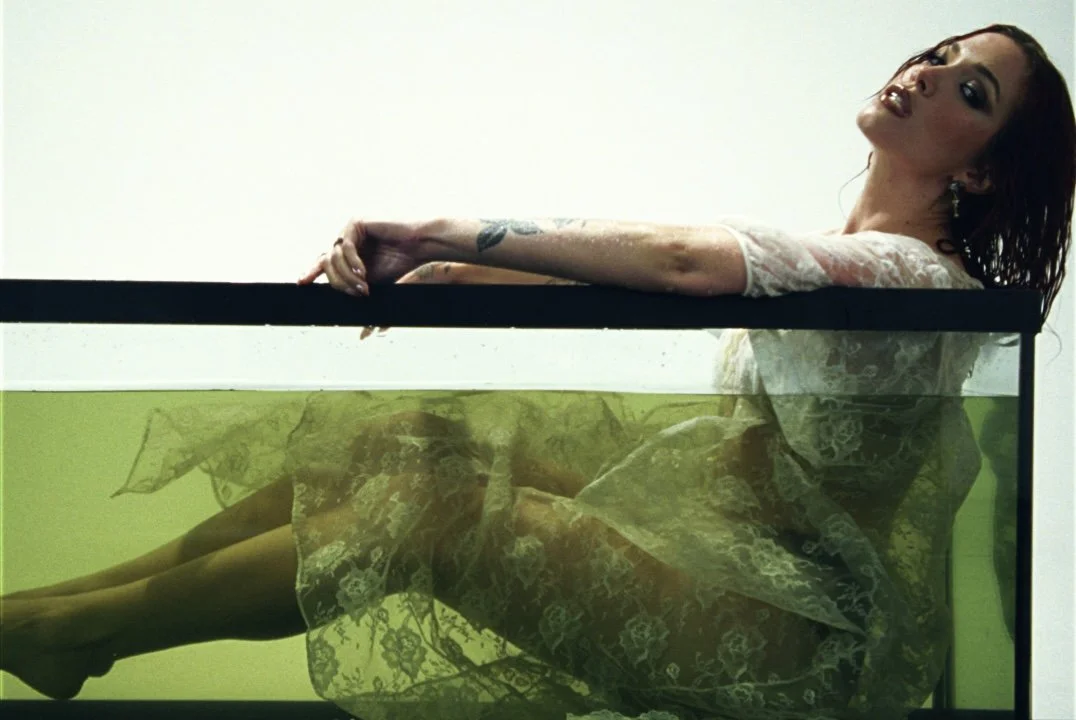
The only thing that was crazy was the fish tank. We tried to warm up the water as much as possible, but the warehouse was really cold, so when I was getting in, it was brutal. Once I had the adrenaline, and once we were in, my adrenaline kicked in. We kept doing shots of me going under and under. My heart was beating so fast, I couldn't breathe. We have some BTS of me in the back dressing room on the couch, layered in everyone's hoodies. Everyone gave me their hoodies and their jackets, and I was mummified on the couch in the green room until I was good to drive home. The water shots are some of my favorites in the music video, so it was worth it.
LUNA: You said it's easy to confuse being someone's comfort with being their cure. What conversations do you hope this song starts among listeners navigating those kinds of relationships?
DELA KAY: If my listeners really heavily relate to the song — whether it's being in a close relationship with someone in an active addiction, or a toxic relationship where they're navigating that dynamic — I'm so sorry. I'm someone that is super empathic. In the past, I had a really hard time setting boundaries because I just assumed that people weren’t bad. I think that people do bad things sometimes, but I don't really think people are inherently bad. You hope that sometimes when people really make poor life decisions or poor choices, or do things to hurt you, that they can be rectified. I know that they were under the influence and they didn't mean this, or they said this thing, or whatever is, and you get yourself into a cycle where something happens, and they apologize, and then everything's good, and then something else major happens, and it just continues in these dynamics.
It's wonderful to be a loving, empathic human and have compassion for other people, because we're all struggling and we're all dealing with life in different ways. I think at a certain point, you really have to take a step back and look at your mental health and say, is this taking a detriment to me and my mental health? I hope my listeners have the courage to speak up for themselves, respect themselves, respect other people, love themselves enough to say enough is enough, and it doesn't make you a bad person to have a capacity for certain behaviors. I think learning to love yourself and take care of yourself and not feel bad about it is healing.
Then if there's people listening on the other spectrum that maybe are dealing with this, and they feel guilty or shameful listening to this song. I definitely don't want to make people struggling feel worse or feel bad. It is a call to being self-aware and that this stuff takes a toll on you and it takes a toll on other people that you love. Sometimes people like to shut that out and act like it doesn't exist. Just take care of the people in your life. Take care of yourself, and that's the best we can all do.
LUNA: What are some ways you show self love or care to yourself, especially when you're navigating heavier material in your music?
DELA KAY: When you really love and care about someone who's maybe not making great life decisions, it can feel really awful. When you're sitting with yourself and you're like, “I need to get these emotions that I have out,” and for me, it was in this song. I've learned to give myself compassion and give myself the freedom to know that my experience is also valid, and I deserve to express how it made me feel and not feel bad about it, and giving it a place to live definitely helped me process it for sure. Giving those really hurtful emotions a place to live and be out of my body. I think that writing the song in a weird way was self love, because you're allowing yourself to experience something, but not let it define you or let it hold you hostage.
The best things I did for myself were the hardest things for myself, like setting boundaries and cutting people off. I told myself at the beginning of the year, I'm going to be single and celibate for a hot minute, no matter who comes along. When you interact with people, they're siphoning your energy or it's all energy exchange. That situation really depleted my energy, and there was a lot of therapy involved and a lot of grieving. I think giving yourself patience and grace to have that special alone time, and cultivate that energy within yourself is precious. Be precious with your energy. Be precious with your time. Get more sleep. Eat better.
For me, I started boxing back in the beginning of May. It was an absolute game changer in my healing process. I did a breathwork course and realized I had so much stuff living in my body, and I was like, I need to move my body. I ended up going to a boxing gym in North Hollywood. As soon as I got locked in, I flew out to Nashville again, and then got locked in over there with coaches over there. Now that I'm back in it, I've been boxing five days a week, working with top-notch coaches, low-key training to fight. They're training me to fight. Boxing has been amazing for healing, for my body, my overall mental health. I'm getting in the best shape of my life, and it's making my voice stronger with singing and feeling better about writing overall.
LUNA: How are you feeling in this current era of your career and what does the rest of the year look like that you would like to share with Luna?
DELA KAY: Feeling so good right now, sitting here with a coffee from Yala Coffee Shop that’s Palestinian-owned in Los Angeles. I am feeling super at peace, super zoned in on the sound that I'm trying to cultivate moving forward. Super excited about maybe diving a little into the hardcore scene. I don't know how deep because I'm just learning how to scream, but excited about where that's going. Excited how my physical fitness is going to have an impact on my performance aspect. My producer is laying out my live show as we speak, getting all my tracks laid out in the keys that we want, and now that I have my endurance up, honestly, it's all coming together in a weird way. Now that my endurance is up, now it's the perfect time to start rehearsing back-to-back and getting that locked in, and then getting a band fully locked in. I'm not really sure how I'm going to do that. Getting the live show underway is definitely the next major step that we've been waiting on. I'm excited that it's officially coming into play. My hope is going into the fall, I would love to play live before the year is out.