
Q&A: Ellen Rodnianski Explores Girlhood, Pregnancy and Community in ‘American Baby’
INTERVIEW
INTERVIEW
☆ BY NATALIE D.C. ☆
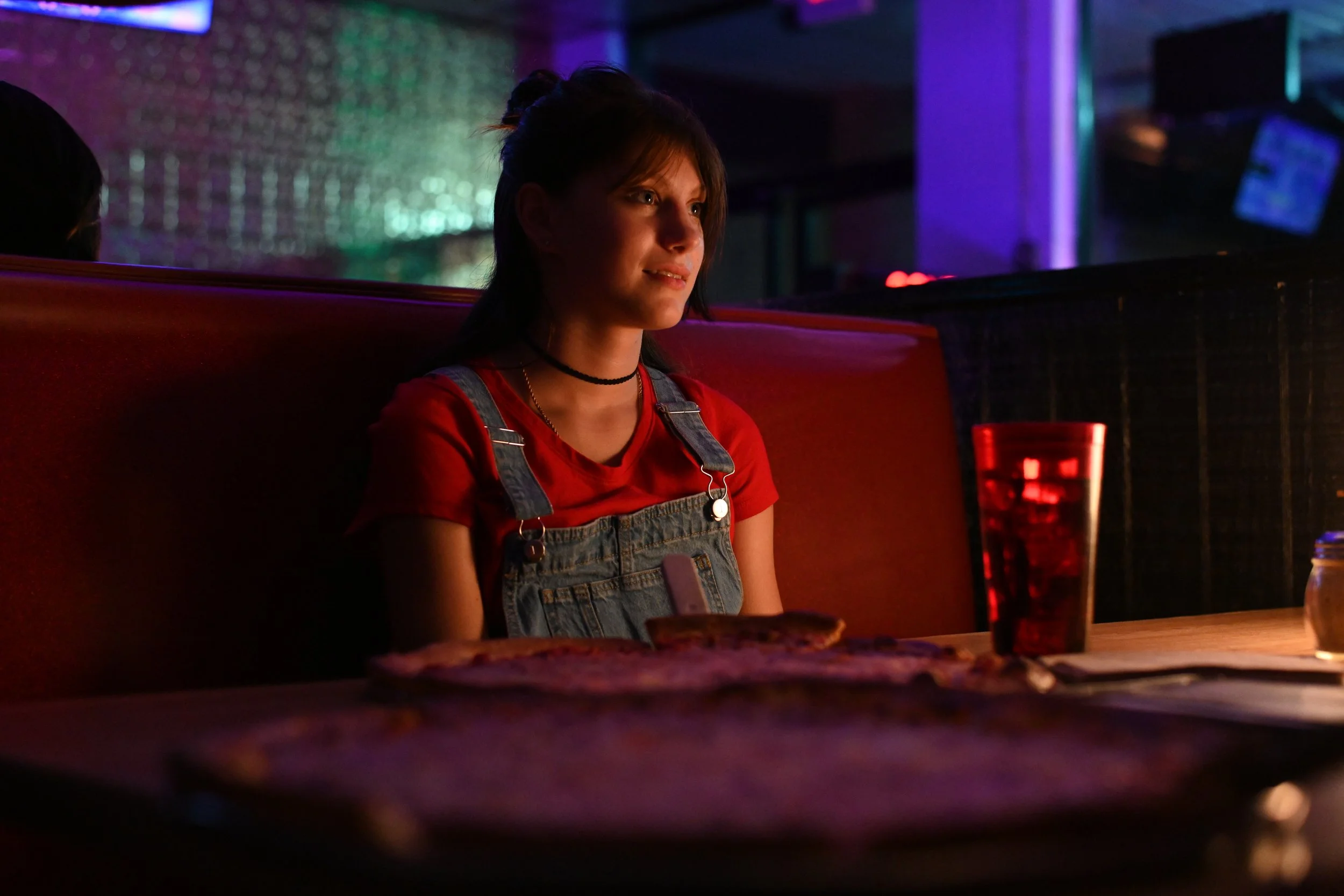
AMERICAN BABY’S OLI FINDS COMMUNITY IN ISOLATION—Written and directed by independent filmmaker Ellen Rodnianski, American Baby (2025) is a coming-of-age drama film that stars Canadian actress Abigail Pniowsky as Oli, a Ukrainian-American girl who finds herself isolated from her conservative, Baptist community in small town Texas when she gets pregnant at 15.
As she struggles to reconnect with Toby (Elisha Henig), the suddenly absent father-to-be of her child, Oli looks back on joyful and tension-riddled moments with her Ukrainian mother Tammy (Janel Koloski) and her childhood best friend Miriam (Claire Capek) in the months leading up to and during her pregnancy.
Tender and timely, American Baby is an impressive directorial debut that touches on important themes of women’s rights, faith, girlhood and the importance of community. After the film’s U.S. premiere at the 2025 Austin Film Festival, Luna spoke with director Ellen Rodnianski and star Abigail Pniowsky about the film’s cross-genre inspirations, music-filled production, as well as the story’s significance in post-Roe v. Wade America.
Read Luna’s conversation with Rodnianski and Pniowsky below.
LUNA: Congratulations on the U.S. premiere of your feature film American Baby! For readers who are unfamiliar, could you briefly describe the film from your own perspective?
RODNIANSKI: The film follows 15-year-old Oli, who is very young and very pregnant as she deals with the repercussions of being very young and very pregnant in her small town in Texas.
LUNA: Ellen, could you speak more about what inspired this story?
RODNIANSKI: The very, very beginning of the story actually started not in the States. Way before I thought this could become a feature, I made a short film in Russia about a pregnant teenager and it was inspired by different circumstances, but when Roe [v. Wade] was overturned in June of 2022, I thought that perhaps the short could be adapted to the States. Those were the very, very early days of coming up with a story and setting it in Texas and thinking about a young girl in this position here.
LUNA: Abigail, what initially connected you to this story and its protagonist?
PNIOWSKY: Funny story, I was at Nationals for a dance competition and I was pulled out of class, and my mom was like, you have to read the script, you're meeting with the director, and it was all very, very fast; but I fell in love with Oli right away. I just think that she is such a good portrayal of teenage emotions and wanting to fit in with your community and the impact that it has when you don't have a place to fit in. That was what I really loved about her.
RODNIANSKI: We had looked at so many girls for Oli. The idea originally, because we were shooting in Texas, was perhaps to find someone in Texas locally, but it was just not clicking. And then, we actually found Abby on a list that one of the producers had for a short film five years prior, and they were looking for 10-year-old actresses at the time. And we were like, “Well, these girls are now around 15 years old.” I saw Abby's name and was like, “I would really love to talk to Abby.” And then we spoke via Zoom, and it was immediately apparent. It's so interesting because it happened via Zoom and you never really think that you can sense these things. But with Abby, there was something so innate in her that fit perfectly for Oli.
LUNA: Some of my favorite scenes from American Baby highlight Oli’s complex relationship with her mother, Tammy. What was your favorite scene in the film to shoot and why?
PNIOWSKY: My favorite scene was probably the most emotionally intense and physically intense. The scene in the kitchen—I don't want to say a lot, not to spoil—but that scene took a lot, both physically, emotionally, and mentally. We shot that specific scene for a long time. I don't remember exactly how long. At the end of it, I was so tired, but I was really, really proud of it. That was probably my favorite.
RODNIANSKI: I think that scene is so powerful. It is so raw. It's so human and it takes her inner conflict into the exterior in such a vivid way and Abby killed it. I was really nervous—I asked a lot of Abby throughout the shooting of this film. There was a lot of emotional heavy lifting. I'm so grateful to Abby for doing the work she did. She's amazing, such a rock star, and a natural.
LUNA: In many ways, this is a story about two impoverished children of immigrants who are failed by poor sex education, restricted access to contraception, and criminalized reproductive health services. Why does this film deserve to be seen in 2025?
RODNIANSKI: For me, it's so interesting that in America—or in certain states in the U.S. in particular—there's this hypocrisy on the subject. On the one hand, it's not taught, sexual education. I looked up the statistics when I was researching for this movie. It was something like 60 percent of Texas schools taught abstinence only. And yet, at the same time, teenagers are going to be teenagers and then they're expected to keep the child. One goes against the other.
I learned about sex ed in the third grade in Germany. I had no choice and I knew it all by then. I was perhaps on the infantile side of my classroom, but I grew up in this world knowing what to do or what not to do or what kind of consequences there are. And it's just very interesting to expect a certain consequence and not actually be educated about how it gets there.
So that's why it's important, I think, in 2025. For me, I wanted to set this film in a religious community because, ultimately, I think this kind of thing perhaps is not discussed as much in these communities. Because Oli keeps the baby for the reasons outlined in the movie, I thought it would be an interesting discussion to have after the film and not one I've seen before. Obviously, this is not the first movie on the subject, but I think it approaches it at a slightly different angle.
PNIOWSKY: For me, I feel like I was glad that I was given the opportunity to be a voice for a lot of young people, because when you're young and you're growing up, especially now, you don't really feel like you have control and you don't feel like you can be heard. So, I think that it's important to know that you can do something. I'm glad that I got to be that person.
RODNIANSKI: Before shooting this movie, we wrote it and before we wrote it, we did a lot of research. A lot of what this movie is about is inspired by real people, not only people who grew up in small towns and experienced pregnancy or were friends with people who were pregnant. And so, it's fiction, but it's a dramatized reality of real people's experiences. It's built on this foundation of reality.
LUNA: Finally, what are some pieces of media you’ve been drawing inspiration from recently?
PNIOWSKY: Throughout the whole film and before we even started shooting, we relied a lot on music for character-building and worldbuilding. Ellen was asking us, “Can you guys make playlists for your characters?” So, me and Claire [Capek] made playlists for our characters. I think Elisha [Henig] made a playlist as well.The specific song that I listened to for Oli to get into her pre-pregnancy mindset was “Lovers Rock” by TV Girl. That was the song that I thought really encapsulated her vibe, at least before she became pregnant because she lost a little bit of her innocence. Music was a big, big, big part in filming.
RODNIANSKI: Music is so important to the inner life of any individual. It's the background to your daydreaming and, ultimately, what you daydream about, who you want to be, what you want to do, your future, your present. So, I thought it was a very important foundation-building tool/instrument and something that we could bond over because I became a fan of TV Girl. I know all of their music now. I had never heard about them before.
Obviously a film, as fun as it can be, it's also a little bit stressful—something's always happening. Music in between scenes was important, I think, for the girls. Both Abby and Claire are dancers, so they would dance. I don't even remember whether music was part of it, but it helped relax us all and get us into focus.
In terms of other inspiration, I am very, very into documentary photography. I don't know whether you're familiar with this photographer. Her name is Alessandra Sanguinetti. She did a series about cousins, two girls, Argentinian, who she photographed for 12 years from childhood to adulthood. One of them got pregnant as a teenager and those photos are A. amazing and B. really inspired the visual language of the movie.
