
Q&A: Emma Harner on her debut album ‘Evening Star’
INTERVIEW
INTERVIEW
☆ BY LUCY BULLINGTON ☆
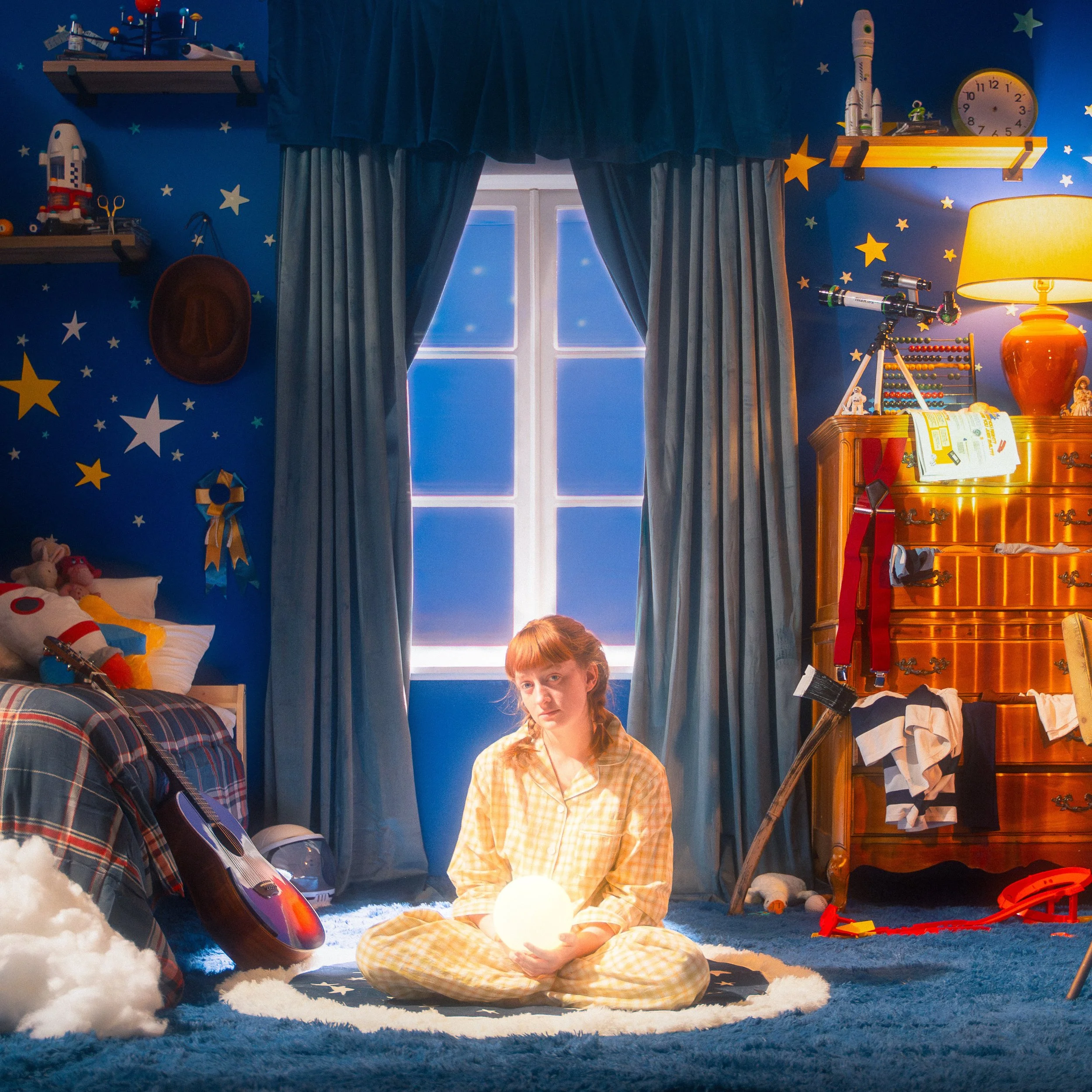
“I HOPE IT’S A REPEATABLE ALBUM. SOMETHING YOU CAN LISTEN TO MANY TIMES AND REALLY GET LOST IN”—This is how Emma Harner feels about her debut album, Evening Star. Sonically, the record shares the same submerged and ethereal atmosphere as Phoebe Bridgers’s Punisher. It is deeply introspective, representing the musical equivalent of being tucked into bed in another dimension. While the record’s melodic elements lead you on a spellbinding journey, the intricate fingerpicking provides the gravity needed to ground each track.
Harner defines the album’s thesis as "childhood nostalgia," noting that the title feels "childhood-y" because you wish on a star. Listening feels like being led by the hand through a distant dream, guided by Harner’s enchanting vocals. It’s easy to lose your footing and simply let the nostalgia wash over you. Drifting from the haunting swells of a vintage pub organ to the chaotic arpeggios of an 80s synth, Harner’s proves to be capable of crafting intricate and unique soundscapes.
Harner is an artist defined by deep intention and a rigorous obsession with the inner workings of her craft. She approaches music through two distinct lenses, balancing the emotional passion of a listener with the technical and almost mathematical precision of a guitarist. Now that she is preparing to tour these songs, she stays rooted in the same reflective process that shaped the album. We spoke about the influence of her desert recording sessions, the intricate madness of her tuning methods and the journey of crafting Evening Star.
LUNA: It feels like the perfect moment to release an album. I know you’ve done an EP previously, but what pushed you toward a full-length project this time around?
HARNER: I got connected with this producer, Jamie Mefford. He produced one of my top five albums of all time, This Empty Northern Hemisphere by Gregory Alan Isakov. He’s one of my favorite artists. My manager asked me who I’d want to work with for the next project, and I was like, “Well, what’s the guy who did that album doing?”
Apparently, he’s very picky and doesn’t say yes to everyone, but he saw my stuff and agreed to a phone call. We just nerded out about Radiohead. After that, I knew if I got to work with him, I wanted to do a full-length. The thing I love most about the projects he works on is that the album puts you in a world—a specific sonic space. I wanted to conceive of a journey like that.
LUNA: I had no idea Jamie was behind this! I can totally tell, because listening back, it has such a cool, melodic soundscape. What was your favorite thing he contributed to your sound?
HARNER: In the past, recording was always like, "Let’s get 70 guitar takes and Frankenstein them together into one perfect take." Jamie was the total antithesis of that. He’d say, "Let’s get one full take you’re happy with," and we wouldn’t even do many of them. With the exception of maybe some "cowboy chord" songs, nothing was recorded to a click track. Everything is nebulous and floating.
He also didn’t dictate the arrangements. He’d ask, "What do you feel like playing?" We were in this studio in Tucson, Arizona, and it was filled with odd instruments.
LUNA: Oh, really? I’m actually from Arizona!
HARNER: You are? I’d never been to the desert before, but Jamie works out of Tucson. It was so magical. We recorded for a week in September and a week the following May, so I avoided the peak summer, but May was still really hot. It felt like feeling around in the dark. I’d look at an Omnichord or an old organ and just say, "Can we put that on there?" I’d make random noises in key, and Jamie would go through later and find the bits that worked. He truly created that soundscape out of the random noises I was making.
LUNA: That explains so much, because there are so many interesting textures. Are there any specific "hidden" sounds people might not recognize?
HARNER: There’s an Omnichord running through a reverse delay. There’s also a "pub organ"—this old thing that folds against the wall where you have to press a pedal to make it go. We used it for textural swells.
I’m also proud of the Juno-6 synth on "Charlotte." It has an arpeggio function where you can control the rate with a manual slider. As the song gets more chaotic, I just pushed the slider to make it go faster. It’s not in time with the music at all, but it creates this "whoa" feeling. Then there’s the Theravox—it’s like a Theremin controller that Jonny Greenwood uses. Jamie had been on a waitlist for one, and it magically arrived right between our two sessions. It’s all over the songs now.
LUNA: While you were immersed in that world, what were you consuming? Music, books, movies?
HARNER: I’m not a big reader, unfortunately! But I was listening to a lot of Radiohead and Adrianne Lenker—specifically her songs and instrumentals albums. Those were big while I was writing. Also Paul Simon. It’s usually a safe bet that I’m rotating those three.
LUNA: I want to talk about your writing process. Your lyrics are so striking. How long had these songs been building up?
HARNER: Most were written about six months before recording, and I kept working on them during the break between the Tucson sessions. Songs come to me very slowly. I’ll have a crazy day where a verse and chorus come together, but then I have to wait six months for the bridge. If I push it, it’s bad.
I use songwriting as an outlet for whatever is bothering me: family drama, crushes, that sort of thing. I approach it like poetry, editing and re-editing. I actually took a poetry class in college, but the blank page of a true poem is so intimidating to me. Songwriting is like a Sudoku puzzle; you have the extra criteria of syllables and rhyme to fit into, and I find that structure easier to work with.
LUNA: What is your favorite lyric on the record?
HARNER: I think the second paragraph of the second verse of my song "Landing"—which, great thing to write a song about, was my grandfather's dementia. And the second half of the second verse, the lyrics are: "It's just supper, it's just decline, the phone call, you have the time." So for me, each of those bits of words mean different things when you look at them versus the others. It's a bit of a stack of wordplay in my head. So that's my favorite bit.
LUNA: That’s really sweet. Really interesting too. What's your favorite lyric that you didn't write?
HARNER: This is a great question. I mean it would probably... oh, gosh. I am so much more of a sonic listener than I am a lyric listener, but my mind immediately jumps to Adrianne Lenker because she has the craziest... oh my gosh, she is the best. But anything that she's done—literally even the song "Anything." That wasn't a pun example. I think maybe my favorite lyrical song of hers is like "Half Return." That one's really good. "Standing in the yard, dressed like a kid. The house is white and the lawn is dead."
LUNA: Does the album have a central thesis, or is it a collection of moments?
HARNER: I tried to find a thesis after the fact! I initially thought it would be a "family drama" album, but I couldn't force that. When I sat down to name it, I looked at all the lyrics and realized the themes were wishing and childhood nostalgia. That’s why Evening Star felt right. It’s "childhood-y." You wish on an evening star.
LUNA: Which song came together the fastest? And which was the hardest?
HARNER: The title track, "Evening Star," was the fastest. I decided on the title before the song existed. I wrote it in about two hours because the guitar part was simple.
"Charlotte" was the hardest because of the guitar. I’m a guitar nerd—I went to Berklee College of Music for it—so I agonize over parts. I had the melody for "Charlotte" in my voice notes for over a month before I found a guitar part that did the melody justice. I still go back and forth on it!
LUNA: I remember seeing you open for Leith Ross at Brooklyn Steel! Your set was amazing.
HARNER: Thank you! That was the biggest room I’ve ever played—so intimidating. That show was actually the funniest I’ve ever seen Leith. There was something in the water that day.
LUNA: What was the biggest takeaway from touring with them?
HARNER: Their mic technique is incredible! I had a total crisis watching them, thinking, "I don't actually know how to sing." But on a more tangible level: breakfast. In the past, I struggled to eat on tour because of nerves. But Leith is big on breakfast. We’d all go out in the morning when the nerves hadn't kicked in yet. That changed the game for my ability to function on the road.
LUNA: When you’re building a setlist now, do you focus on the narrative or the energy?
HARNER: It’s 90 percent tuning and 10 percent energy management! It’s a math problem. I tour with two guitars—an acoustic in Open D and an electric with a hardtail bridge for fast changes. I have to order songs based on how quickly I can get from, say, FACGCE tuning to something else. I do try to intersperse the "less devastating" songs so it isn't just sad song after sad song, but the tuning usually dictates the flow.
LUNA: Last question: what do you want people to take away from Evening Star?
HARNER: I hope it’s a repeatable album. Something you can listen to many times and really get lost in. Right now, I’m just basking in the release for a second before I slowly figure out what’s next. The cycle is cycling!
