Q&A: Hysteria Plunges into Beautiful Ruin on “Angela”
INTERVIEW
INTERVIEW
☆ BY KIMBERLY KAPELA ☆
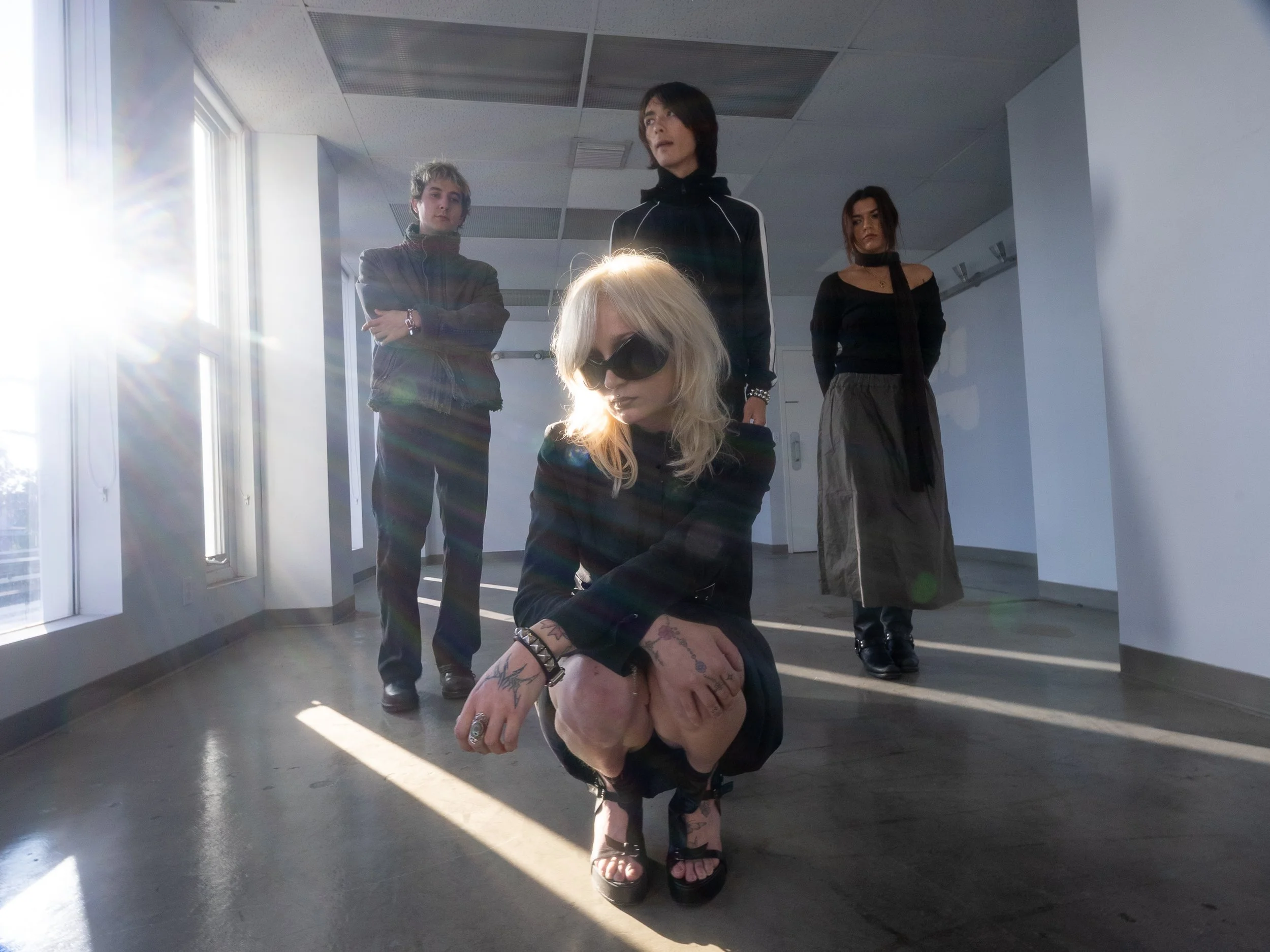
Photo Credit: Fiona Kane
EVERY MOMENT IS BOTH AN ASCENSION AND A DECLINE — LA band Hysteria, the project of frontwoman Dakota Cosgrove, releases their newest single, “Angela.” Hysteria doesn’t flirt with emotional ruin, instead they dive headfirst into it. The track is a study in contradiction: a demanding, high-wire melody cuts through guitars that shimmer and scrape, always threatening to splinter apart before surging into massive, gut-punch choruses. Drums land with bruising force, turning longing into something almost bodily.
Drawing from the aching sincerity of bands like Mineral, Jejune, Texas Is the Reason, and Sunny Day Real Estate, Hysteria honors the genre’s lineage while rewriting its perspective.
Produced by Photographic Memory, “Angela” balances raw abrasion with deliberate control. Nothing feels accidental. Every swell and collapse mirrors the emotional vertigo Cosgrove describes.
“Every moment is both an ascension and a decline, leaving you face down on the ground,” Cosgrove says. “Angela is the year of your life you want to erase, a desperate cry to be loved, that sick desire to be broken and put back together. Angela is the girl who you let destroy you.”
At its heart, “Angela” is about loving what destroys you. It captures the magnetic pull of someone or something you know is bad for you, but can’t release. In Hysteria’s world, that tension isn’t softened or moralized. It’s amplified.
“‘Angela’ ended up being really about loving someone so much or something so much that you know is bad for you, but you can't stop,” Cosgrove tells Luna. “I think the contradiction of pain and love together is something that I think the song emulates for me.”
Their music lives in the space between tension and release. 90s emo is empowered to shine through, but is reclaimed by a sound that feels unapologetically female, loudly embodied and impossible to dismiss.
The name Hysteria itself is a reclamation. Historically weaponized as a diagnosis for women who dared to feel too much, “hysteria” once pathologized emotion as illness, even attributing it to the myth of the “wandering uterus.” Cosgrove leans into the absurdity and violence of that history.
“When I was looking for a band name, hysteria was in my notes for a while. It’s perfect because it emulates everything I want to say in such a short word,” Cosgrove explains. “Hysteria was a term that was given to women in early times of psychology, and it was a diagnosis for women just simply having emotions at all. They thought that it was attached to this phrase called ‘wandering uterus,’ where women's uteruses would migrate. They thought that caused their emotional distress. I think it's just funny to reclaim that word as a powerful thing, instead of a negative assumption.”
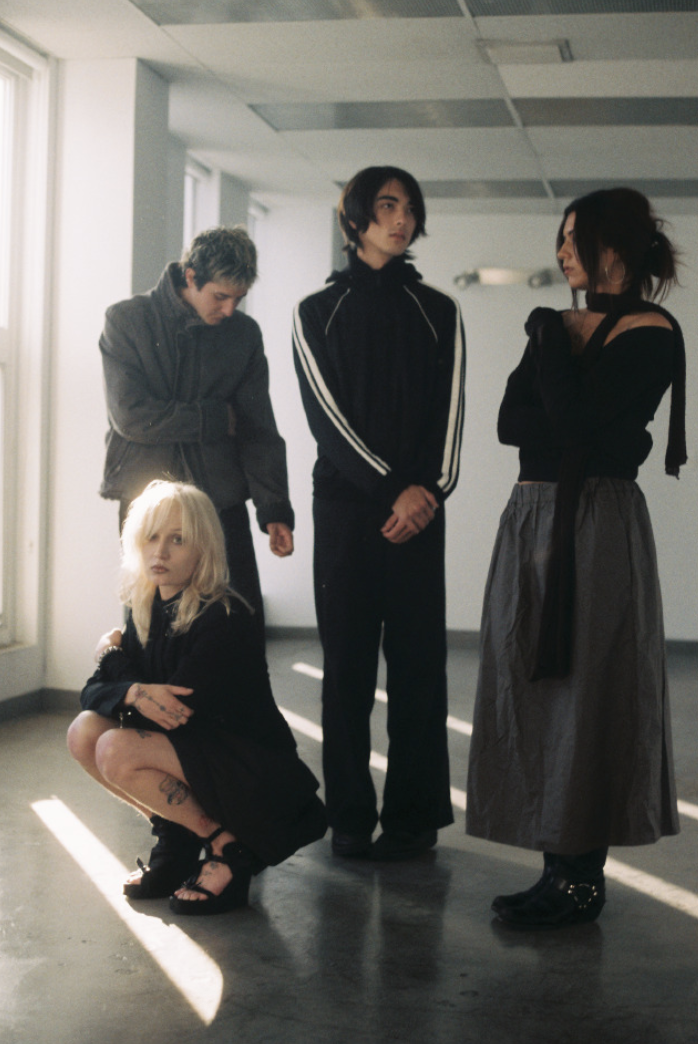
Photo Credit: Fiona Kane
LUNA: Thank you for talking to Luna. Our readers would love to get to know you and your music more. For any readers who aren’t familiar with you yet, what inspires your artistic style and sound?
DAKOTA: In terms of sound, I'm very influenced by 90s emo bands like Mineral, Jejune, Texas Is The Reason and Grade. Sonically, that's my favorite music to listen to. When I was young, I listened to Pierce The Veil, Bring Me the Horizon and a lot of those emo bands. As I got older, I found the true emo which is like Rites of Spring and stuff like that and it came from post-hardcore. But as a kid, I was really drawn to the power of feeling like an outsider. I think that emo music really allows you to embrace emotions as something that can bring power and community rather than something that isolates you.
I listen to Paramore, and it's really cool to see a woman and that coming out of hardcore, but I think it's not as common to hear a female voice over that sort of instrumentation, which is something that I felt like I wanted to fill that space for a male-dominated field and genre. I want to reclaim that and make it my own. So in terms of music, that's who I'm really inspired by, sonically. In general, I'm very inspired by women in music like Courtney Love, who just gets a lot of hate for basically being a woman and being emotional. I love Liz Phair. I love Kat Bjelland from Babes in Toyland. I love Kim Deal from the Pixies. I just think it's so cool to be confident as a woman, even though all the odds are against you. Just to see really kick ass women killing it and not being scared of haters.
LUNA: How did you land on the name “Hysteria,” and what does reclaiming a word historically used to undermine women mean to you — especially within a male-dominated scene?
DAKOTA: When I was looking for a band name, hysteria has been in my notes for a while. It’s perfect because it emulates everything I want to say in such a short word. Hysteria was a term that was given to women in early times of psychology, and it was a diagnosis for women just simply having emotions at all. They thought that it was attached to this phrase called “wandering uterus,” where women's uteruses would migrate. They thought that caused their emotional distress. I think it's just funny to reclaim that word as a powerful thing, instead of a negative assumption. Especially for emo, it's being male-dominated by a lot of incel men. I think it just was a perfect name for what I'm trying to convey with this project.
LUNA: You described your newest single “Angela” as “every moment is both an ascension and a decline.” What is the inspiration behind the track or the feeling that pushed this story to the surface?
DAKOTA: In terms of that specific phrase, I'm really interested by contradictions and beautiful things contrasted with ugly, terrible, disgusting or dirty stuff. I really love the juxtaposition of those things. I've always really been interested in that. I think “Angela” is a good example of those two things coexisting as the instrumentation bends and chugs and heaviness. Obviously I'm shouting, but in the verses, I'm singing more delicately. I like the contrast in my vocals with the instrumentation and also the verses, with the choruses and having such a big contrast reminds me of my favorite art that has those elements.
The song was co-written by me and our former guitarist, Sam Schifano, and I was struggling. I had a million versions of the vocals, the chorus and the melody. I had the verse and melody always, but I was struggling to write the chorus. It was about so many things at first, and then I started seeing the name Angela, because the alliteration and the way that the name feels like when you sing, it just felt right. I have no clue how that name came to me. I didn't know an Angela at the time or anything. I think it can be an analogy for it doesn't have to be about a girl named Angela. I think everyone can take their own meaning from it. But for me, I think it ended up being really about loving someone so much or something so much that you know is bad for you, but you can't stop. I think the contradiction of pain and love together is something that I think the song emulates for me.
LUNA: How did working with Photographic Memory shape the production of “Angela?” What was it like bringing them into your creative process, and how did they influence the sound of the single?
DAKOTA: Max and I have been collaborators for quite some time. I met Max and 2023 I was playing guitar in a band called Out West, and Max was referred to Brian Ruthenberg, who was the lead singer of Out West through a friend, and we were recording an EP with him. He said he has this project called Wisp that he’s building a band for and asked me if I wanted to play. We played together in Wisp for a year and a half. During the tail end of that, I started working on Hysteria.
I had this song and he wanted to get in the studio and record the song for this new project and that's how we started working on Hysteria together. After that, I had already paid for an EP at the time, and the band was still progressing, and “One Reason to Pray” was written and recorded when I didn't even have a band. He has his own project, Photographic Memory, and he was planning on opening for the band After at Moroccan Lounge. Hysteria also was opening for After. I had a month to get a band together and write more songs and during that time, I wrote “Angela” and three other songs in a span of a month just because I really wanted to get it going and start the project.
When we were going to record these songs with Max, “Angela” was one of them. We did it so quickly. We ended up doing three songs in three days. The recording process went really quickly, and he really knows what sounds I want out of the guitars and what low end I want out of the guitars and the bass. The drums had been recorded previously with someone else, so we put the drums in there and then recorded the guitars and bass and vocals over it. The reason why it took a while to start working with Max again, is because we wanted to do a live recording that was for the feel of emo music in general, and the tempo changes and how it's not necessarily always on the click. We wanted to have that feel, and because we weren't able to do it live, Max was able to embody that feeling through recording through tape machines. I wanted something not as polished for this song.
LUNA: How do you hope listeners — especially your femme audience — can connect with or find power in this new era of music from you? What emotions or messages do you want to leave with them?
DAKOTA: I would like them to take away the sentiment that you are never too much for anyone, and your emotions are big and beautiful, and that is okay, and if anyone tells you otherwise, they're not worth your time. Being a woman is a beautiful thing, and having emotions is part of the human experience, and being able to be honest and open about your feelings is so powerful.
I remember when we toured in San Marcos after we played, there was a group of girls that came up to me, and they were just crying, and they were like, ‘I'm so overwhelmed. I just want to say thank you so much. It was so cool to watch you do that, and I'm so inspired by you.’ That was the best feeling I've ever had. I would say for younger women, don't be scared. Just pick up a guitar, pick up a bass, and just get started.
LUNA: What is fueling your fire right now that’s pushing you into this next chapter in your career?
DAKOTA: What's motivating me now is I'm looking forward to playing bigger shows and to perform more often, because the feeling that you get from being on stage and sharing music that you've made and having people receive it is the best feeling that you can ever ask for. Playing in Wisp, I got a taste of how it felt to play. We played Coachella. We played Lollapalooza. I was able to experience that for someone else. It gave me a taste of what could be possible for me as well. I'm motivated by the possibilities in the future of this project.
I've always been a very self-driven person, and when I put my mind to something, I know I'm going to do it because I get obsessive and it's Hysteria. It's all I think about all the time, 24/7, and I do really believe in the power of manifesting, in addition to putting in all the work that you can into something. I think the combination of that you have to speak things into reality. I'm just excited for the future of this project.
LUNA: How are you feeling in this current era of your career and what does the rest of the year look like that you would like to share with Luna?
DAKOTA: Right now, I'm feeling excited because my currently my guitarist and bassist, they live in Austin, Texas, so we have a Texas, California connection. I have a guitarist and bassist that live here that we played with when they're not in town, but they're coming into town on the 21st and we're going to do some eight hour days where we practice and write new material. I have a lot of material that I just want to work through in the room with them, and get some new songs ready to a point where we're able to play them, even if it's not like the final version.
I'm excited to have some new songs to play, and I'm really excited for our show on the 26th with Tommy Fleece at El Cid. I really love cross-genre bills, and he's an electronic artist that also has worked with emo bands like The Dallas Cowboys. It's going to be a really, really cool show. He's never played in LA before either, so I'm really grateful that we were asked to be the opening band. After that, we are going to be playing SXSW for the first time, which I'm really, really excited about, because I feel like that's a rite of passage for newer bands. We have a really busy March from the seventh through the 11th. We're recording three more songs for our EP, and then on the 12th, we're filming a music video for “Angela.” Then the 13th through 18th, we're playing SXSW so we have a really busy time in Texas, but it's all really exciting stuff. By the end of the year, I hope to have a booking agent and support tour, that's what I'm looking forward to in the upcoming year.