
Q&A: Laila Smith is Your Guide Through Grief on New Single ‘I’ll Do Anything’
INTERVIEW
INTERVIEW
☆ BY MOLLY PECK ☆
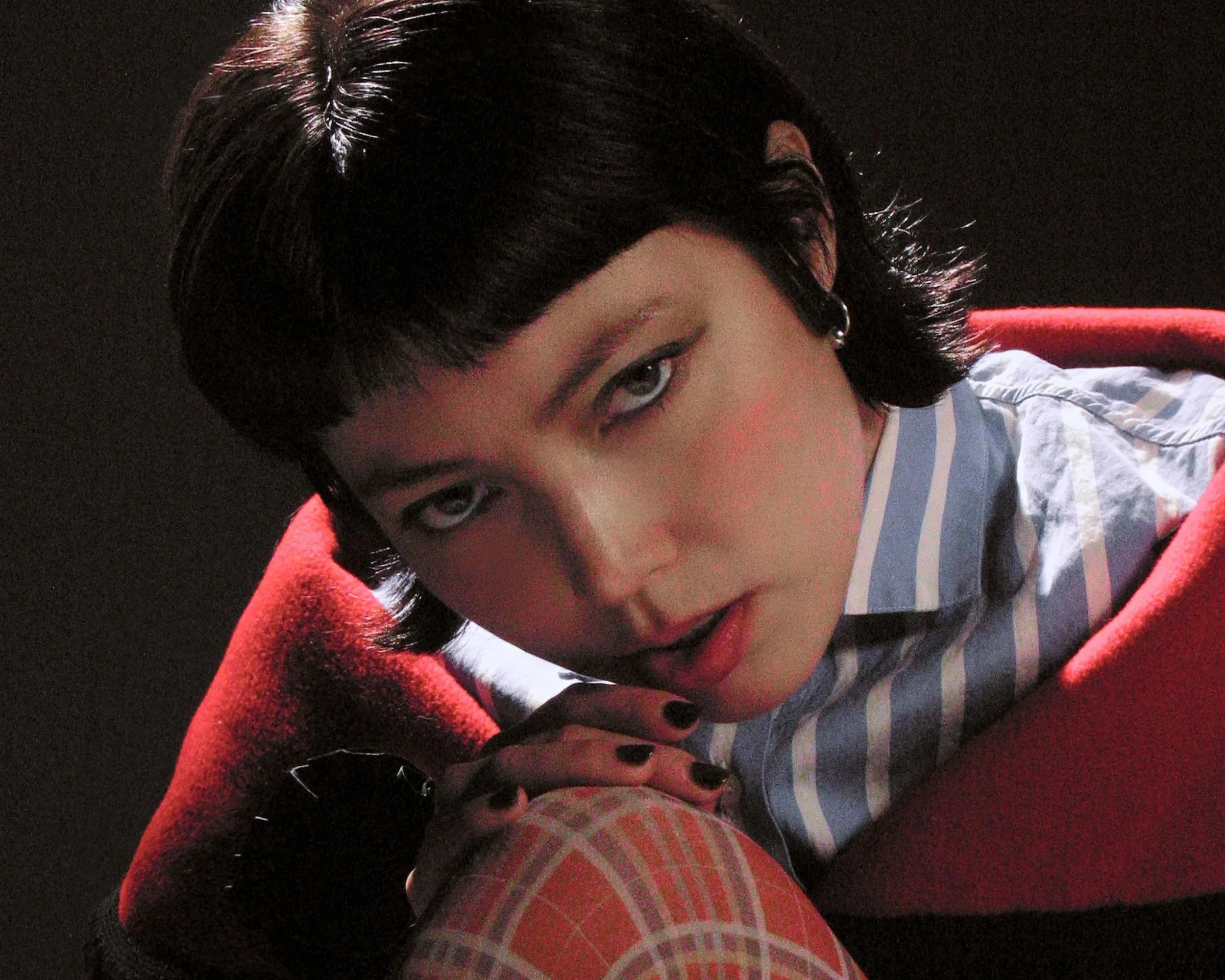
LAILA SMITH MAY HAVE LEFT JAZZ BEHIND—but it hasn’t left her. Tapped as a jazz prodigy by the age of six, Smith has a deep background as a musician and as an artist. She looks at the world through an artist’s lens, catching new inspiration for her auditory and visual art at every turn. Her new EP, Something Dreadful is Going to Happen, is her latest project as a pop singer, but the record’s twists and turns are still reminiscent of the beautiful chaos of jazz.
As a child, Smith was abruptly introduced to the adult world through performing with other, more mature, jazz artists. Like any child performer, she was in spaces that were not child-friendly and around people who were not particularly sensitive to a child being amongst them. Her passion for art and music never cooled, but her relationship with jazz as a genre changed in response to her environment. Performing in hotel bars as a tween does not make for the best associations.
Smith switched her focus and ended up at Harvard, studying social theory as an undergrad. She then went on to pursue experimental performance and has been critically acclaimed and featured in the New York Times. However, music was never out of the picture. Smith’s installations and other visual art projects frequently coincide with whichever musical project she’s currently working on. Her 2025 single, “Diorama,” was accompanied by a digital rendering of the album cover, featuring a doll-sized image of Smith that users could move around a diorama of her bedroom and interact with various objects within the space.
Smith takes a similar approach with Something Dreadful is Going to Happen. The project is centered around the five stages of grief: denial, anger, bargaining, depression and acceptance. On her website, fans can click through bemusing mini-games reminiscent of the early days of the internet, when creativity and sly humor reigned supreme. Each song on the EP is dedicated to its own stage of grief; the first two singles are dedicated to denial (“I Don’t Think of You”) and bargaining (“I’ll Do Anything”).
On “I’ll Do Anything,” Smith plays with the futility of trying to regain control of a situation that has long been out of one’s hands. The plucky acoustics at the beginning of the song set the listener up for an experience reminiscent of an indie-pop song from the early 2000s, only to be overtaken by electric guitars and crashing drums during the second chorus. The song is dreamy, introspective and also feels like organized chaos. One of Smith’s great talents is blending genres that shouldn’t go together and yet feel inevitable. The shift from ennui to a flare of intense emotion shown by the sudden rock-inspired break in the song is both a metaphor for grief and a very satisfying listening experience. Smith’s feelings are expressed poetically by the lyrics “Flash flood you drown / But it’s the ocean inside my head” and musically by the soft choral harmonies and the explosion of sound at the end.
Smith might be making pop music, but that talent for the organized chaos that jazz thrives on is still there underneath it all. Her tracks are thoughtful, emotional and have an improvisational, playful touch where her jazz sensibilities shine through. Luna sat down with Smith to discuss her artistic style, inspirations and what we can expect from her next project (hint: eggs, in a way you won’t expect). Read below for more.
LUNA: For those unfamiliar with your music, what are some of your biggest influences and inspirations?
SMITH: I'm very interested in chasing specific kinds of feelings, and these feelings tend to be ones that I find undignified. In my day-to-day life, there's this attempt to be a normal, functioning, healthy human. I have this relationship with mental illness and hysteria and insanity, and my artistry is the place where I get to articulate the most toxic parts of myself. I'm very interested in the history of feminine hysteria in art-making.
I grew up as a jazz musician, and played my first festival when I was like six, and sat in with old men when I was eight. Jazz made me who I am in many ways, getting to know that interesting history of women making art through a really complex and fucked up historical period, and connecting to a lucidity that is in a way beyond this realm. That's how I see it. I see that in Billie Holiday. I see that in Nina Simone. It goes beyond jazz, of course. We get that feeling with Judy Garland, with Fiona Apple, with Bjork, and you could even go back to Cathy Berberian if you want to go to classical music. It's all around us, so I'm just trying to be part of that.
LUNA: You have a background in jazz music. What led you to pop, and what do you like about creating pop music?
SMITH: I feel like I'm still evaluating this question. It's a lifelong journey. Jazz raised me and made me who I am in so many ways, and at the same time, it wasn't an incredibly healthy place for a young woman to grow up. It is, in certain ways, a fundamentally objectifying position for a young woman to be in. I started to sing in hotel bars at a super young age. I probably started gigging regularly in local restaurants and hotels, probably at twelve, and it wasn't super safe. Looking at the history of how women are treated in music—and it's not everywhere, it's not everyone, but I would say that there is a baseline, intensified garden-variety misogyny. Basically, I had to rebel from jazz and make my own way musically. Only right now am I learning to integrate it all.
I really wanted to learn how to write songs, and I wanted to learn how to make recorded music. Growing up in jazz, all we do is make live music. We learn how to improvise, we play live, we listen. Making recorded music, in my opinion, is a really different kind of artistry and a really different practice. I'm trying to bring improvised music into what I do and make things more experimental and lean on some of that music that I love so much, but also have a complicated relationship with.
LUNA: Your new EP, Something Dreadful Is Going to Happen, is all about the five stages of grief. How did you arrive at this concept, and what was so interesting about that emotional process?
SMITH: The record is about a couple of different kinds of grief. The inciting moment that brought me to writing this record was sexual violence in my life, and the death that I'm grieving is a death unto my own body. There's a lot of media about sexual violence out there, and for me, it felt like a grieving process. I was angry at my body. I was bargaining with my body. It was a long and weird process. It wasn't a process where I realized, “I'm a survivor, and that makes me strong.” It really wasn't like that. It was long and complicated, and I don't like to simplify things into your standard narrative boxes. I really tried to do that on the EP too. I wanted to let the songs represent specific stages, but at the same time, I wanted to mess with the linearity of those stages. I wanted those stages to bleed into each other, and I also wanted to express what I felt were my experiences of those stages.
I'm socialized as a woman, so is my anger a full-throated anger? No. My anger is this dissociated, far-away type of thing. These things can be very complicated. There is no exact way to do it. What's the thing people always say about grief? “There is no right way to grieve.” It was my choice to frame it this way, and there's also a grieving of the relationship that I had to jazz in there. In acceptance, there has to be a kind of rebirth. You let go of the reality that you had. What I had to do was let go of the relationship that I thought I had with my body and put in the work to make something new. It's not easy, and it's not what it was, but it's something new.
LUNA: The single, “I’ll Do Anything,” is specifically centered around the bargaining stage. What does that bargaining stage mean to you, and how were you thinking about it in the context of the song?
SMITH: Bargaining, to me, is the stage that most represents the desire to take control. To have so much devastation that you try to counteract it with some level of hubris; you think, “Maybe I can make some deal with the universe that lets me have control of this situation.” All this stuff about the body, and obviously sexual violence—but also everything, lowkey—is about control. The song is really about control and also this feeling of helplessness. Natural disasters are a theme running through the song.
LUNA: “I’ll Do Anything” has a very interesting sound and style. It starts off acoustic and dreamy and transitions into a more intense, rock vibe. Why did you want to include that kind of intensity in this track, and how does that relate to the theme of bargaining?
SMITH: I grew up in such a genre-ed world. You can have a very rigid understanding of what jazz is, and I received a lot of messaging as a kid about what jazz is supposed to be. It's only as I've gotten older that I try to let myself experience it more fluidly. I'm very obsessed with trying to articulate certain kinds of feelings, and a strong sense of sectionality is something that I find very useful as a musical device.
Something weird about me is that I'm definitely a musician's musician in many ways; I grew up playing and listening to a lot of instrumental music. But in my current form as an artist, I try not to get too deep into the details of the sonics. You hang out with people, and it's like, “We're doing synth design,” and honestly, that doesn't make me tick. The thing that makes me tick is, “Are we giving people a sense of dread, even as they're listening to something that they like?” This sectional changeup…it keeps the body on its toes.
LUNA: The visualizer for "I'll Do Anything" depicts you adjusting beads on a giant abacus. Why did you choose that image for the song?
SMITH: Why the abacus? There's the simple fact of taking account, taking stock of what is happening here. One of the lyrics in the chorus is, "There's a ledger they'll make with your name.” It's that desire for there to be an ultimate account of what everything is. Of course, it can never really be that way. What is justice? I don't know. There's some aspect of that, but I also just find myself very drawn to objects. I'm an interdisciplinary artist type of person. I see a giant abacus on Facebook Marketplace, and I have to get it. It belongs to me now, and it belongs in this world, in this artistic zone.
For me, there's a strong sense of intuition of the way something is supposed to be, and maybe you don't know why exactly at first, but it all comes together. In this world of this EP, every song and every stage of grief is represented by a feminine archetype. On the EP’s cover, they all stand together and make this cycle, where there's a sense of causation between all of them. There's an oracle in the center who keeps up the cycle and keeps it going.
LUNA: When is Something Dreadful is Going to Happen coming out, and what song are you most excited for fans to hear?
SMITH: It’s coming out on July 24, and I'm so happy for it to be in the world. I have two answers to which song I’m most excited about. I love every song on this EP, and it's a bit of a journey. In this modern world, there's a lot of stuff that features passive listening. This is not a passive listening EP. This is not “Put it on, and it's a vibe at the party.” So I love every single thing.
The song that represents anger is “I Needed You to Know.” When I sing that song live, the feelings are so alive to me that I almost start to cry. It's really weird because as a performer, you're a channel; you're embodying all kinds of things, but that is a song that still gets me. In terms of emotional articulation, “I Needed You to Know” is really doing something for me.
In terms of something that intrigues me musically, it is the last song on the record, which is “The Heat Goes Down.” That's my version of acceptance, and I've always found it hard to use the word acceptance. Certainly, there is a kind of move towards a new reality, and that is what you have to accept to move forward, but I call it “tender.” It's allowing yourself to reopen up to the world and become tender to yourself, to allow yourself to let things in again. That song is definitely a musical journey. It's me and my collaborator, Gabe Gladstein, pulling in a bunch of artistic references and allowing ourselves to do more experimental stuff. We both also did crazy avant-garde experimental music, and this is us bringing some of that stuff in, like interesting electronics, like a beautiful sax choir, interesting strings and allowing ourselves to fully explore musically.
LUNA: What else is coming up next for you?
SMITH: I really like to make things in addition to the music, and for Something Dreadful is Going to Happen, I also made a website. If you go to lailasmith.com, there is a website where you can click the stages of grief that are represented on the EP. I truly made by hand these mini games, and the games are sort of toying with you. There's something about a digital world that lends itself to projection. When you're grieving, there's always the sense of projection of the person that was once there. For me, that being the metaphor for my own body, my body felt so far away from me all the time. I made this weird little website of…I would call them poetic games, and I'm really excited to share that with people. I just really like things like that! I like old-school, indie PC games.
I'll definitely do an EP release show. I haven't booked it yet, but I'll definitely play the music live. What else? I'm working on the second EP, which I'm super, super excited for. I'm continuing to make art and make my weird little things. I'm working on an installation that I'll put up by the end of the year of giant metal eggs. My next obsession is metal eggs, so definitely look out for that. It's weird being an artist; everything is art to me.
