
Q&A: Lost Grrrl Found Talk 90s Inspiration, Interdisciplinary Collaboration and Coming of Age With Queer Art
INTERVIEW
INTERVIEW
☆ BY NATALIE D.C. ☆
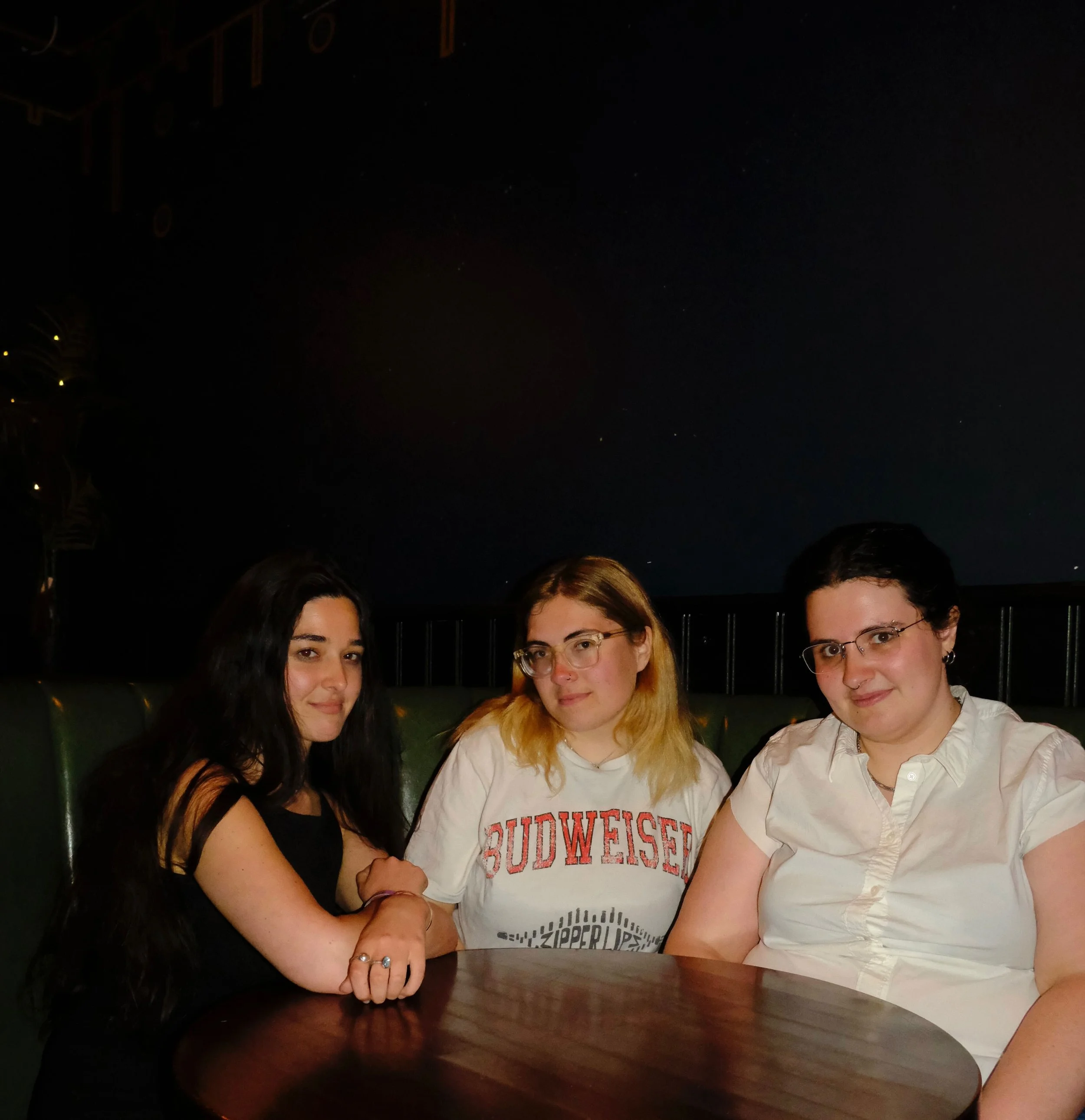
Left to right: Marina Carlstroem, Holly Nance, Penelope Gould
PART BAND, PART PLAY, LOST GRRRL FOUND IS A ONE-OF-A-KIND SHOW—In 2025, Lost Grrrl Found’s fictional punk rock band Zipper Lips released their first two singles “Happy Home” and “Do Ya?”, odes to riot grrrl bands of the 1990s like Bikini Kill and Team Dresch.
On May 17 and 18 at TV Eye in Ridgewood, NY, the “only play with a mosh pit” (co-written by Queens-based musician Holly Nance and Brooklyn-based playwright Penelope Gould) brought 22 original songs to the stage alongside a heartfelt queer coming-of-age story that follows Izzy, a college freshman living in the 90s who discovers the power of riot grrrl, gay crushes and local DIY spaces.
The Friday before their two-night comeback, Luna sat down with Nance and Gould as well as NY-based theatrical director Marina Carlstroem to discuss this unique project’s humble origins, multifaceted inspirations and the importance of interdisciplinary collaboration to foster an artistic and politically active community.
Read Luna’s conversation with Gould, Nance and Carlstroem below.
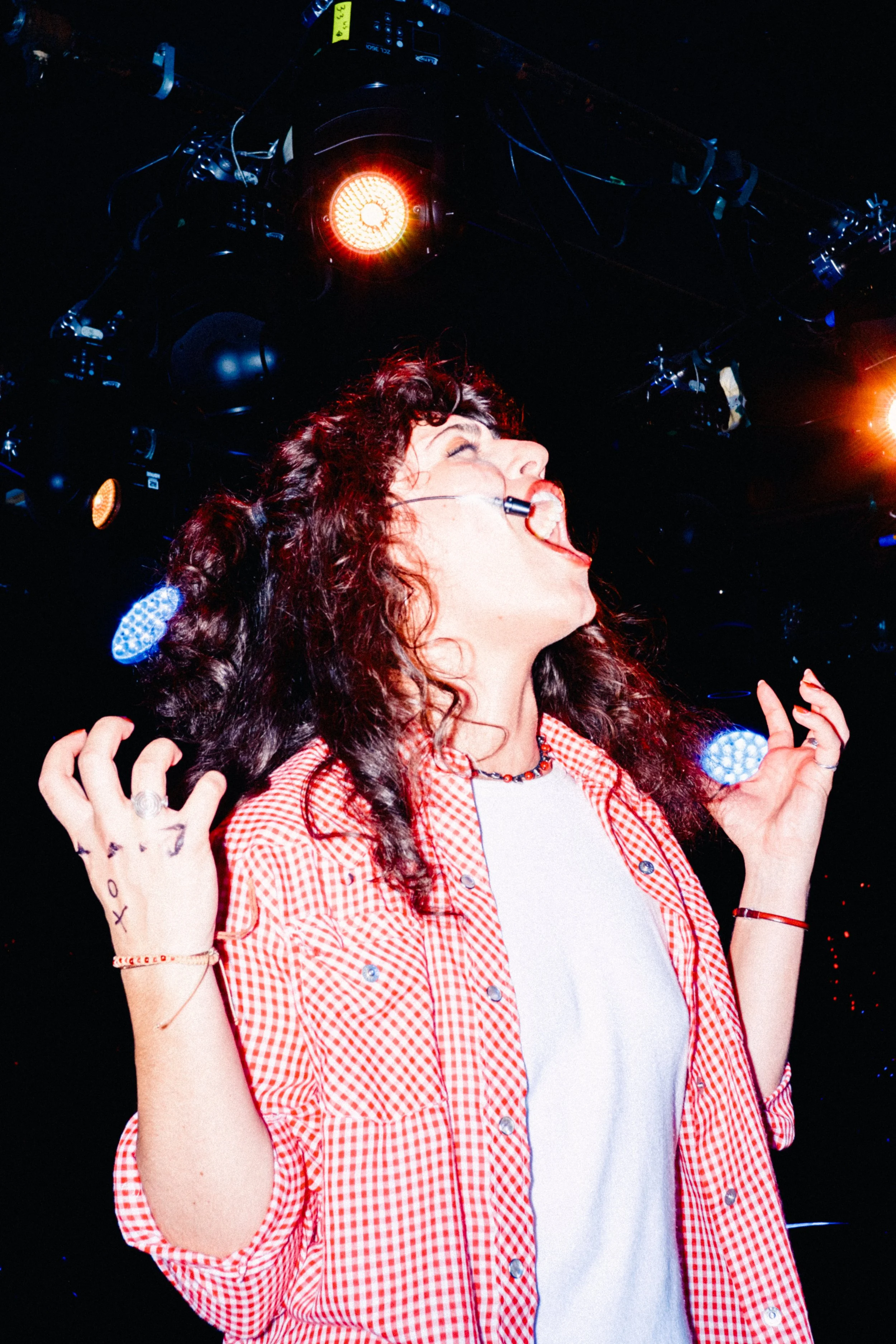
Photo by Chloe Fuller
LUNA: Congratulations on your shows at TV Eye! For readers who are unfamiliar, can you each describe the sound and style of Lost Grrrl Found from your own perspectives as co-writers and director?
GOULD: Lost Grrrl Found is a musical. It's narrative, it's 22 original songs and scenes. Stylistically, in terms of the music, it's inspired by riot grrrl and queercore of the early 90s. As a play, it's melodramatic, it's moving [the] story fast. We've learned so much doing it a bunch of times, but it's interesting to ask an audience to be standing for a play. It really tells you how you need to structure the scenes based on how people's attention feels, where things drag—people want to get in and out of scene quickly, and that is okay with us. We're grateful for the knowledge, so that's another interesting thing about style for us.
I would also say that the melodrama means that it keeps people engaged. It's high stakes, there's lots of moments of gasping, lots of cheers, lots of booing. It feels right to have it be that intense of a reaction, because people are allowed to be embodied at our shows—people are dancing, people are reacting with their whole body, sometimes walking out if they're really upset about the ways that characters are acting on stage.
NANCE: There's a fictional band in the show that's a riot grrrl band [that is] very inspired by Bikini Kill and Bratmobile. Those would be their contemporaries, that's very much the scene they're in. At the beginning of the play, the protagonist has never been introduced to riot grrrl. So, thinking about what her early 90s references would have been,and then writing those songs was super fun to think about. We had a lot of fun thinking about the specific characters. The lead guitarist, Sam—she's a music student, a lesbian and a really good guitarist, and I feel like she would love Team Dresch, Mary Timony and Helium. Thinking about all those things was so, so fun as fans of so much of that music.
CARLSTROEM: One thing you were saying the other day, Holly, when we were having a conversation about the music, you were sharing about how you were also thinking about, sonically, what riot grrrl bands of the time were inspired by.
NANCE: Yes, the same way that bands now are so inspired by 90s music, it's fun to think about 90s bands being inspired by the B-52s. I love the B-52s, and I feel like there's so many parallels, musically, you can make between the B-52s and Bratmobile specifically. They feel so twinned to me, such a nod to the B-52s [who are] cool, queer. Thinking about what this band, who's newly starting a genre, what their references would have been, was really fun.
LUNA: Lost Grrrl Found’s fictional band Zipper Lips has previously released two singles and your shows will feature 22 original songs alongside a queer coming-of-age storyline. What is the origin of this multidisciplinary riot grrrl-inspired project?
GOULD: The origin story is the power of friendship. We have definitely come of age with creating this. Me and Holly began working on this project together when we were both playwriting students. We were 19, and we realized we have this shared love of riot grrrl music, and we were inspired by how so many of their stories are like, “We didn't know how to do this, and we did it anyway. We just started, and saw how we could make it happen.” That's really the story of us making this musical, too.
We started writing it very heavily during the pandemic, when we had nothing to do, and me and Holly would get on video calls and just assign each other things to do to make this project happen. I would share lyrics with her via Google Docs, and she would just be sending me back ideas, and we'd just be texting about it all the time, and then, when we got back to the city—both of us were in California, where we're both from, during the pandemic—we both started learning the skills we would need to actually put on a show like this.
Me and Marina started working together as a playwright-director duo, self-producing plays in New York. Holly was starting to play in bands and learning about that side of it, and so we were gaining these skills to be like, “Oh, we could actually make this idea, this draft that's so nebulous, into an actual live show.” When I was working with Marina, she started being like, “Wait, what's this riot grrrl project that's half-baked and you talk about all the time? You never share the drafts with me. What's going on with all that? Let me get in there!”
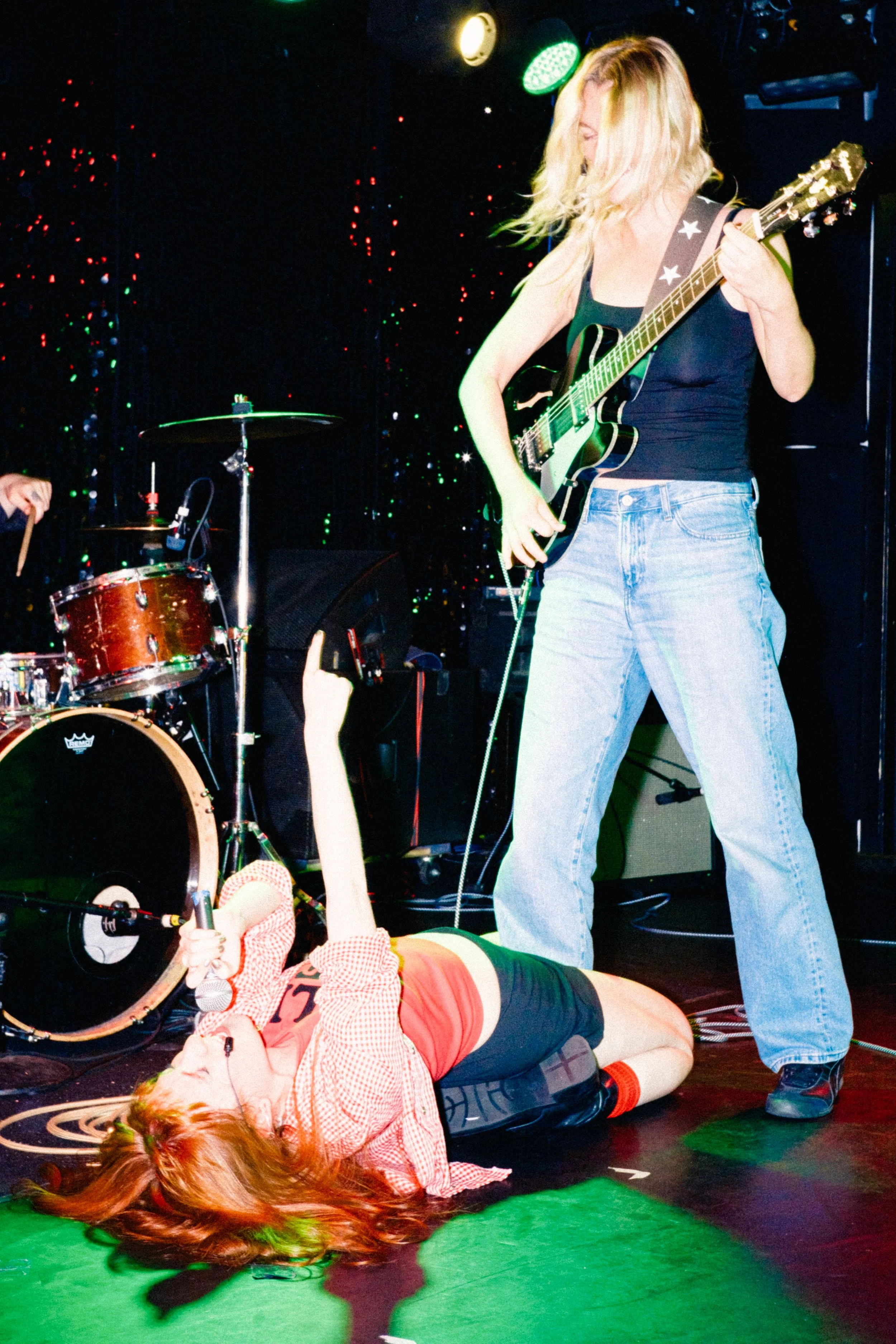
Photo by Chloe Fuller
CARLSTROEM: Yeah, I begged for the script. I was like, “Please finish this, so that I can have it, and we can do something together with it.” It's been two and a half years since we've started working on it because we did a pretty intensive “What do we want the shape of this to look like?” with the cast and the performance team who jumped in [during] the first run.
We have a lot of the same cast who've continued throughout that time, which has been really fun to grow the project with them, and have them come up with new ideas of who these characters are as their lives have grown and changed over that time too. A lot of our cast members have music projects outside of this show, and are primarily musicians, which is really different for a play. Most of them have never been in a play in their adult lives, and so that's a really cool part of our community, and something that they bring into rehearsal every time.
We really thought about not only what the content and the form of the actual play would be, but the longer term idea of what this show would look like. As Penelope and I were working together on other projects, we started dreaming about what it would mean for a play to function like a band, and how we could do a pop-up situation where bands play every three to however many months. That's pretty different from how we have seen plays function in New York City, specifically…and so it was really exciting for us to imagine a new model where we could do a play for one night only—in this case, for these shows, two nights only—and then go away for a little while and come back in a new space and bring new people along for the ride.
NANCE: Me and Penelope just really locked in over the pandemic. I had a horrible restaurant job that I hated, and this was literally the saving grace of my life. Getting back in New York, and, like Penelope said, coming of age with the story was very kismet. We were starting to understand how we could make this thing actually happen, which was very crazy. Basic things like how to book a show at a venue to being like, “Oh my god, we have to find a drummer that is a good drummer who’s also down to speak lines on stage.” We knew nothing, so it was perfect timing, because we started to get these skills separately, and then brought them back to this project that we had on the back burner.
LUNA: Holly and Penelope, what was it like collaborating on this cross-genre punk rock musical? Marina, what was it like directing “the only play with a mosh pit”?
NANCE: I feel like me and Penelope really lucked out in that Penelope is a playwright first, but is also a huge music lover and music consumer, and we have this exact same musical language. All of our references are the same. Penelope is a huge music person as well and also ultimately works in music as a day job. I was studying playwriting—I don't even know why I was doing that to be so for real. I wanted to be a TV writer. I had this dream, and then I ended up just really doing music, but I did also have a playwriting background.
In this project, we took on the roles of playwright [and] musician, and we collabed on the story. We really pull from the same language and references, which was super, super helpful. In a practical sense, we would basically have these Zooms where we would piece together the story, and then Penelope would go and write dialogue and lyrics, and then bring them to me, and we would talk about them, and make any changes or not, and then I would go write music, while Penelope wrote lyrics for the next thing, and we would just do that for the whole process.
GOULD: Something that was really fun about this project is that we were also giving ourselves homework assignments every week outside of the writing. We were listening to the same albums to be like, “Okay, which of these songs do we really want to reference for this moment?” Sometimes, we were listening to musicals and reading plays as well. We were rigorous with our pedagogy, and it was very fun to think about how do you write these songs that are sometimes in the style of people learning to write a song, so the structures that they are using are not traditional structures, because they hadn't learned what traditional structures were supposed to be yet. How are we imitating that—I want to use the word amateur, but not in a derogatory way—amateur, in a way of finding and learning and beginning a new project. Trying to find those sparks that created these interesting song structures also meant that we were relying on looking at songs exactly how they structured their lyrics and pulling pretty directly from those structures. Each song in the musical, at some point, had two or three songs that we were really specifically targeting for the inspirations, and then obviously they grow past that, but those were the way we were seeding all of them.
CARLSTROEM: We've said the word unique a lot when we talk about this show, but directing this play is unlike, I imagine, any other project that I will ever work on as a director, and it's a really fun thing to keep coming back to. In a standard theatrical model, you might have a couple weeks or a few months of rehearsal, and then you have the big week of tech rehearsal in the venue where you spend a full day doing lights, a full day doing sound, a full day doing blocking, etc.
None of those things work for this play, so we need to find rehearsal spaces that have enough room to move around. We've been able to find spaces…for rehearsal processes, and then our tech time, because we're going to different venues each time, is one day in the space we've been lucky enough to sweet-talk our way into taking more time in…on the day of the show. We go through our 100 light cues. We have a sound designer [Ray Cunningham] who comes in to support the sound team at the venue with lav mics, so that we can hear the actors when they're doing their lines. We'll be in there all day, run the show, do all of the tech and then do the show that night.
Holly, you're speaking [about] shared language. It's been interesting because so much of our cast…don't come from a stereotypical acting background. There's a lot of code switching that I do as a director to try to get language that feels resonant for the team in terms of moving the story forward. It's really helpful that I have a music background also, because I'm able to…think about how the music blends with the story in a way that would be really tricky if I didn't have that background. In terms of saying, “Your objective in this scene would be this.” [For] someone who does not come from a theatrical background, that's not going to be helpful. So, it's been a lot of thinking about how I get a performer to the place that I want them to go without drawing on that language specifically. I also have a musical theater background in a way that's a little bit different from Holly and Penelope, so that's been a fun thing to…bring those references to the table. I've been thinking a lot about cult musicals, like Heathers, or things that I discovered as a kid through cast recordings that never have gone to Broadway. Yet.
Just to speak to “the only play with the mosh pit,” that was something that continues to be really exciting, and blows us away every time, how engaged the audience is, and open. The way people respond in the room is so much more active, like Rocky [Horror Picture Show], people are having big responses of shouting “No!” when a big betrayal happens, or feeling excited [enough] to jump around and mosh during songs, and that feels like a cool part of what I build into the show as a director.
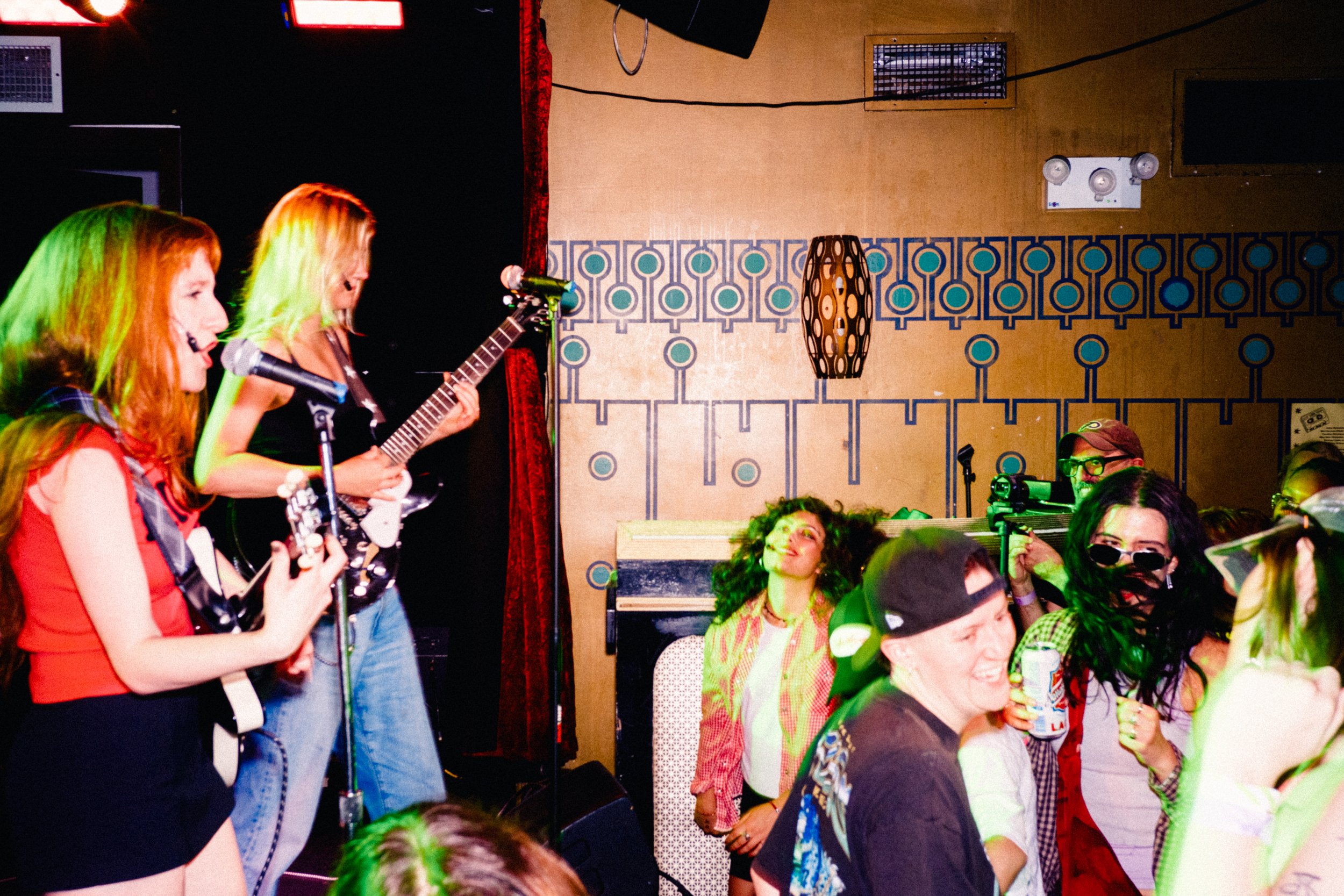
Photo by Chloe Fuller
LUNA: After this interdisciplinary collaboration, what does the message behind Lost Grrrl Found mean to each of you? What do you hope the audience takes from this story?
NANCE: There's a line at the end—Penelope really slayed with this one—that gets me every time: “Open up the pit, open up the pit / I'm pushed forward by colliding into you.” That's, to me, just so beautiful. Whenever I hear that, I'm just like, wow, the message of creating these spaces and building community pushes everyone forward, and having space for messiness, for jumping around. That line always just really sticks out to me—DIY community, DIY spaces, all of this is so important, and I do feel like how this story came to be was so DIY ethos. That final line just really cements that for me—you can do it yourself with your community.
GOULD: I want people to take away how artistically and politically powerful crushes are, and that a crush can allow you to change the way you're thinking about the world in a way that is actually beautiful for your own growth. I do think it's about encouraging audiences to feel empowered, to build, to organize, to be politically and artistically motivated by their own communities—and that that’s not an inaccessible thing.
CARLSTROEM: Yeah, there's a section in the middle of the show where the protagonist, Izzy, gets on stage during one of Zipper Lips' songs to talk about what being in riot grrrl club means to her. Leanna, who is the lead singer of Zipper Lips, asks her, “Why should other girls join?” and she says, “Because it's fun, but also serious, and we're building a space where girls can be both.” I think that that is something that feels really true about the show and “grrrl” with three Rs, which is, to us, a very expansive term.
I echo both of your sentiments, Penelope and Holly, and I think it is a space where I hope that people take away that it's cool to care about things, as part of the riot grrrl ethos—they stood tall, and they do stand tall, in their earnestness around organizing, and their refusal to separate their musical projects from political organizing. This Sunday and Monday, we're going to have a lot of community orgs tabling, and that feels like a big part of what we try to bring from riot grrrl specifically into our work, and we hope that the folks that come to our shows feel inspired in the same way to link those things in their artistic and political practices. Being fun and serious at the same time is possible in these spaces.
LUNA: Finally, what are some pieces of media (music, film, literature, etc.) each of you’ve been drawing inspiration from recently?
GOULD: Holly, Marina and some of our friends are in a book club, and we all just read Mood Machine by Liz Pelly, the book about the rise and fall of Spotify, and it taught me so much about the way that music can be powerful in negative ways too, like the way that the power of music can be harnessed to actually work against our own best interests, and the listener's best interest, and for sure the band and artist's best interest. It felt like an invitation to use your music and be thoughtful about the way you both consume music and create music to try to work outside of these systems of harm.
NANCE: I'm just gonna go with the first one that came up in my mind, which was the movie, The Incredibly True Adventures of Two Girls in Love. I just rewatched it, and it's just so good, fun, sad, [a] beautiful love story.
CARLSTROEM: I have two short ones that are dissonant. The first one: I took a songwriting class with Oneohtrix Point Never recently, and he spoke a lot in that class about how you can make music from anything, and just being unprecious about your work, which has been a really exciting tool to think about. He did this one lecture about listening to a Madonna CD while hearing the sounds of a park outside, very inspired by Pauline Oliveros' work, and thinking about the way that the sounds of the world blend with the sounds that you make. That feels like a big part—both for this project and my general ethos as a creative person—of how the thing that you offer entwines with the beings who are around you, whether that's birds or people hanging out in the park.
Also, The Devil Wears Prada 2. I was excited by how, in some ways, that movie was more politically motivated than I thought it was going to be, and that it was about trying to regain artistic control and feeling excited about working hard. You could say that it's about enjoying making things that feel real in the face of a world that is wanting to plasticize and make you be bought and sold by billionaires for clickbait. I love you, Meryl Streep.
GOULD: None of us said music, which is kind of crazy. Can we do an album shoutout? I know what I can do. No Need to Be Lonely by Gladie, this Philadelphia band I'm obsessed with. I think it's super cool, grungier and dirtier than their last album, and I'm just totally obsessed.
NANCE: I've been obsessed with the new record by Quiet Light. I think she's a genius. I'm not the only one that thinks that, obviously. Pop is back, and I'm really excited about that.
CARLSTROEM: I'm gonna shout out Kitty Craft, who is riot grrrl-adjacent. I've been feeling inspired by the stuff that she's making now, and how it's in conversation with some of her work from the early 2000s.
