
INTERVIEW
INTERVIEW
☆ BY KIMBERLY KAPELA ☆
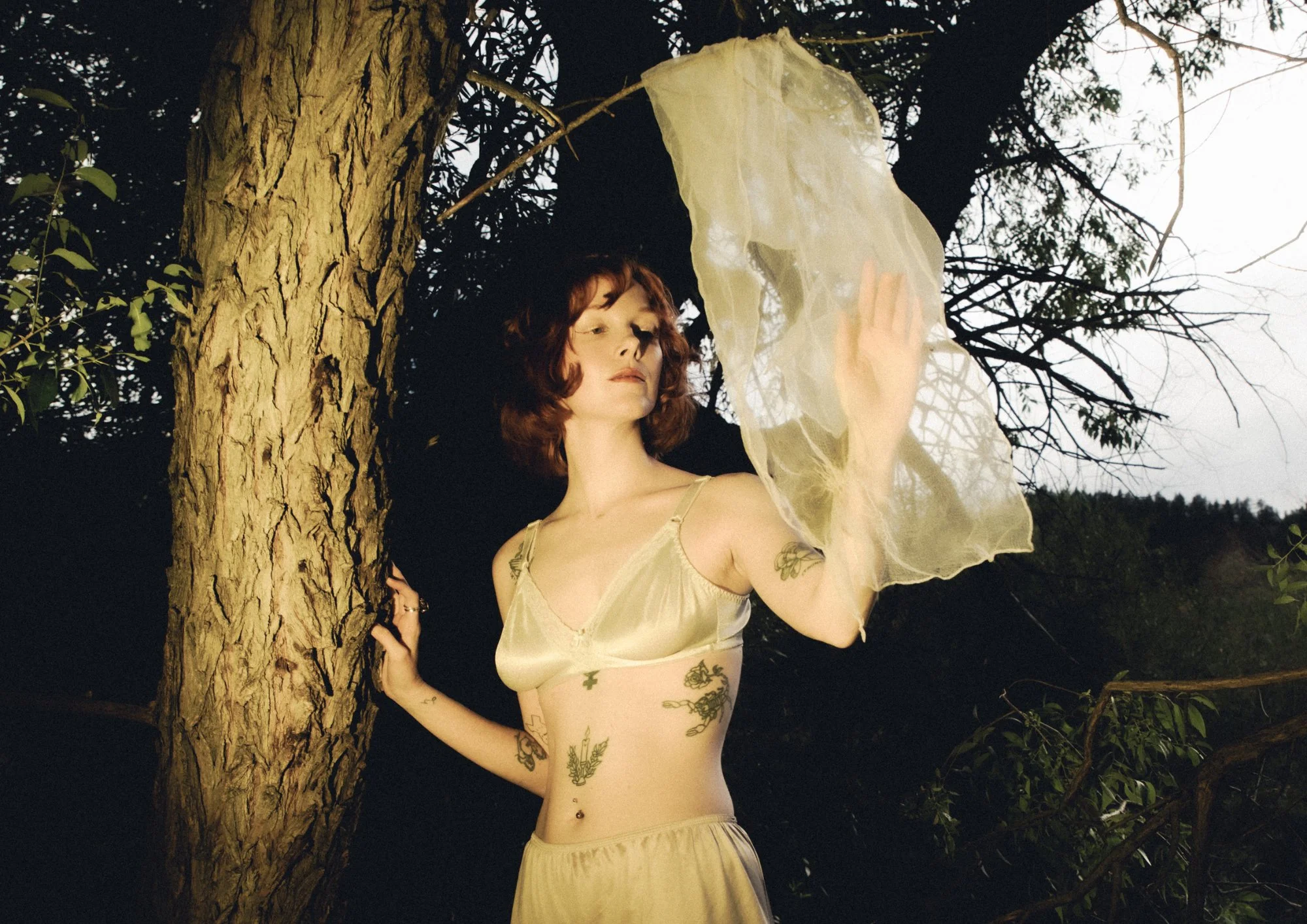
Chloe Barkley
THE FAWN RESPONSE IS A SURVIVAL INSTINCT ROOTED IN APPEASEMENT — the impulse to please others, suppress your own needs and prioritize someone else’s comfort in an attempt to feel safe. For Maddie Medley, it is a pattern that has shaped her understanding of relationships and self-preservation. On her debut full-length album, Fawn’s Enemy, the singer-songwriter begins to dismantle that instinct, confronting the complicated ways people learn to abandon themselves in exchange for acceptance.
Named for this response, Fawn’s Enemy traces the journey toward reclaiming a voice that has spent too long accommodating others. Through songs shaped by trauma, Medley creates a world of her own called Fawn’s Forest, where old habits collide with new beginnings, and every path leads back to one question: What does it mean to fully trust yourself?
Across tracks including “Fawn’s Rage,” “Dawn,” and “★★★” (aka “Dan + Me”), Medley examines people-pleasing tendencies and the process of learning to recognize her own instincts. Fawn’s Enemy embraces the contradictions like the desire to be loved can coexist with anger; the pursuit of independence can bring old fears to the surface. For Medley, she sees herself in Fawn.
“Fawn can be tender, she can be spiteful, she can be self-destructive, she can be strong-willed and self-assured,” Medley explains. These different facets of Fawn give the album its emotional depth, reflecting the realization that the enemy is not always another person. Sometimes, it is an unhealthy pattern, an old fear, or the impulse to betray your own instincts.
Co-produced with Luke Krutzke, Fawn’s Enemy was recorded across Tennessee, Kansas City and Denver. The musicians took their time with the material, building an organic sonic landscape through the warm, woody textures of mandolin, fiddle, bouzouki, upright bass and acoustic guitar.
“We captured a sound that was organic, but also very angry and imperfect, too,” Medley says. “Fawn’s Enemy is a view straight into my heart, so we went after anything that sounded real.”
Medley approached Fawn’s Enemy with one guiding rule: every word had to come from her alone. The decision to protect her creative autonomy allowed her to not compromise her instincts to accommodate someone else’s expectations. She begins to challenge the very patterns the album seeks to unravel.
Through Fawn’s Forest, Medley invites listeners to examine the habits they have developed to feel safe and reconnect with the instincts they may have learned to silence.
“[Listeners can take away] an acceptance of their own rage and anger, and a knowledge that it is okay to feel that rage,” Medley says to Luna. “You don't have to stifle it or mask it. You just have to feel it however it comes out.
Medley transforms the work of confronting old survival patterns into an intimate act of self-reclamation. By allowing herself to speak without compromise, she creates space for others to do the same.
LUNA: Thank you for talking to Luna. Our readers would love to get to know you and your music more. For any readers who aren’t familiar with you yet, what inspires your artistic style and sound?
MADDIE: I'm majorly inspired by Fiona Apple, Gillian Welch and Tori Amos. I grew up in Nashville listening to a lot of folk and country music, so I’m super inspired by these powerhouses. Damian Rice is an artist I grew up listening to and absolutely love.
LUNA: Congratulations on your debut full-length album, Fawn’s Enemy. You’ve described the record as a world of its own. The album’s title references the “fawn response,” the instinct to appease others as a means of protection or survival. What initially inspired you to explore this concept, and how did writing these songs help you begin to challenge those patterns in your own life?
MADDIE: Totally. When I initially started exploring the idea of the fawn response, I wrote a song called “Fawn's Rage.” It started out as a poem, and I was just recognizing patterns of performing comfort or happiness, without really feeling it. I was working retail and a lot of customer service-facing jobs where I had to be perky all day every day. I think that spurred some thought for me, and the “Fawn's Rage” poem came out of it, and then the whole record formed itself around that.
LUNA: You’ve spoken about Fawn as a character who can be tender, spiteful, self-destructive, strong-willed and self-assured. How much of yourself do you see reflected in Fawn?
MADDIE: Definitely.
LUNA: You’ve described the album as a return to the music you always wanted to make and to the person you needed to become to make it. What did that earlier version of yourself imagine your music would sound like, and what changed along the way that brought you back to that original vision?
MADDIE: Honestly, I always knew I was going to make or that I wanted to make folk music. When I initially started my career, I was signed to a major label, and put up pop songs that I obviously loved for what they were. I always knew I wanted to come back to folk music. I feel like this record sounds like me and sounds like my heart.
LUNA: The album’s commitment to creative autonomy is especially striking: you made it a rule that every word had to come from you alone. Can you speak more on this?
MADDIE: Absolutely. Co-writing is huge where I grew up. I think about when I entered the music industry, it was highly recommended and encouraged for me to do a lot of co-writing, and I definitely love to be collaborative. But for me, sometimes my words came out a little diluted, or I wasn't able to work out what I wanted to say exactly in the songs in co-writes with those constraints of a few hours in an unfamiliar studio with somebody new that you've never met before. Going into making this record, it was really important to me that every word was exactly what I meant to say. I knew that the only way for me to really do that was writing by myself. It was very important for me to do it as a solo practice.
LUNA: Do you have a personal favorite song on Fawn’s Enemy — one that feels closest to your heart or most revealing of who Maddie Medley is right now?
MADDIE: “Dawn” is always the most cathartic to play, and when I listen to it, I feel like it always strikes something in me where I deeply feel why I wrote it.
LUNA: How do you hope listeners — especially your femme audience — can connect with or find power in this new era of music from you? What emotions or messages do you want to leave with them?
MADDIE: An acceptance of their own rage and anger, and a knowledge that it is okay to feel that rage. You don't have to stifle it or mask it. You just have to feel it however it comes out.
LUNA: Now that Fawn’s Enemy is out in the world, what does this new chapter feel like for you? After spending so much time building Fawn’s Forest and exploring the process of reclaiming your voice, what are you most excited to discover about yourself as an artist moving forward?
MADDIE: I'm most excited to tour. I was on my first tour in March of 2020, so that quickly ended. I’m hopping back into the touring world, and I feel very raw and vulnerable now that it's out. I think that's a good thing. It's funny to know that people know everything that I have felt for the past decade of my life in this contained way. I'm excited but feeling a little raw.
LUNA: How are you feeling in this current era of your career and what does the rest of the year look like that you would like to share with Luna?
MADDIE: I am going on a southeastern tour in November with Big Guy & The Very Large Men and She Returns From War. Both of them are artists that I admire so much and highly recommend to listeners. I'm very excited to go on tour with them.
