
Q&A: Marika Che’s “Saint Charles Avenue” Is a Slow Burn Toward Something Bigger
INTERVIEW
INTERVIEW
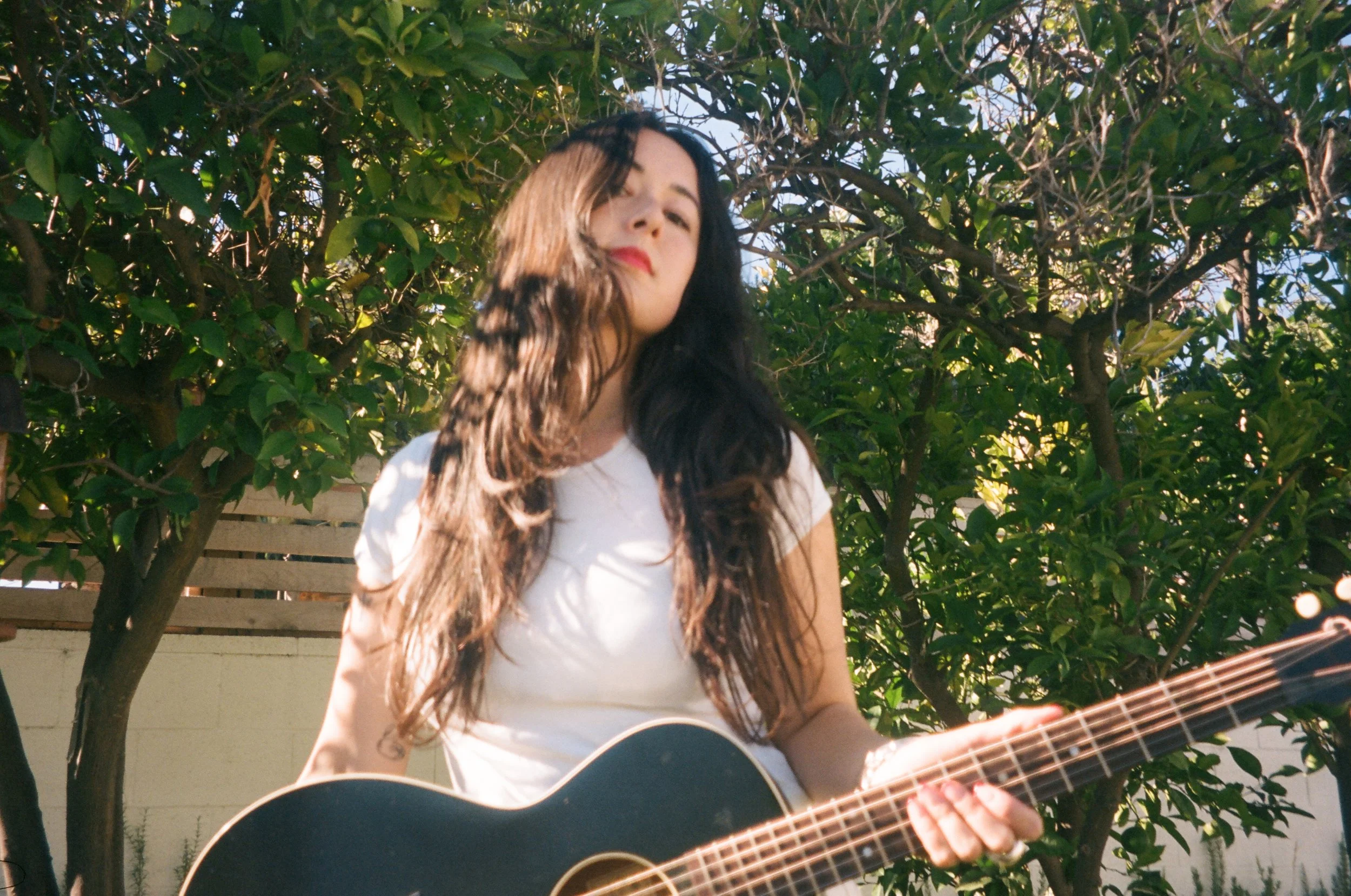
Photos By Miró Myung Justad
LA-BASED SINGER-SONGWRITER MARIKA CHE INTRODUCES HER NEXT CHAPTER WITH “SAINT CHARLES AVENUE” - a slow-burning, luminous single that unfolds with patience and emotional precision. Built from a single guitar line and Che’s velvety vocals, the song gradually opens into a lush, horn-laced slow dance that’s intimate, cinematic and quietly devastating. It’s a track that rewards stillness, capturing the kind of feeling that lingers long after the last note fades.
The single arrives alongside the announcement of Che’s debut solo album, Bright Flame, out April 8, 2026 - a twelve-track body of work that traces the space between safety and wildness, memory and becoming. Accompanied by a music video directed by her sister and longtime collaborator Miró Myung Justad, “Saint Charles Avenue” follows her previous release “Hot Moon,” a folk-leaning ode to Los Angeles that first hinted at the album’s sun-warmed, nocturnal world.
For listeners who first encountered Che as the frontwoman of indie-rock band Tangerine, whose music earned praise from NME, The Guardian, Stereogum, KEXP, and more, Bright Flame marks a quieter, more inward turn. Written and recorded in Los Angeles, the album moves through grief, creativity, identity and the inherited contradictions of being deeply American while always slightly outside of its center.
Where “Saint Charles Avenue” swells gently outward, the rest of Bright Flame follows suit: songs that hold both the ordinary and the infinite, from dirty dishes to distant planets, long walks down empty boulevards to the weight of family history. It is a debut that doesn’t announce itself loudly, but confidently, a record that glows rather than shouts, revealing an artist finally letting her inner world take up physical space.
LUNA: After years as the frontwoman of Tangerine, what was the moment that made you feel ready to step into the spotlight on your own as Marika Che?
CHE: The music industry has always been tough, but it’s only become tougher since Tangerine stopped touring and releasing music. I think most musicians would attest to that. For a little while there I thought maybe it was no longer for me. I found a really good therapist, and they helped me re-connect with my innermost feelings and — cliched as it is — my inner child. Soon these songs were just sort of pouring out of me. Everything felt very natural, almost effortless. Even my relationship to my voice changed — when I sing now, I feel less encumbered than I used to, and I think my voice sounds more authentic to who I am at this moment in my life.
So developing this project, “Marika Che,” felt less like a decision and more like a homecoming. There’s a lyric from Lorde’s latest LP Virgin that really rings true to me: “My babe can’t believe I've become someone else. Someone more like myself.”
LUNA: “Saint Charles Avenue” unfolds slowly, building from intimacy into something lush and cinematic. Why did this song feel like the right first official single for Bright Flame?
CHE: Choosing a single is such a difficult decision! I’m so close to the songs I almost can’t even imagine what it’s like for someone else to experience them. When I was sharing the album with friends, I noticed a lot of people connected to this one, people whose taste spans the musical spectrum. I think there’s a gentleness but also an urgency to it. It’s also a song about learning to be independent, which felt very appropriate for this moment in my career.
LUNA: You’ve described yourself as a “failed would-be child star.” How did reframing failure shape both this album and your decision to release music solo?
CHE: I felt a lot of pressure as a child to be perfect, to achieve, and yeah, as strange as it is, to be a star. I sang, I danced, I modelled, I attempted some acting (but was awful at it). I think my inclination to be creative, to write songs — which I did from an early age — was misinterpreted as a desire to be in the spotlight. I’m actually not someone who naturally seeks the spotlight.
By age 13, I felt like a failure. How insane is that? I mean it’s just so young to feel that way. At 16, I signed a development deal with Columbia that never came to anything. That also left me feeling like a failure, again at such a tender young age.
It’s been a long journey of learning to disentangle my natural love of music, art, and writing from the pressure I faced as a kid. I mentioned earlier in the interview that this album feels like a homecoming for me — in more ways than one. It feels like a return to my original love of writing music. I can feel that little 10-year-old kid who wrote out lyrics and chord charts in the basement of my parents’ house celebrating alongside me.
LUNA: Los Angeles feels like a quiet but constant presence throughout Bright Flame. How has the city influenced the emotional and visual language of the record?
CHE: Los Angeles will never cease to fascinate and inspire me. After nine years I do feel that it’s my home. It’s hard to put into words what LA means to me. I feel like I chose this city and it chose me back. It has sheltered me through some of the hardest moments of my life.
The sprawling nature of LA can feel lonely, but it also gives me the time and space I need to think. That languid, noirish quality definitely influenced Bright Flame. This was an album born of freeways, long walks down empty boulevards, the trees of Griffith. It’s not a classic city album.
When I lived briefly in NYC years ago, I suffered from major writer’s block. Maybe someday I’ll go back and try to write my New York album, and it’ll take on that frenetic energy. But Bright Flame is LA, through and through.
LUNA: Your work often grapples with Americana through the lens of being a perpetual outsider. How do you navigate that tension as an Asian-American artist?
CHE: I never knew where I fit in culturally when I was growing up. My mom was born in Korea, and my dad’s family came over from England in the late 17th century. I feel deeply American in the sense that we are a country of immigrants. I feel connected to all kinds of music and cultural traditions, including Americana.
My step-grandfather raised my Korean-immigrant mother on outlaw country, and she always had a soft spot for Merle Haggard because of him. Yet my step-grandpa was also a racist asshole. So you feel this push and pull at all times, even when it’s the only thing — the only home — you know.
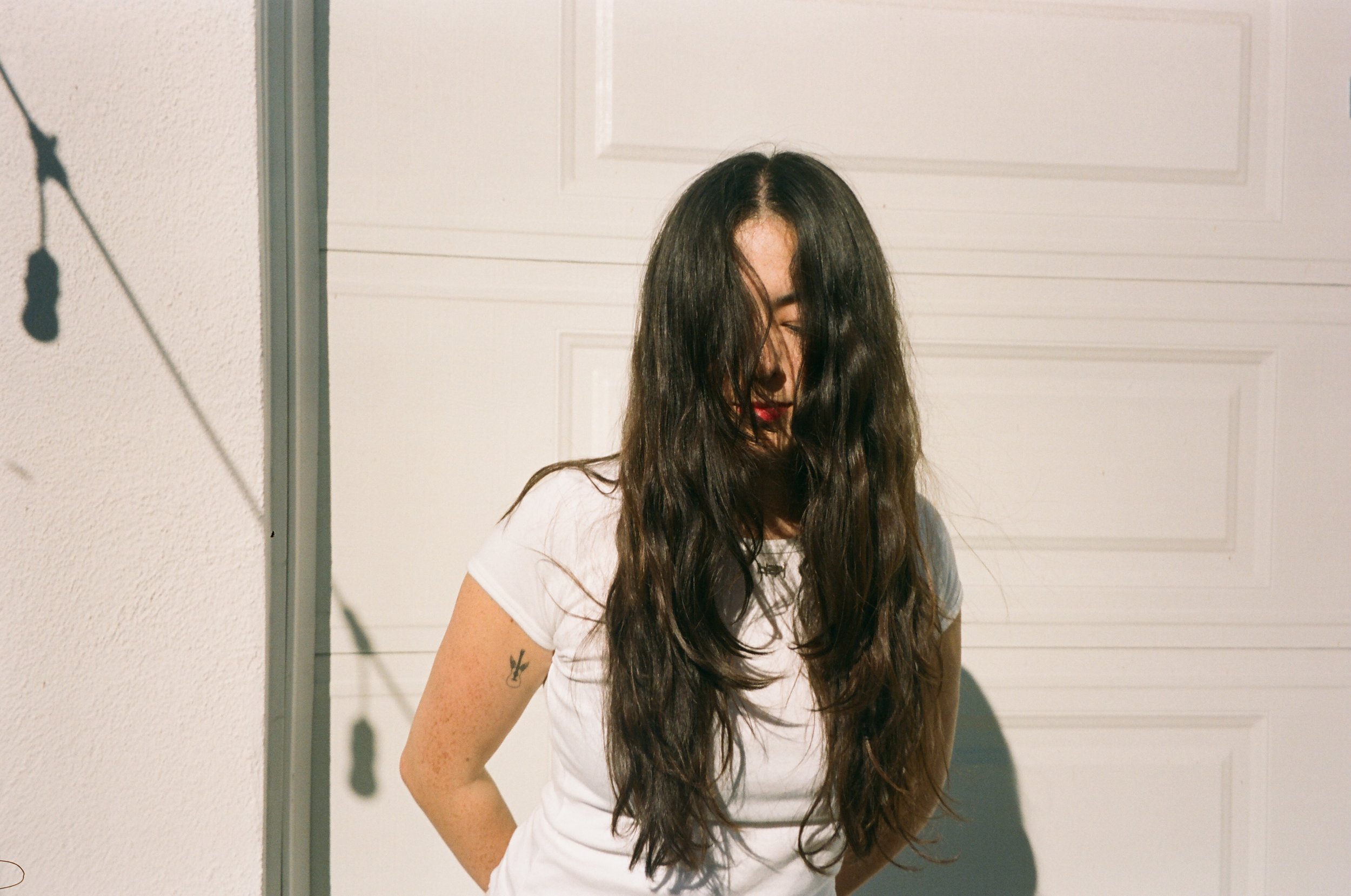
LUNA: The visuals for this era are a collaboration with your sister, Miró. Can you share more about what that process was like?
CHE: My sister Miró Myung Justad was the drummer for Tangerine. We started our first band together, called The Neons, when we were 14 and 12! So we’ve been collaborating for a long, long time.
She’s an amazing visual artist and over the years she and I sort of developed a shared visual language and aesthetic. It’s been such an honor having her direct all the music videos for Bright Flame. She also shot all my press photos. Together we’re always pushing each other to clarify our own sense of artistry and aesthetics, to always keep growing and to trim away what no longer feels authentic — whether it's a music video, a photograph, or even a table setting.
LUNA: You’ve spoken about literally mapping the album on your wall with images and photographs. What did seeing Bright Flame in physical form reveal to you about the project?
CHE: When I saw all my visuals taped up onto the wall, I was excited to see a coherency and a message coming through that I had not consciously planned. Bright Flame is ethereal but deeply rooted. It’s full of soft blues and hazy images of planets, cornfields, blue skies, 35mm photographs from the recording studio.
An image of a circle, an orb, kept coming up — cross-sections of vegetables seen through a microscope, images of planets and moons taken by the Hubble telescope. When I saw my collected images, I realized I had successfully let go enough during the creative process that my subconscious had done most of the work for me, connecting all the dots.
I didn’t write a random collection of songs — I wrote an album, one that inhabits a world of its own. As someone who had been questioning if I still had music in me, it was reassuring. It felt like an affirmation that I’m on the right path.
LUNA: For longtime fans coming from Tangerine into this new chapter, what do you hope feels familiar, and what do you hope feels entirely new?
CHE: I’ve always been a melody-first writer. At my heart I think I really have quite poppy sensibilities and I always have. So if you liked that about Tangerine, that will still be there with Marika Che.
But this project will feel much more personal and intimate. And as I move forward with Bright Flame and beyond, I think there will be more playing with genre and experimenting with different kinds of instrumentation. There’s a freedom to it all that I’m looking forward to playing with.
