
Q&A: Rabbitology Releases New EP ‘Phthalo’ Ahead Of Her Upcoming Tour
INTERVIEW
INTERVIEW
☆ BY GIONA CIACCO ☆
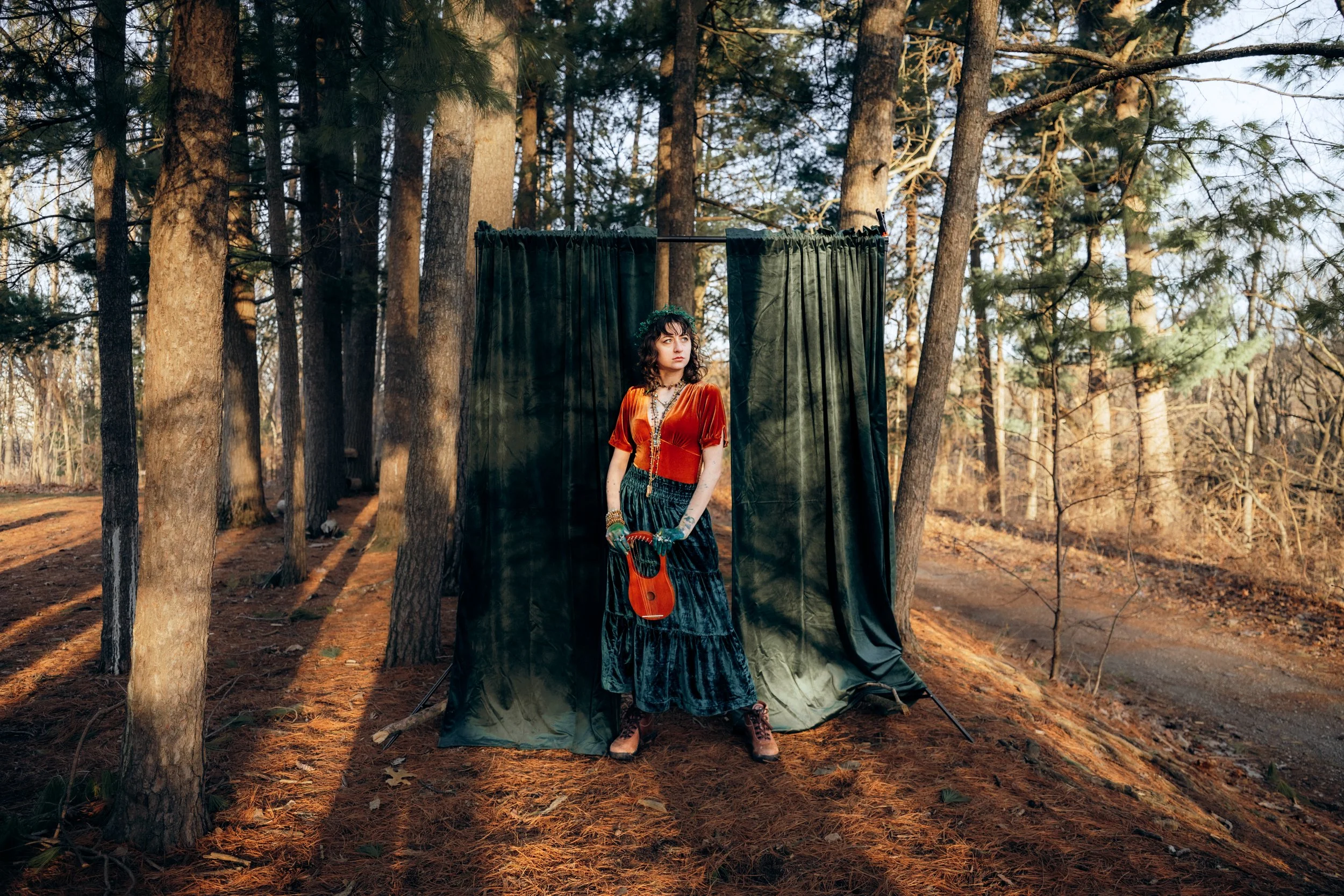
Photo by Aria Zhou
TACKLING WOMANHOOD, LOVE, GROWTH, AND REBIRTH—Rabbitology’s EP PHTHALO pushes the boundaries of alternative folk through haunting vocals, poetic imagery and unconventional production. Inviting us into a fantastical world of two-headed hares and sleeping gods, the EP balances magic with real-world issues, providing listeners a reflection on immortality and existence.
The Michigan-based artist began releasing self-produced demos from her dorm room in 2023, with her most popular demo, “The Bog Bodies - Dorm Demo,” gaining nearly 11 million streams on Spotify. Their debut EP, Living Ghost, and its expanded B-side version Living Ghost: Still Rising, released in 2025, explore themes of death and stagnancy, directly mirroring those of PHTHALO. In 2025, the 23-year-old’s Artist Spotify Wrapped boasted 1.3 million listeners and 20.7 million streams, just two years into her career. Alongside a summer 2025 solo tour, Rabbitology appeared as a guest performer on the fall 2025 tours of The Oh Hellos and Elio Mei.
PHTHALO features five self-produced songs, with its sixth, “Two-Head Hare,” produced by Tyler Heath of the famed folk rock duo The Oh Hellos. With allusions to Millais’ Ophelia in “The Bog Bodies,” ancient Greece’s Pygmalion in “The Glowing,” and Icarus in “Sweet Death of Me,” the album acts as a scavenger hunt through the woods for English majors and literature lovers alike.
She begins her trio tour, The Three Wishes Tour, alongside Amélie Farren and Lilith Max on September 24 in Cleveland, Ohio, with a total of 18 stops across the U.S. She has also been announced as the special guest of Eivør’s 2027 European tour.
Rabbitology sat down with Luna to chat about their new EP PHTHALO, their upcoming tour and how they learned to produce music.
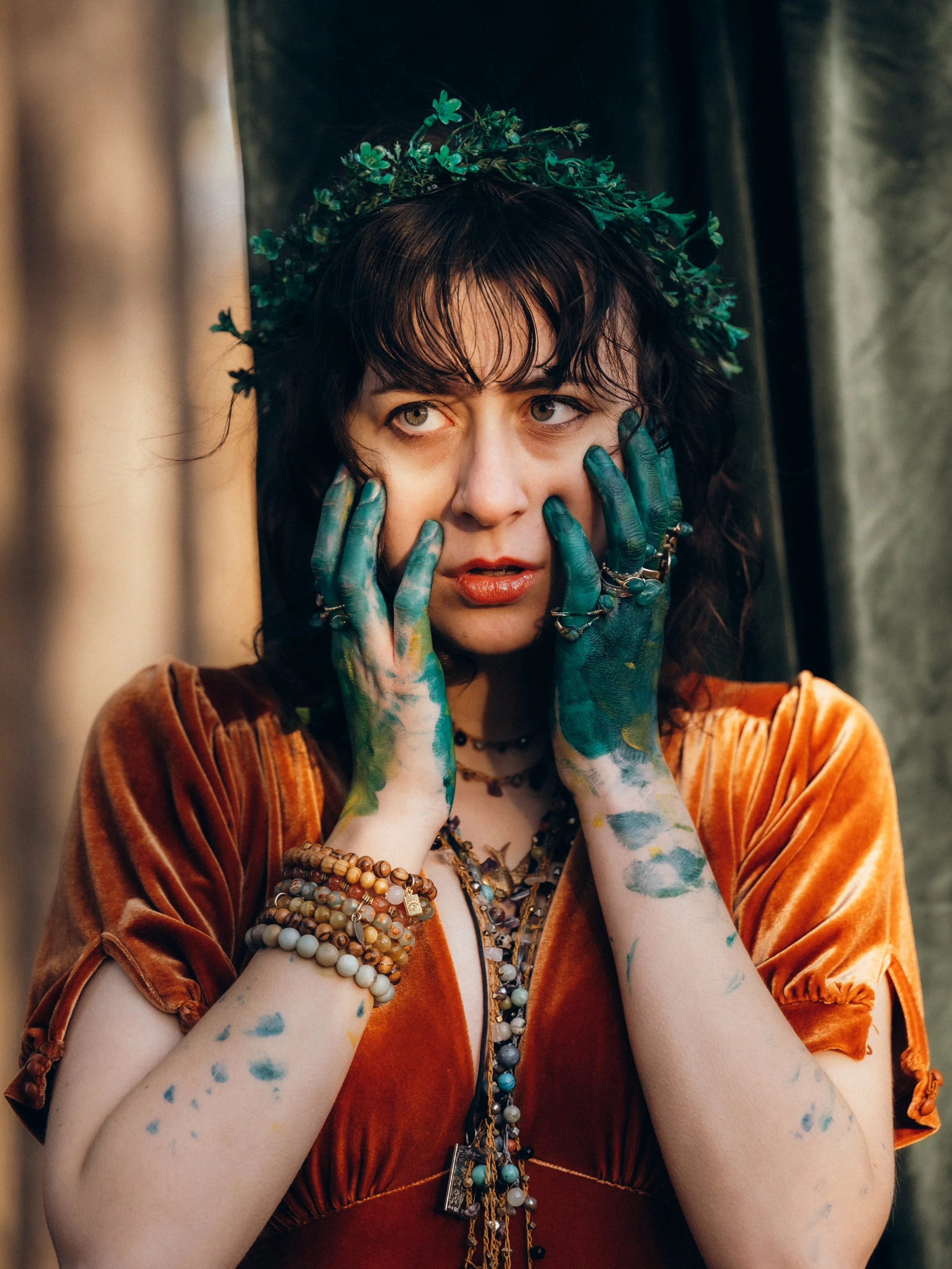
Photo by Aria Zhou
LUNA: When did your journey with music begin?
RABBITOLOGY: I began exploring music when I was 11 years old. I joined the school band and played clarinet. I couldn't read music, but I didn't want to tell my teacher that, so I started playing by ear. I did that for way too long before my teacher realized I wasn’t reading the music. It was a fun challenge to try to memorize or predict based on sound, and I think that was the root of where my music interest started.
I really started to see Rabbitology take form in my freshman year of college. I used the sound of music as a therapy to soothe me after a busy day, to go back to that flow state I was in when I was really young and [to] exist purely with sound.
LUNA: When did that turn into producing music?
RABBITOLOGY: I started learning production on Ableton in high school. I wanted to make music for movies, so I would make a fake movie in my head and then write a score for it. I was doing it originally all on GarageBand. My band teacher, who's the same one as before, came up to me and was like, “Why aren’t you using Ableton? We have [Ableton] free with the school. You should try this.” So we were on a bus on a band trip in Toronto, and he sat down with me and taught me how to use Ableton at the time, and I instantly forgot how to do it. But I started messing around with Ableton then in high school, and learning how to use it again with this band teacher's help.
Then in college, I actually started making full songs in production. Now that I knew the rules, I started breaking them a little bit—using plugins and filters that should be used to do reverb and using them instead to make an instrument. Just finding ways to push the program to its max, and that's when I started doing my production.
LUNA: Did you go to school for music production?
RABBITOLOGY: I did not. It's actually a funny story. I was torn between wanting to be a writer and wanting to be a musician. My parents were like, “I think you should get one art degree and one non-art degree so that you can have something to fall back on.” So I was like, “Okay, I'm gonna have to pick between music and writing. I think I have more of a chance of having a career in writing, so I'm not gonna study music.” So I studied writing and communications instead. It's funny because I have a job in music now, despite thinking that it would stay a hobby.
LUNA: When did you become Rabbitology, and how did you come up with that name?
RABBITOLOGY: I became Rabbitology in college when I started releasing music on SoundCloud to entertain myself. I wanted to have a collection of things I made on a playlist. That was the reason I started releasing music because I was like, “This would be satisfying to look at.”
“Rabbitology” came in high school. I spent the entire four years writing a play and producing it. I didn't know what it was like not to have a big project. So I was like, “I don't know what I'm going to do after this big project. I think I want to try music.” I had this name. It was going to be called “Rabbit Odyssey,” and it was going to be a concept band with cute folk songs. I was driving home one day, and I was like, “I don't know if I can write cute folk songs; that's not really my vibe. I write spooky, weird stuff.” In the car, I kept repeating the flow of “Rabbit Odyssey” over and over again. I was like, “That sounds like Rabbitology,” which has letters that evoke a little more strangeness in them, and is a little less cutesy. So that's where the name came from.
Usually, I just say that it’s the study of myself, and I feel like I see myself as a rabbit, if any animal. But the real answer is I thought it sounded cool in high school.
LUNA: Do you consider Rabbitology to be playing a character? Do you release music, or does Rabbitology release music?
RABBITOLOGY: It's a weird thing because I started this being like, “Rabbitology is the project, and I'm just the creator behind it.” But you can't do that if you're also making TikToks every day, showing your face and going on stage. You can't just be the creator behind the project when people are announcing you as Rabbitology. It's definitely become a character. I'm not putting on a costume because it's stuff I always want to wear, but it feels like drag in a way where it's bringing out the most intense ideas I have onto a stage, in terms of both how I present myself and physicality, and then also in outfits and makeup. It feels very theatrical, so I would say I'm playing a character.
LUNA: Do you draw any inspiration from artists that you grew up with?
RABBITOLOGY: Yes, absolutely. I found a couple of musicians in high school. Cosmo Sheldrake was one of the big ones. I thought it was so cool that he used animal sounds and weird objects for production. At 15, I found out he was slapping a cow carcass in one of the songs, and I was like, “I didn't know you could do that.” He was a really big inspiration in opening the doors for unconventional production.
Another big artist that I took a lot of inspiration from was Dave Bayley of Glass Animals. I remember in high school finding a podcast about how he made his first album, and realizing he did a lot of it in his bedroom and following what he did a little bit.
LUNA: What's the most unconventional thing that you've done in production?
RABBITOLOGY: I used raw chicken as a percussion in “Butteress.” That was a lot. I don't like raw meat. If I had a choice, I wouldn't mess with raw meat. I was sticking my hands in it and stabbing forks in it, doing all this stuff. It was weird to use an instrument. I obviously used an apple and ate it after when I did “Candleburn,” and I've used onions in songs before and ate them, but it felt different to use chicken and then eat it. I don't know why; I was like, “I'm eating my song in a way.” That's definitely the most unconventional object I've used just for gross-out factor.
LUNA: On August 28, you released your second EP, PHTHALO. What is “phthalo” and how did you decide on that name?
RABBITOLOGY: The name comes from a type of paint. “Phthalo” can refer to phthalo green or phthalo blue. I specifically use green because I think I'm more of a green person.
I wanted this EP to evoke feelings that are opposite of Living Ghost, so feelings of growth and rebirth versus Living Ghost was stagnancy and death and feeling out of one's life. I wanted this EP to feel very present and almost mindful, and I think something that feels opposite of death is growth, and growth is green. I started there, and I was like, "What are other words for green?” And then when I was painting one day, I saw phthalo, and I was like, "Ooh, it's a nice-looking word. It just looks cool.”
I think naming it after a paint color gives this idea of creation and control over one's life, or some kind of agency. I want PHTHALO to feel like a creation myth in a way, like what is Rabbitology's creation myth? How do things get created in this universe? We paint them to life. So PHTHALO came from the main word being creation throughout all of this, and asking how we can look at creation in different ways.
LUNA: Did you have the plan for mirrored EPs when you were creating Living Ghost?
RABBITOLOGY: I don't think so. It was weird because I was writing both EPs simultaneously, so I didn't quite get the mirrored idea until after Living Ghost came out. I was like, “These songs that I'm writing feel like they're dealing with the same theme, but [in]reverse.” And then I was like, "Oh wait, that's fun. Let me see if I can keep doing that.” So [the mirrored album idea] was spontaneous, about halfway through writing PHTHALO.
LUNA: So the songs on PHTHALO each have a counterpart on Living Ghost that's an opposite, right?
RABBITOLOGY: Yes!
LUNA: When you realized that you wanted to do the mirrored idea, did you start writing the songs as counterparts?
RABBITOLOGY: I think I had the ideas for each song first, and it helped me form the lyrics. Especially with “Sleeping God,” I had the instrumental track beforehand, and a draft of the themes. I was like, “This feels like the exact opposite of ‘Preybirds,’” so I started writing the lyrics based on “Preybirds,” and using words like “heartlines” because that appears in both songs. It came from being like, “Okay, I have the song, how do I make it an opposite?”
LUNA: Did you do the artwork for both of the album covers?
RABBITOLOGY: Yes. All of the album covers on Spotify were painted by me. I regret doing a painting theme because painting takes so long. I would tell people, "Oh, I can get this done by tomorrow,” and then it would be four days later, and I'd still be painting away.
The “Two-Head Hare” music video on YouTube had a guest artist, Chris Krysta. I know how to paint vaguely, but he really knows how to paint. [PHTHALO] is such a special project I needed to bring one other person in to really breathe life into this that I can't quite do. So almost everything was made by me.
LUNA: The PHTHALO album cover includes hands holding different objects; what is the significance of the objects?
RABBITOLOGY: There are six hands. I wanted each hand to represent a song, so they're all in the tracklist order. The first one holding paintbrushes is “The Glowing” because it's a song about painting someone back into existence. “Sweet Death and Me” is holding the flowers. That was a real dead bouquet of flowers I had, and I was like, “That's a little on the nose, but they look nice, so I'm gonna paint those.” The third one is a candle for “The Bog Bodies.” I imagine an altar with a candle on it. The fourth one is the apple core for “Sleeping God” because I thought an apple was a cool motif; I imagine an orchard with apples falling as a visual for that song. The hand with the star is for “Magnanimity,” and then the vow hands are for “Two-Head Hare.”
LUNA: What is a “two-head hare?” When I tried to Google it, the only result I got was your song.
RABBITOLOGY: This is really funny. I was in a bunch of creative writing classes in college, and I wrote some weird poem about a two-headed turtle. Originally, [“Two-Head Hare”] was going to be about a two-headed turtle, but outside my house in college, I kept seeing two rabbits every day when I was there with my partner. We were like, “Oh, this is us in a past life coming to visit.” So I originally started writing that song, being like, “Imagine if a two-headed hare came and it was both of us.”
Then one of the rabbits got hit by a car, and it was actually dreadful, so that made the song a little darker, I think. We still shed some light on it where we're still coming back to visit each other in a past life, even though one of us is going to get hit by a car; we're still choosing to do it, isn't that something? So a “two-head hare” is this thing that I made up, but it's based on the large amount of rabbits in Ann Arbor. There are so many.
LUNA: “Two-Head Hare” was produced by Tyler Heath of The Oh Hellos. Is that the first song you've released that wasn't produced by you?
RABBITOLOGY: Yes, fully not produced by me. Tyler did the whole thing. I sent him a couple of demos of what I wanted in there, and then he took the reins and made it fully. “Stranger By Small Fools” had a guest producer. Nathan Prilliman and Ruthie Prilliman came into a track that I had already halfway produced, juiced up the instruments and made them sound a little better, and added some pieces. But “Two-Head Hare” is the first full guest produce[d] song.
LUNA: How did that change the creation process for the song?
RABBITOLOGY: It was a lot of Zoom calls chatting about the song. It was a really fun experience and also difficult because every song you make is a piece of your heart, and a lot of musicians are control freaks with their own stuff; it's hard to let go. I genuinely think that's why a lot of collaborations don't happen; it's hard to let go of your song, your baby. So at the beginning, even though Tyler Heath is an artist that I incredibly look up to, I still was like, “Oh, but what if I tried this?”
Eventually, I was like, “Wait, I love what he does. I trust everything he does. I'm just gonna step back and see what comes out of this.” I'm so glad I did because there would have been way too many cooks in the kitchen if I tried to step in. We're both maximalists. It would have been the loudest, most obnoxious song you've ever heard. It was a challenge to not get overly involved, but eventually we found a rhythm.
LUNA: “The Bog Bodies” was originally released as a dorm demo in 2024. How has the song evolved since that initial release?
RABBITOLOGY: There was a lot more I wanted to do with that song, but I didn't have the capabilities at the time to do it. I didn't have the connections. I didn't know these other musicians at that time, much less have the money to bring them onto the project. But this new “Bog Bodies” features a lot of people I've met along the way.
We have Marcus Quintana on guitar, shredding throughout the whole song and bringing a new energy to it. Annie Elise is on violin, and both of those folks were people that I met throughout my music journey. Then just a bunch of other people helping out on the song have made this more of what I wanted it to be when I first started making it. It's almost become more of a collaboration.
LUNA: You produced PHTHALO while actively pursuing a college degree. How did that affect the album’s production process?
RABBITOLOGY: It took forever. It's weird because I was less busy with PHTHALO than I was for Living Ghost, but I think there was a fire in my eyes with Living Ghost and Living Ghost: Still Rising, where I hadn't been doing this for very long yet, and I was able to keep the candle burning on both ends. But when PHTHALO came around, I'd been doing this for three years, and I was like, “Oh my gosh, okay, here we go again.”
But I gave myself a little more grace starting PHTHALO because Living Ghost was written basically over 21 years. I had never made anything before, so I could do anything, and then PHTHALO was written in one year. I had to start from scratch, [because] all these ideas I had growing up, I'd already done. So I gave myself a little more grace, tried to go a little slower, and just feel the music. I was a weird creature back in sophomore year of college that I can't recreate. So I treated myself more like a human being and not like whatever I became making Living Ghost.
LUNA: What's a small detail about the production of PHTHALO that listeners wouldn’t notice?
RABBITOLOGY: If you listen really carefully in “Magnanimity,” there's a cricket that acts as a metronome. Before the beat drops, it's just there, and then after the beat drops, it's cricketing on beat. I thought that was really fun. You can only hear it if you pay attention, but I was really proud of that little cricket.
LUNA: “Sleeping God” was released alongside a music video. Can you talk about the production of the music video?
RABBITOLOGY: It was produced by University of Michigan students as part of a music video class in the film television media department, and they were friends of mine who reached out to me. I was in a club called Filmic, which is a bunch of filmmakers, and they were like, “Can we make a music video for you?” And I was like, “Absolutely.”
I've done this before. About two years prior for Living Ghost, “New Girl, Old Ghost,” one of my friends reached out to me and was like, "Hey, I'm in this music beauty class. Can I make a music video?” And I went, "Absolutely.” And so it happened again. I was like, “How serendipitous!” How I started my music journey in college is how I'm ending it.
I think PHTHALO was a lot about learning how to let go of the reins a bit. I was super duper hands-on with the “New Girl, Old Ghost” [music video] almost to a point where the production became difficult because people didn't want to turn down my ideas, but my ideas were really complicated. So this time around, I told the two girls that reached out to me, “I'll tell you what the song's about, but unless you really need me, I would love to see what you guys come up with for a music video because that's the fun part, and I don't want to take that away.”
So they came up with all the visuals and the pattern for that video, and I'm really glad they did. I'm not really a music video writer. I don't think I’m good at writing for that medium, so it was nice to have someone else come in who's very visual and come up with the ideas for that. We shot it in the Arb in Ann Arbor in March. It was so cold. You can't tell in the video, but we're shivering so bad. It was some Tuesday night at 2 a.m. But it was an awesome experience. We got milkshakes after, and it was a very college way to end college.
LUNA: What's the storyline for the music video?
RABBITOLOGY: That was one thing that they came up with. They wanted it to be me coming across a body and wondering what this body was, being haunted by it, this other specter, and that's the energy of the music video. The alternative part is this frustrated painting sequence, which I envision as a frustration of this ability to create. It's this big pressure. Instead of [“Sleeping God”] being about literal creation, like painting, it's about womanhood and motherhood. So we use [the painting sequences] to visualize a frustration with this pressure. The music video is a lot more visuals and metaphors about motherhood and the stress about that.
LUNA: Your songs are very fantastical; do they all exist within one universe?
RABBITOLOGY: Yeah, I would like them to all exist in the same Rabbitology universe. I think all of my songs share the same rules. If there is magic in it or some form of magic, it has to be magical realism; there has to be some groundedness to the magic. I don't really do fairies, and I don't do high fantasy. This could exist in a world slightly slanted from ours if things were just slightly weirder.
I think some songs push that a little bit, like “Who Shot the Bird Boy” really pushes that rule that I have for myself. But I would like all the songs to exist in the same universe. I don't want to outright say that in case there are plot holes or plot lines that don't make sense, but I would like them to.
LUNA: This album has a lot of crown imagery. Are you queen of the Rabbitology universe?
RABBITOLOGY: I don't think so. I think I just love the way a wrap around the head looks. It's just a really cool visual, and I honestly did not realize I wrote about crowns that much. That shows how much I like that metaphor. It's just fun because it can be seen as a halo. It can be seen as a vice. It can be seen as a crown of thorns where it’s something binding you. I didn't even realize that, but I think I do really love the metaphor of a crown.
LUNA: You begin your trio tour, the “Three Wishes Tour,” at the end of this month. How did that tour come about?
RABBITOLOGY: We're all a part of this wonderful talent agency called Mint, and we got a call from them being like, “Hey, we want to do something kind of unique. Are you on board? These are the other two people that we're looking at right now,” and it was Lilith Max and Amélie Farren. And I was like, "Absolutely! If this works out, it will be so fun.” So that came about through us having a similar management team for live shows, and I think once all of us heard the concept of it, we were like, “That's wicked! Let's do it!”
LUNA: What song off of PHTHALO are you most excited to play on The Three Wishes Tour?
RABBITOLOGY: I really, really, really want to play “Sleeping God” at least at some shows; the problem is it's such a long song, and it would take up a big chunk of my performance time. So I'd probably have to figure out a way to shorten it, which I'm trying to do. But I think that one's a very cathartic song to sing, that one and “Magnanimity.” I love the brooding, cathartic, almost yelling songs live because it's a fun energy, especially when everyone in the room is feeling it. I'm looking for something similar to “Wolf House,” which I think is my favorite song to play live, just because of the energy that the room gets.
LUNA: Do you have a final message to fans?
RABBITOLOGY: PHTHALO isn't quite over yet; there's still a couple of things that didn't make it on the EP that I want to share, so keep your eyes out. Come see us on The Three Wishes tour, especially if you want to hear PHTHALO be played for the first time.
