
Q&A: Sweetbreads Extends a Compassionate and Understanding Hand Through Debut Album ‘Punisher of Love’
INTERVIEW
INTERVIEW
☆ BY IVONA HOMICIANU ☆
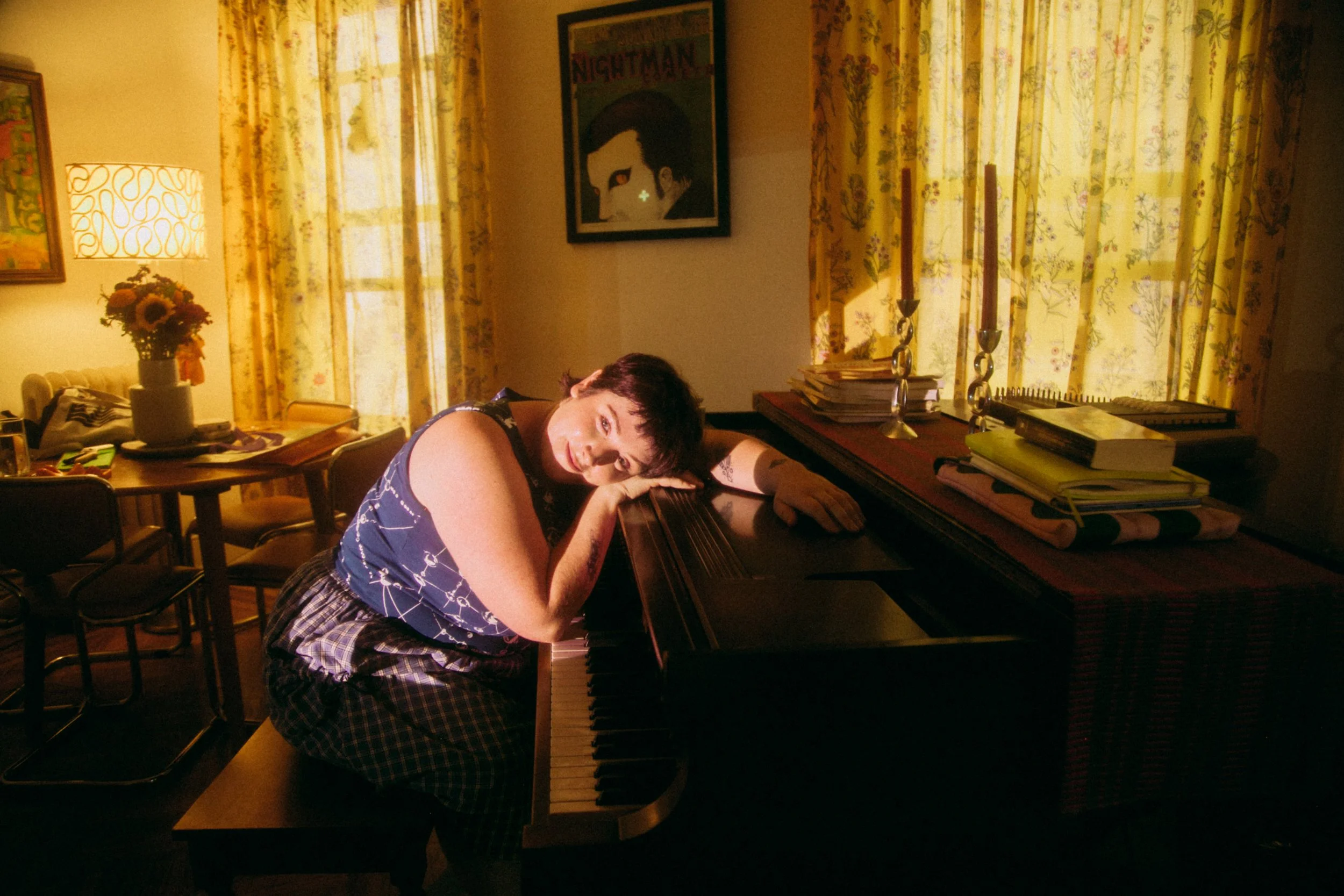
Photo by Sandy Honig
PUNISHER OF LOVE STANDS OUT WITH A HUMANITY-LEAD APPROACH—Through vivid storytelling and indie-folk production, Sweetbreads verbalizes her thoughts and anxieties that surround living. The songs touch upon a plethora of subjects that everyone can identify with, namely identity and relationships in all of their forms. Punisher of Love reminds us of how connected we are to each other.
Melody Stolpp, a New York-based singer and songwriter, is at the heart of the Sweetbreads project. Since she began her music career in 2020, she released two EPs titled Out of Range (2022) and Goodnight! (2023). Punisher of Love is a debut album rooted in collaboration, mainly with producer Quinn Devlin but also with Sweetbreads’ group of musician friends.
The opening track “Open Mic” sets the tone for the album with an emotional story about how witnessing a friend’s addiction made Sweetbreads reflect on her own addiction to success. The songwriting immerses the listener in the narrator’s universe. On a string production, she unfurls the complexities of making it in life as an artist, but also widens it to encompass the human experience.
“Punisher of Love,” the title track, is a personification of the artist’s anxious attachment. Throughout the song, she details the ways in which she’s overthinking and compares it to being a ticking time bomb. On “Satisfy,” she considers others’ perceptions on what seems to be someone’s ideal life and how that pressure affects the person. “Empty” looks inward at the spiraling that occurs when the life she imagined appears off track.
“Sea Change” grapples with the difficulty of making a decision between staying or leaving. “Ben” picks up the pace with an honest recounting of missing someone, knowing there’s no possible reconciliation but still struggling to let go of the person. “Two Steps Forward, One Step Back” considers the differences between generations and the complexity of closing the distance between members of a family.
The record closes with “The Anvil,” a joyful track celebrating connection and ending the album on a high note. It ends on a cathartic repetition of “You are good,” a reassurance for people who are unsure of where they’re at. While there isn’t a specific answer to all of life’s questions, Punisher of Love offers a place for people to find understanding and compassion.
Luna caught up with Sweetbreads for the release of her new album Punisher of Love, out now.
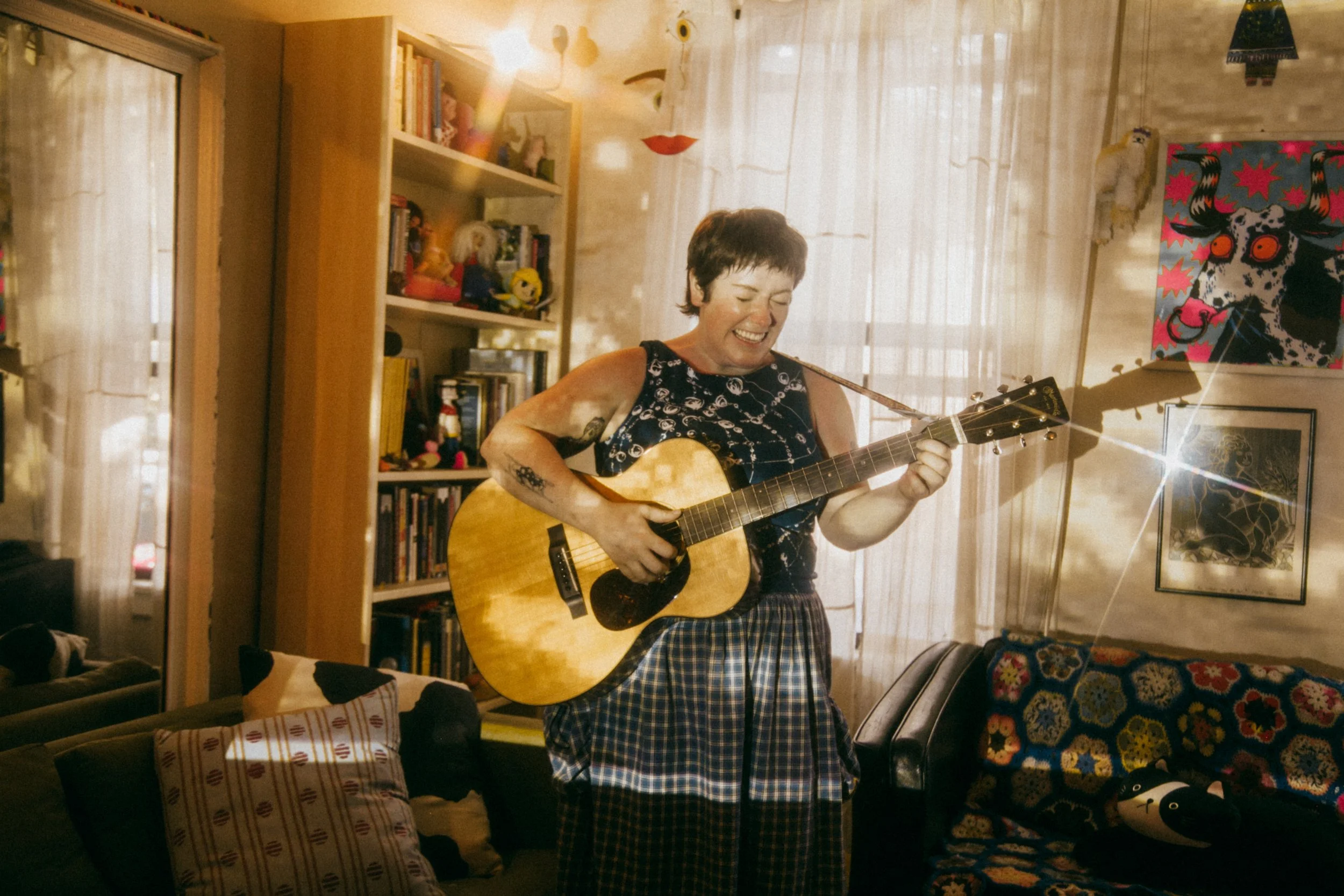
Photo by Sandy Honig
LUNA: Could you introduce yourself?
SWEETBREADS: My name is Melody. My project is called Sweetbreads, so that's what I go by. I live in New York City, and I've been writing songs for over 10 years, playing in the city for a long time. I'm going on my first actual tour in a week, which I'm really excited about, with my friend Jacqueline Hackett. I have my upcoming record coming out on September 25.
LUNA: Congratulations on the release of “Open Mic.” I really love how it’s almost five minutes long. I felt like it was an experience I was immersed in. I usually listen to music while I do other stuff, but here I stopped and listened.
SWEETBREADS: That's a huge compliment. Thank you so much for stopping to listen. It's an intense story. I'm very proud of that song. I wrote it with my friend Nick Watt. We both feel strongly about how that song encapsulates a lot of what it's like to be a person in the world. I wrote it mostly for songwriters, but I think there's a lot about it that can be widely related to. Mostly for creative people that are struggling, but everybody has their struggles. Everybody's trying to get by. Everybody deals with addiction. Everybody is trying to make ends meet.
I don't know if I'll ever write a song as good as “Open Mic” again, but we're very proud of it. I'm really happy what you said about it feeling like a whole world too. There's been a trend [of] short songs, so sometimes I'm like, “Maybe there's not a place for this,” or “It's a little too moody.” It means so much that you listened and you felt engrossed in what we were saying.
LUNA: You spoke about how this track was inspired by witnessing a friend deal with addiction. Do you often get inspired by real life situations, or do you find inspiration in other places as well?
SWEETBREADS: Yes. I write a lot about things I see or experience, but I also tend to fictionalize them a little bit because it helps to create some separation for me. Of course, I changed my friend's name in “Open Mic,” “Satisfy” is another song that I'm really proud of. That was like a collage of different things I was seeing in my life at the time. The most direct song that I've ever written is probably “Ben” because I did not change the name in that song. I was really, really heartbroken when I wrote that.
I definitely draw from life. I draw from what I read a lot. “Open Mic” is based on a poem. I had this rough night with my friend. I kept ruminating on it. I felt out of control in that situation. I didn't know how to help her and I was at this open mic like, “Why am I even here? Why are we doing this?” And I didn't really know where to place the feelings. Sometimes when something like that happens, I tend to think about it long after the fact and replay it in my head. Then I found this poem called “Watching My Friend Pretend Her Heart Is Not Breaking” by Rosemary Wathola Trommer. That poem made me think of that night. It helped me put my own thoughts in an order where I understood them more. The line with swallowing stars, it's not directly from that poem, but it's obviously an idea that's lifted from that poem. Sometimes when I'm having a hard time processing, something that I've put in the back of my mind is like, “I do want to write a song about that.” Reading and seeing different artwork, all of that can help to make sense of and put all my feelings into context.
LUNA: There's a lot of metaphors in the lyrics. Do you have one that you know you resonate with more?
SWEETBREADS: “Swallowing stars” is the line that I'm most proud of. I don't think I would have been able to come up with that if I hadn't come across that poem. “Nipping at God's heels,” I do really like that line. I was thinking of desperation and when you feel like your life is out of control, you're pleading for relief. That's where that idea came from. Nick came up with “Kicking up dust, watching storm clouds form / Why is dying easier than being born,” so I really am proud of that whole chorus.
Nick and I wrote [the song] half and half. His daughter was born right before we finished that song, so when I brought it to him, he was still processing his wife giving birth to their daughter. She was so young, she was crying while we were writing and he was like, “It's so crazy her organs are still being formed and that's why kids cry because it's super uncomfortable.” That's when he came up with that line, “Why is dying easier than being born?”
“Open Mic” is a perfect snapshot of where we both were at that time. He was probably feeling more optimistic having a newborn child, but it felt like this perfect blend of circumstances and all these different things happening at once that created that song.
LUNA: I love the fact that witnessing this moment of your friend's addiction made you think about your own addictions about success. I thought that was so interesting because it's not something typical that we see or that we think of when we think of addictions.
SWEETBREADS: Being obsessed with creating and having a creative career is so hard to sustain now. Especially because you have to keep thinking about yourself through a lens because you're always trying to promote yourself online and keep churning out content and creating a story for people. It can, on its worst days, make you feel pretty narcissistic or you can fall into narcissistic tendencies.
Watching my friend go through something really hard and not knowing how to help her, and also having to accept that she's an adult—I couldn’t find immediate relief and it made me think about my own pursuit of music. I was at an open mic, feeling like a cog in the wheel like, “Why am I insisting on even being here when there's other things I could be focusing on?”
There’s also the feeling of being in my 30s and, even at the time I was writing it, more of my friends were progressing in their actual careers. I was feeling self conscious, like maybe I'm holding on to something I should be letting go of. All of that stuff came into play when I was thinking about my friend and how I was trying to make space for her to just be in that moment.
Photo by Sandy Honig
LUNA: You said in the lyrics, “We all carry a heavy load.” It's really difficult. As an artist, you feel behind when it comes to life. Even though you shouldn't compare yourself to other people, you still do. There's a lot of overthinking about, “Should I give up? Should I do something else?” Ultimately, doing what you're passionate about is better than doing something that's not bringing you happiness.
SWEETBREADS: In a lot of ways, being a creative person is harder than ever, just because of the economic disparity. In some ways, it's always been hard to be an artist and I don't think that we're told those stories enough. I was talking to a friend once, and she told me that she read in a book that artists either work day jobs, have a patron or come from family money, and that's how it's been forever. The model hasn't changed at all. It's interesting how societies have always taken art for granted, but then we all need to experience art. Why is this the art form that people just think should come for free all the time?
LUNA: I'm curious about how you wrote “Open Mic” because it feels like a story unfolding, like it was done all at once.
SWEETBREADS: It took me so long to write this song. I knew I had the first verse and it is very much about what happened that night, but finding the poem and working with Nick, all of that had to come together in order for it to really solidify as a song. Especially the bridge. I remember not knowing what I even want[ed] to say in that part, but knowing [it] has to be about hope and encouraging people to carry on and talk about their experiences. The bridge was also something that Nick lit the spark for with the “angels crying out.” I came up with the line about the heavy load and I was like, “Is this too on the nose? Is it too corny?” It's been nice to see that it hasn't been received that way.
LUNA: Were you scared of releasing this track?
SWEETBREADS: I've been playing it for a while. It took a long time to get a plan together to make an album, and then after we had the album recorded. It's been about a year and a half since then. When I first wrote it, I changed my friend's name because I was worried. I didn't want her to feel like I was targeting her or that the song wasn't coming from a compassionate place. It's funny because later I posted the song and she called me. She was like, “Is that song about me?” And I was like, “It is, but you know I love you.” I was a little afraid. I'm always a little bit afraid when I write a new song that feels confessional but that's a thing most songwriters will tell you. If you're afraid to touch it, it's probably the thing that you need to write about. The feeling behind it was that everyone’s protected in the situation. No one's named and it was something that made me think a lot and made me feel a lot.
LUNA: Who are your sonic influences?
SWEETBREADS: I grew up with '90s country and musical theater. My mom listened to '90s country. My dad's a musician, but I feel like when we were in the house, he was mostly playing chill music because he was always out at night playing rock music. I spent a lot of time in the car with my mom so I grew up on Martina McBride, Faith Hill, Wynonna Judd and Reba McEntire. So many of those songs are deeply embedded in my brain, the women of '90s country and the country hits at that time.
I was a huge theater kid. I pretty much only listened to musicals until I was in seventh grade, and then I realized that maybe I was a loser for doing that. I found an indie radio station that I really liked and that was when I developed more of a taste for indie music. I got really into Joanna Newsom. She's so beyond in my eyes in terms of songwriting. Musical theater like Sondheim, Rodgers and Hammerstein; those are the two big ones for me. I love Company. I love Sweeney Todd. I grew up listening to Oklahoma! and I was in it a bunch as a kid.
All those songs are so beautiful. The lyrics are so simple but eloquent, and I was really attached to the stories. I remember specifically getting the cast recording of Wicked without having seen it and listening to it on repeat, trying to figure out what the story was in between the songs. That had a lot to do with my lyrical and melodic sensibility. With theater, you write in a way where it seems very conversational, and even the melody is informed by the way people talk, the rhythm that people talk in. I nerd out about that with my friend Haley. We're always talking about how pentameter is a huge part of writing that people never talk about, but when a song makes sense and it’s easy to hear the lyrics, it's because it feels like a conversation.
Photo by Sandy Honig
LUNA: Let's talk about your album, Punisher of Love. How would you describe it?
SWEETBREADS: I would say it's a little campy. We had a lot of fun recording it. I'm definitely a music maximalist because I loved those lush orchestral recordings as a kid. A lot of times, I want to add more. Dynamics are a big thing for me. There's a lot of that on the album. I'm really, really proud of this work. It’s a collection of songs from a pretty long span of time. There's not a song to me that feels like a throwaway. I think all of these songs are great in a lot of ways, and I had so much fun making it with people in my community, like my producer Quinn Devlin—I love that guy. I feel like we've become like brother and sister through this experience and you can feel that in the songs. Many of them are intense lyrically, but there's a bubbliness to the production. There's fun in it, even though it's a lot of heartfelt stuff. It's very sincere in the lyrics.
LUNA: Do you have a song that you're really excited for people to hear?
SWEETBREADS: I'm really proud of “Open Mic.” There's a song called “Sea Change” on the album that I think is so beautiful. My friend Sarah plays fiddle on it and it's got this buoying sound to it that's beautiful and meditative. I'm really proud of that song. I just didn't think it was single material, so that's one that I hope doesn't get lost in the sauce. I hope people will listen to the whole album.
There's a song about my family called “Two Steps Forward, One Step Back.” That one I'm also very proud of, and the arrangement's so beautiful because it was the last song we did for initial tracking for the record. Quinn wanted me to come in and show the band the songs for the first time so that was the last song I wrote before we recorded. I was embarrassed about it. I was a little worried that it was too on the nose and too obvious. When I brought it in, everyone in the band was like, “Wow, that song is so lovely,” which was nice to hear because I was insecure about it. We all sat in a circle around one mic and did a live take so what you hear is a full take. We did it around three times and then we were like, “We've got it.” That felt like a really magical way to end the recording with that lovely group of people. After four long days in the studio, it just felt like an intimate, special way to end everything.
LUNA: What are you most excited for when it comes to this upcoming year?
SWEETBREADS: I'm excited for these tours. I'm hoping to plan some more touring, and I'm excited to share the songs with people. Whenever I meet people at shows, whether it's the other bands that I'm playing with or people in the audience, I find it so cool that music can bring us together like that. Whenever I feel like my community is expanding, it just makes me feel happier to be in the world. That's the big one.
I'm excited to promote this record but I’m ready to move on and write new material. My favorite part was recording this record. That was such a high that it took me so long to put it out because the rest of the work to put it out wasn't nearly as fun or fulfilling, and it was isolating. I'm excited to start that process again.
