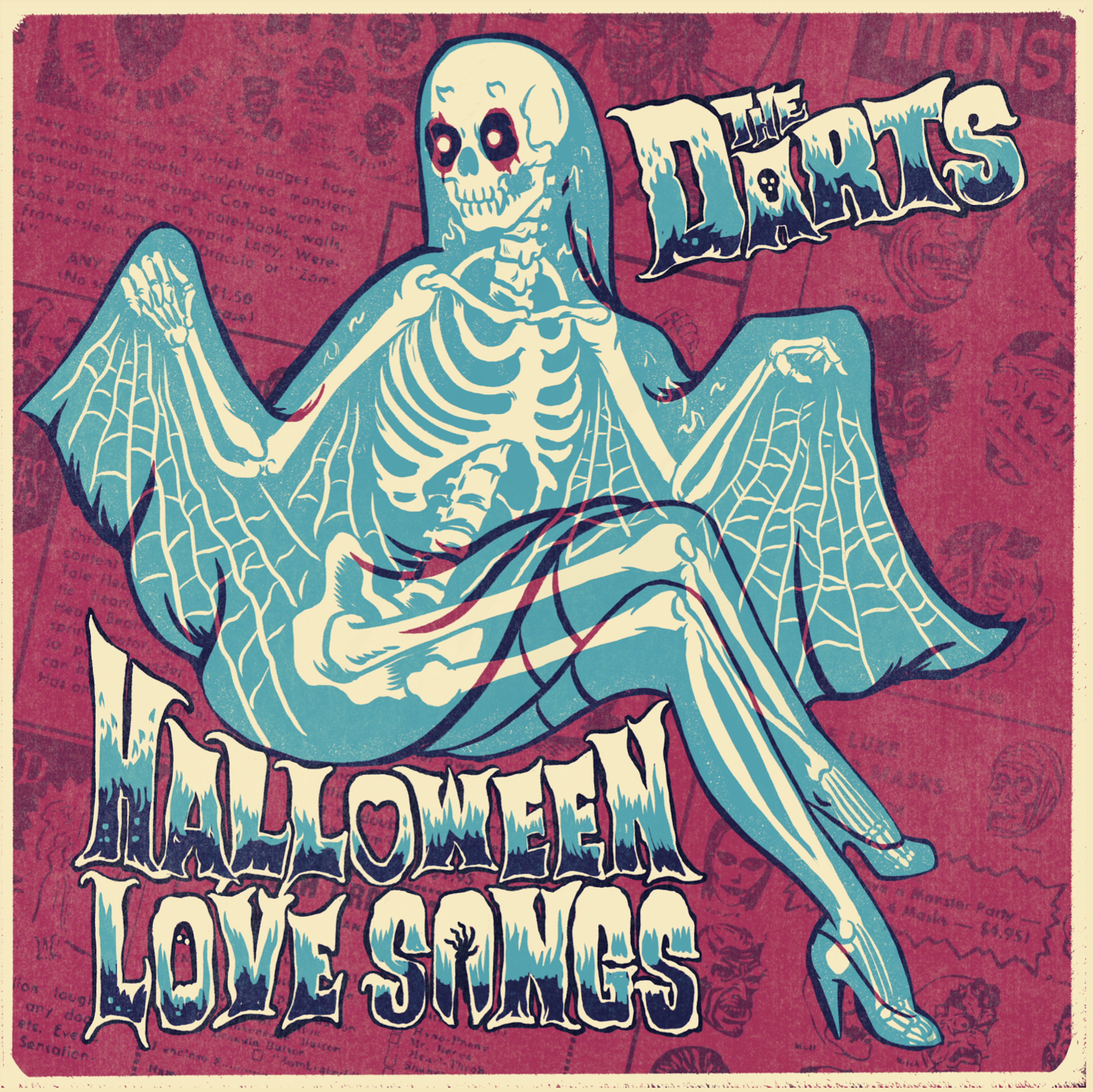
Q&A: The Darts Embrace the Darkness in ‘Halloween Love Songs’
INTERVIEW
INTERVIEW
☆ BY KIMBERLY KAPELA ☆
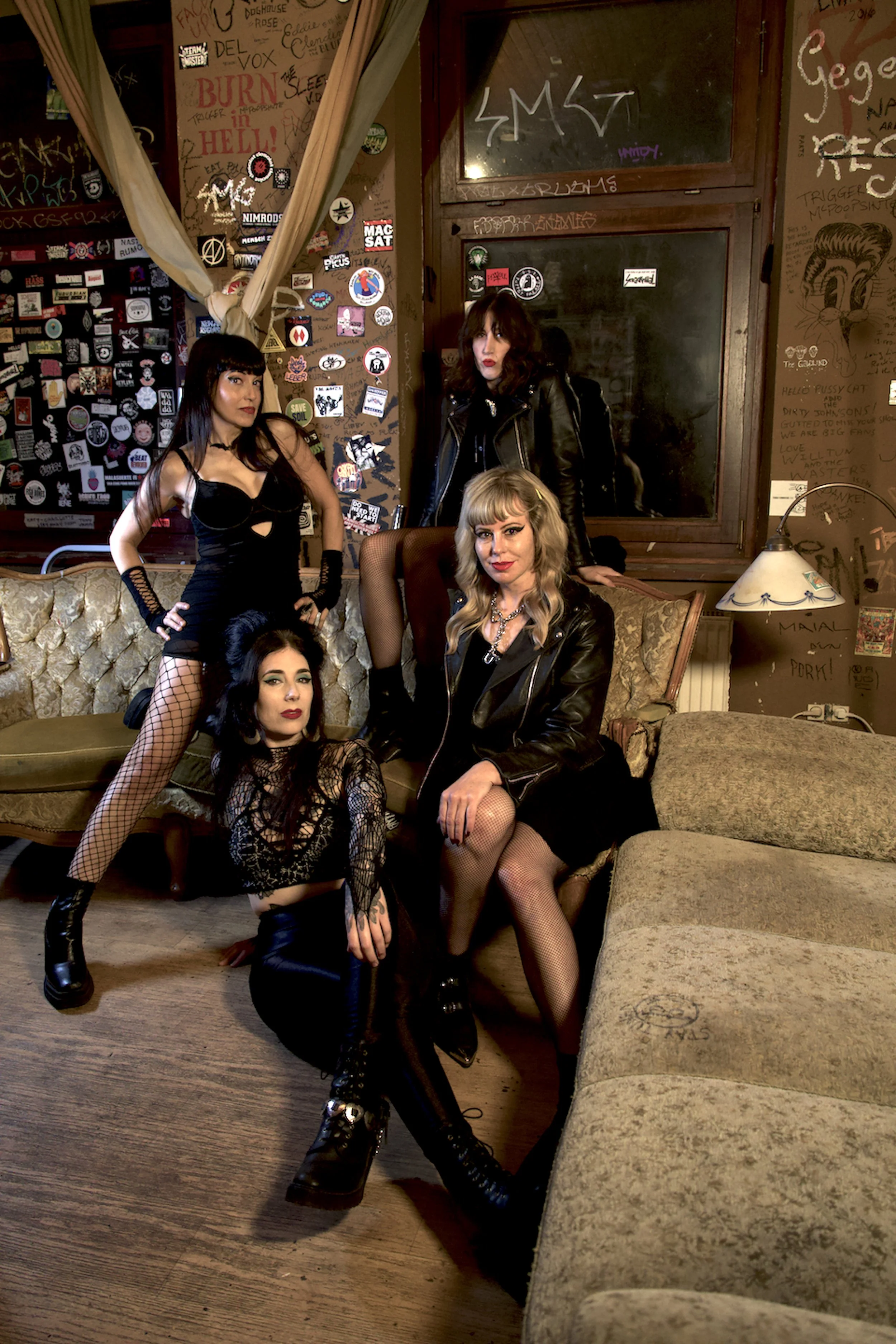
Photo Credit: Tina Gross
MONSTER LOVE SONGS FOR THE WITCHING HOUR — The Darts deliver a love letter to the darkness and to the night itself with their newest album, Halloween Love Songs. Immersed in monster love songs, dark ballads, and stories of what happens after the trick-or-treaters go home, the Seattle all-women garage-rock road warriors lean fully into the shadows. This isn’t a novelty record built on plastic pumpkins and costume-shop camp. It’s the sound of lipstick smudged at midnight, bonfires burning low and amps humming long after the porch lights flick off.
After a decade of tearing up stages across the globe, The Darts return sharper, heavier and more cohesive than ever. Produced by Mark Rains at LA’s Station House Studio, Halloween Love Songs captures a band operating at full voltage.
The spark for Halloween Love Songs ignited during a 2024 interview with Rock n Folk in Paris, when singer and keyboardist Nicole Laurenne joked that Halloween deserved more than one throwaway anthem.
“I didn’t want an album that was just monster-costumes on the playground,” Laurenne says. “Side A is full of colorful, early-evening energy, the kind of songs you could blast while the neighborhood lights are flicking on. But Side B is the soundtrack for after dark, when the bonfire is raging. It’s for sweaty middle-of-the-night dancing, making out on a bed of empty candy wrappers, and spinning through an all-nighter apocalypse.”
That dusk-to-dawn structure gives the album its narrative backbone. Side A struts in with “Midnight Creep,” already road-tested across continents. Tracks like “Zombies on the Metro” and “Every Night Is Halloween” expand the early-evening palette, driven by Nicole’s Farfisa grit, Rebecca Davidson’s guitar snarl, Lindsay Scarey’s low-end punch, and the heavy snap of returning original drummer Rikki Styxx.
Side B is where the night deepens.
“Apocalypse,” inspired by the medieval Apocalypse Tapestry in Angers, France. Cuts like “The Devil Made Me Do It” and “Darkness” push the band into heavier garage rock territory with a pulse and a shadow, still wired to The Cramps, The Trashwomen, The Seeds,and Death Valley Girls.
With Halloween Love Songs, The Darts turn the night into their own playground. After a decade on the road, they’ve made a record for dancing in the dark and losing themselves until dawn. When The Darts step into the night, they don’t just play it, they own it.
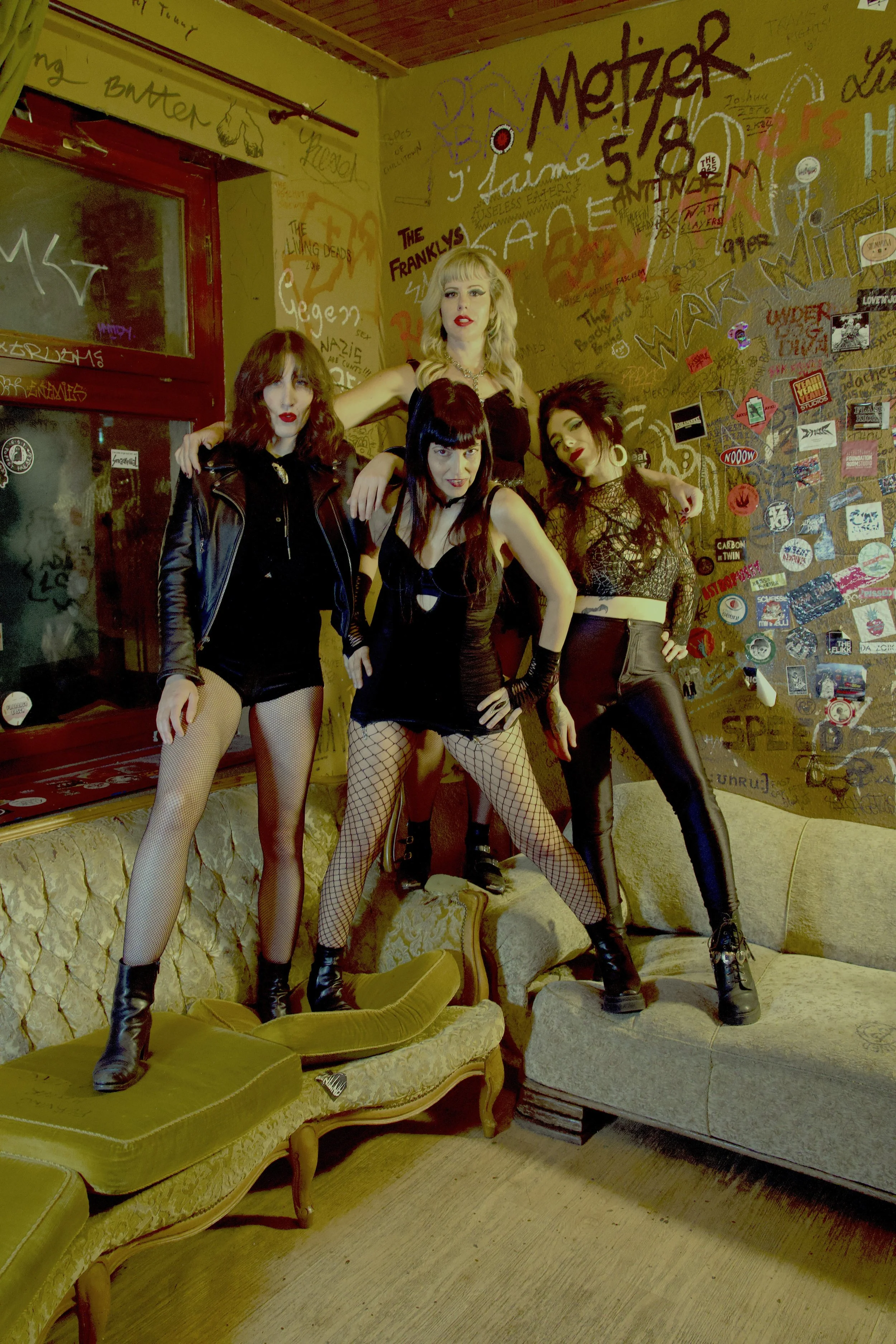
Photo Credit: Tina Gross
LUNA: Thank you for talking to Luna. Our readers would love to get to know you and your music more. For any readers who aren’t familiar with you yet, what inspires your artistic style and sound?
NICOLE: Literally everything. I am always writing songs, whether I'm in the van or in a hotel, it's just everything that goes on around me I can synthesize into some creative sound. For The Darts, I pull a lot of my inspiration from 60s garage, 70s punk. There's some Dead Kennedys, Stooges, Cramps and L7 in there. It spans a lot of genres, and I want it to be timeless sounding so it appeals to a bigger set of ears, so it doesn't really niche into one genre. Somebody called it spooky kitten garage rock and I think that's where we're at.
LUNA: The Darts are about to release its seventh album Halloween Love Songs and huge congratulations! It feels like the band is fully locked in. What inspired the album and what thematic ground or emotions did you feel drawn to explore this time around?
NICOLE: This is the most ridiculous story. I was doing an interview while we were in Paris two years ago with Rock n Folk magazine, and the journalist and I were joking that nobody's written any more Halloween anthems since “Monster Mash,” and it's time. We can't just have one song for that holiday. I left that interview, and my brain started going, I should be writing a Halloween themed record. I immediately got to work, I started writing. And then as time went on, I realized I wasn't only writing these Monster kitsch 60s-inspired Halloween songs. I touched on a lot of darker, rebellious, fuzzier inside of Halloween, like after the trick or treaters go home and you do the big bonfire and everybody's wrecking stuff, there's music for that too on this record. Side A is the kitsch and Side B is the darkness.
LUNA: Halloween is often about masks and alter egos. Did this record give you permission to explore sides of yourselves you hadn’t fully leaned into before? How does this record feel different from past releases?
NICOLE: It definitely follows The Darts formula. It follows The Darts theme. I would say this album, especially Side A is really fun, and that's new for us. Usually we're a little bit darker and a little bit more jaded in our lyrics, but I just had so much fun writing monster songs. We got “Vampires in Love,” we've got “Zombies on the Metro,” we've got “Midnight Creep.” This whole world opened up that's just kind of tongue-in-cheek, hilarious to me, but still dark. We're having a great time with that every time we play these songs live. We've been touring them for the last year, testing them out and getting them ready for the recording and everything.
On Side B, The song “Apocalypse,” was inspired when I saw this big apocalyptic medieval tapestry in France in a castle, and the tapestry was made by a bunch of women back in the day. It's two parts. The top shows what the gods are thinking while the world is just being destroyed, and the bottom shows what's happening to the humans and the royalty. It's just this really, really sick piece of art. I left there going, ‘oh my god, I got to write a song about the apocalypse.’ Part of that tapestry idea was that an apocalypse is not all bad. You get to eliminate the bad stuff and have a do over and start over. Part of this song is the theme of the record is, I think you can find joy in the darkness, things are caving in, everything's blowing up, but let's sing, let's dance, and let's hope that a greater thing is coming.
LUNA: I would love to touch more on the creative process behind the album. You worked with producer Mark Rains at Station House Studio. What was it like bringing him into your creative process, and how did he influence the sound of the album?
NICOLE: This is our second time around with Mark. I was going through a really hard time way back, and one of the records that I've spun until, I swear the grooves are almost transparent now, was Death Valley Girls’ Glow in the Dark. That album got me through some stuff. I don't know what it was. It just hit me right at the right time in my life, and when it came time to record boomerang in 2024, I was going back through my records, looking for a producer, just to give things a new spin. I like to change things up for once a while. All our previous records were done by one of my heroes, Bob Hogan and it was co-produced by Jello Biafra. And after all that, I was ready to have a new take on this for the first time. I went back through my records, and I saw Glow in the Dark, and I was like, who did this record? And it was Mark and I immediately wrote to him. He immediately signed on. It was one of the easiest processes I ever did.
When we did Boomerang, I told Mark I really know exactly what I want. It was the easiest thing, and it came out sounding so cool and raw that when it was time to do the next record, we had to go back to Mark. We did the whole thing again in three days, two days for the band, and 13 songs worth of vocals and backup vocals in six hours. That's how me and Mark can work together. I can walk up to the microphone, and without thinking about it, he knows exactly what the vocal change should be. I was very lucky to have Bob Hogan in the past, and now I'm very lucky to have Mark on board.
LUNA: Do you have a personal favorite song on Halloween Love Songs — one that feels closest to your heart or most revealing of who The Darts are right now?
NICOLE: I'm a sucker for a great dark ballad, a ballad that is huge and fuzzy and hits just right. I love all the stuff on this record and we're having so much fun playing it out there. The very last song on the record is always a big ballad. This record has a ballad at the end that has, frankly, nothing to do with Halloween except vibe. It's called “Late Drive,” and it's just about what I do. I drive a lot on tour. I drive all night. I drive all day. I drive 12 hour shifts. I find myself on dark roads when everybody's asleep and it's totally silent. I'm driving on these dark, desolate, unlit roads, and you're tired, so things are wobbly, and there's this crazy thing that kicks in during those drives that's just really ethereal and really cool, where you feel a sort of peace, but it's still dark and it's still lonely. I wrote a song that captures that finally. When I played it for the band, they were like, that's the song. We're adding it to our set list for 2026
LUNA: Looking back at the Nightmare Queens album , how do you think you’ve matured as artists and storytellers since its release?
NICOLE: Nightmare Queens was very unique, because it really was a compilation of songs that were on the sold out records, from the very first record all the way up until the brand new two new songs that are on that record. It really tracks the entire career of The Darts, so you can really hear the evolution of The Darts’ early days. Half the band was in LA, half the band was in Phoenix. I wrote part of a song. Michelle, our guitar player at the time, wrote a couple songs, and we just mashed them up together. I would go in after hours for that first record and get on Pro Tools by myself and record the parts, and bring in my bass player and record the parts. It was really raw. We added so much distortion to the vocals, we added overdrive. We wanted to sound like The Trashwomen meets The Stooges, and it did. We didn't think about it. We just went in there. If I had a riff, it went down. If I had a lyric, it happened as we evolved and the band got bigger.
Obviously there was a little more pressure to put a little more thought into things, and especially when I met Jello Biafra, his first comment was, there's too much fuzz on the vocals. Clean up those vocals. Your voice is too good to have all this fuzz and distortion on there. Who are you trying to be? So we dialed back a little distortion, especially on Snake Oil. The one that Jello worked on is a broader range of genres you can hear. You can hear a much wider range of influences as the band goes on. It's no longer just garage. It turns into classic rock, sometimes there's even an 80s keyboard line that you can hear bopping around over a distorted guitar riff. There's a lot of evolution that's happened, but the theme of using a spooky chromatic riff will never change. You can hear that throughout.
LUNA: How do you hope listeners — especially your femme audience — can connect with or find power in this new era of music from you? What emotions or messages do you want to leave with them?
NICOLE: That's such a beautiful question, because we just got back from Hawaii, and every night on tour, for once, the front row was all women of every age. There were little girls there, there were teenagers screaming and dancing. There were people older than me. I felt so hopeful. Women always needed an outlet for our angst and our disappointment with the world and there's a lot of quiet anger that needs a place to go, and angrier music doesn't always speak to me because it's too on the nose.
Sometimes I feel like as women, one of our best traits is our ability to diffuse conflict and our ability to bring people together. Two of us in this band are mothers and we spend a lot of time with our kids, trying to make their lives better and help them through the rough spots. I feel like our music is doing that. We're trying to do that for our audiences too. We're not just trying to hammer a message home. We're trying to have fun with it and bring you in with our love and our joy and our dances and our sing along and all that, but then quietly whisper the message in your ear at the same time, so you walk away with that message in your heart, and you're singing it, and you realize, oh my gosh, I'm singing a protest song right now, or I'm singing about the sadness that you feel when people don't notice you or listen to you. And that's what our songs are about. They're just tucked in there in these sort of more spooky, joyful songs.
What do I bring for women? I think, first of all, you got four women on stage who I specifically select always, no matter what the lineup is, to be the best musicians I know. We don't rehearse, we get on stage, I send them the tracks, they learn them at home, and we meet in Spain and we go on tour, and they're ready for a festival without any rehearsal. The rehearsal is the sound check. And with that level of talent, I want women to realize that we can do that and we do it all the time in this band. We write all the songs ourselves. We demo everything ourselves. We produce everything ourselves. There's no reason ever why a woman shouldn't be able to do this stuff. When we left Hawaii, actually, one of my favorite comments was probably by somebody who was about 17. She was gothed up and as she was leaving the merch booth with our signatures all over her face, she walked away going, I'm starting a band.
LUNA: When you feel a creative spark coming on, what do you need in your space to nurture it? Are there any rituals, objects, or energies you always return to?
NICOLE: I write wherever I am. I also have a solo project, Black Violet, that's a jazzy trip-hop, that's also touring all over the world. With both bands, they'll tell you that I sit in the van with my headphones on, and I'm just writing, and by the time we arrive in Germany or wherever we are, there's a song that's done. All their parts are written, it's ready to go. If I have those two things, my headphones and my laptop and some suffering, it just pours out no matter where I'm at.
LUNA: How are you feeling in this current era of your career and what does the rest of the year look like that you would like to share with Luna?
NICOLE: I'm feeling on top of the world and I don't say that lightly, because I spent many, many, many years producing pretty good music, but never feeling as solid as I do now. It took a lot of work to get here. It took changing the people in my life and getting rid of a lot of substances, and being vegan, and taking care of myself on a lot of levels, but mainly surrounding myself with people that get me and want me. They don't compete with me. They don't try to keep me back. They don't make me want to make myself smaller. They really want me to succeed and to make more stuff, and they want to be part of it, and they want to help put it out there in any way they can. Now that I'm surrounded by people like that in both of my bands and my entire team, my agents, my publicists, it feels so good and different.
We just did our preorders for both of my bands yesterday, and the US preorder supply in LA sold out in one hour. We're all just running around trying to get them restocked and and like, when that happens, there's no better moment in your life where you feel that people understand what I'm trying to do here. 2026, if I survive, will be the best year of my life because the tours are incredible. We leave on tour with Black Violet, my other band on March 6, and pretty much from that moment, The Darts and Black Violet hopscotch, recording and touring the entire year until December 6. It is non freaking stop.
We've got to figure out gear. I've got band mates that can do some tours and so people are setting in, and it's just a lot of preparation. In the middle of all of it, as always, we're going to stop and do a new record for each band in the studio in August. We're going to see all of the US with both bands and all of Europe. We're spending two and a half months in Europe in the fall. We're going to be in the UK. We're going to be in Japan, and Australia is coming together. I have high hopes for this year, but honestly, it's all gravy. I feel like I've met my biggest goals in my life and everything that happens from here, I'm just grateful for.