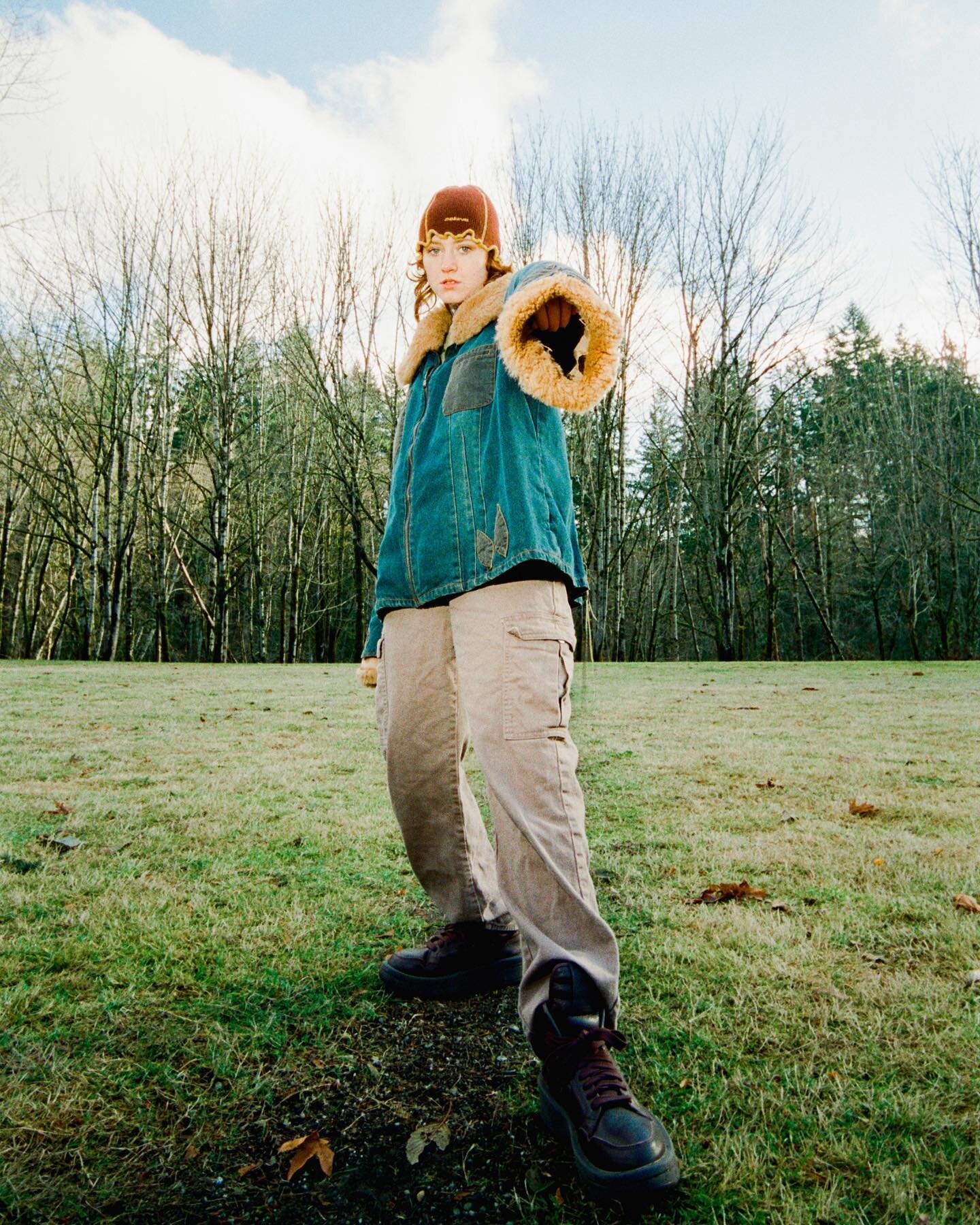
Spotlight: Feng Suave Embraces Absurdity to Make Sense of Existential Dread

WHEN THE QUELL TO YOUR EXISTENTIAL DREAD IS IN TOWN — what do you do? Feng Suave’s crowd in Brooklyn is uncontainable: they’re interactive, jumping up and down to the music; they’re adoring and ecstatic to be here in the presence of the Daniëls, and who wouldn’t be? Videos taken at each of their performances across North America serve as undeniable evidence.
Daniël Elvis Schoemaker and Daniël de Jong compose the Dutch musical duo Feng Suave. Following their funky, lo-fi debut song “Honey, There’s No Time” going viral on SoundCloud five years ago, the duo has only gotten bigger since then, with millions of listens on almost every song they’ve released.
Feng Suave’s resounding influence on listeners around the world comes from their nonchalant existentialism, comedic despair, and pleasant-sounding, melancholy-laced nostalgia. Their music has a dreamy, ethereal quality, anchored by riveting guitar riffs, use of reverb, and delay effects to create a sense of space and depth, as well as emotive vocals that draw keen listeners in. But with closer examination, lyrics about existence and the passage of time and reflections on detachment, uncertainty, and resignation will strike a chord in most — even if they don’t want it to.
Brilliant, personal music transcends the biggest global shifts and helps bridge the reality of before and after. The duo’s experience performing on stage remained the same pre-pandemic to post-pandemic, but de Jong mentions that while touring and playing live is still hectic, they’ve gotten better at hiding their nerves. Their tour in 2022 commemorated five years of making music — this was their first tour in North America.
While performing live, it’s the candid honesty of self-doubt and regret in Feng Suave’s music that holds the crowd hostage. Even so, the duo leaves their lyrics up to interpretation, as some listeners find real solace in the cheeriest stanzas. “If the irony goes over people's heads, that's fine,” Elvis says. “If they enjoy the music, that's cool. I just hope it feels a little bit personal.”
The seamless blend of indie rock, alternative rock, and dream pop speaks for itself and is often purposefully ironic.
“The music doesn’t always sound that sad — for instance, in ‘Toking, Dozing,’ if you don’t listen to the lyrics, you can easily think that this is a very happy-go-lucky song,” de Jong explains. “But I think we like contrast. Even in serious songs, I remember laughing really hard. Like saying, ‘I’m just a bug.’ Irony is what justifies the vintage approach to songwriting. It makes it more 21st century.”
This laid-back mentality toward how their lyrics are perceived is the same one applied to their general songwriting process. “Usually, the first lyric is the easiest one because it's just something that sounds right,” Elvis says. “And you've got a couple of words, you're like, ‘Oh yeah, I guess that kind of means something.’ And then the middle part is slowly add[ing] to the first sentence, like trying to distill some kind of topic. Then the last 10% of the words are the hardest because you [have] to fill in the gaps.There were some moments where there were big gaps and we were about to go record the vocals [but] we didn’t have the lyrics yet.”
“Yeah, especially because we're Dutch,” de Jong adds. “[English] isn't our first language so we don't mind saying bullshit. Usually when you're jamming you're saying random shit. Dan [Elvis] is usually the lyricist. He's more of a poet and he reads more books. I just sing, and there were two songs that I did on my own: ‘Day One’ and ‘Show Me.’ [With] ‘Show Me,’ I had all the lyrics — there was just one line before the song transitions into the last chorus, and I was in the studio recording the vocals. Dan was sitting outside and I texted him, and he figured [the line] out last-minute. That was in the crunches of time pressure.”
Of all the songs, “Toking, Dozing” happens to be one of the duo’s favorite songs lyrically. It might be the first song in existence to take into account the afterlife of dolphins, yet again displaying Feng Suave’s pioneering spirit in songwriting. In contrast, they pull inspiration from various time periods of music — from soul to boogies to jazz — to embark on their sonic journey.
In an interview with Clash Magazine, Feng Suave revealed that their most recent EP, So Much For Gardening, was done fully on cassette tapes, a process which compelled them to think of music from the ’60s and ’70s differently. “It’s a limited way of recording music,” Elvis imparts. “I think what we’ll do in the future is a hybrid approach because you lose a lot of freedom of editing [and] post-recording when you go to tape, and when you stay in the computer that gives you more freedom to be very nitpicky about takes and specific moments of their coding.”
In “Honey, There’s No Time,” Elvis had written the main riff when he was 15, which didn’t progress into an actual song until the duo began playing it together. Feng Suave tells The Line of Best Fit that together they added bass lines, vocal melodies, a bridge, and keys. The composition of the duo’s masterpiece sits idly until the time is right; it is an organic, unpretentious process in which things fall into place when they are meant to. Every chorus, every riff, and the underlying harmony of their compositions are seemingly predestined for greatness — things come and go as they are meant to.
One bears witness to the natural, inevitable evolution of their growing skill in creating meaningful music as their discography grows. While songs from their first, self-titled EP such as “By the Poolside” have a surf-rock, laid-back, sun-drenched sound that evokes a carefree attitude and relaxation, the newer their work gets, the less it bears resemblance. In So Much For Gardening, songs such as “Tomb For Rockets” have a more introspective, serious tone accompanied by an experimental and alternative rock sound.
While both have a similar theme of escapism, the methods employed in attaining freedom are different. “By the Poolside” conveys the idea of enjoying life to the fullest and living in the moment to escape all semblance of guilt, mistakes, and responsibilities. The speaker turns to a romantic relationship, one of physical intimacy to compensate for the overwhelming detachment they have from the rest of the world.
On the other hand, “Tomb For Rockets” explores a person who feels disconnected from the world around them, as a lost wing stands for an essential component of someone’s life going missing. They are on a collision course with dawn, a difficult time in their life in which light will be shed on sharp edges. Looking for answers in the sky is a futile quest, so they turn to music to escape their current reality.
Such drastic changes in theme and lyricism are accompanied by more adjustments in melody. Reggae and indie were big influences on Feng Suave’s latest release, So Much for Gardening, but the duo have been experimenting with all kinds of genres.
“When you make music for a little while, like we’ve been doing, you start to realize that you can basically rip off anything and it’s kind of like yourself,” de Jong explains. “That’s what I found out — at least to a degree, of course — but in the end it’s not going to be as different as you think it is. In your mind you’re thinking, ‘We’re going to use a synth arpeggio,’ but in the end, your fingerprints are all over it. It’s really difficult to really change your sound.”
Once Feng Suave uploaded “Sink into the Floor” to streaming platforms, the rest was history. “We woke up and had, like, 30K streams,” de Jong describes. “We were like, ‘That’s huge!’”
Today, they’re close to a million listeners every month. “That was the high of my career — [that was] the way it felt,” Elvis explains. “I remember we were on your [de Jong’s] balcony. You were living in a ship tenement yard. We were talking about how when you upload music, it doesn’t show the amount of plays up until a certain point when you hit 1,000. Fresh music is less than 1,000. And we were like, ‘Oh, I really hope we can get past 1,000 — this looks dumb.’ And a night later, we had 30K. Nothing beats that feeling.”
The duo still feels like they’re working toward something bigger. Even if the number of listens has quadrupled, that isn’t what they’re focused on. Feng Suave wants to attract the right crowd, hear from other musicians about their work, and continue to perfect their craft.
“Some days, you’re just going through the demos,” de Jong divulges. “You’re like, ‘This is going to be our best work yet.’ But other days, you’re like, ‘Oh, I got nothing. Nothing. Yeah, trash. Start over.’”
Feng Suave is always trying to up the ante, even if it’s ironic. The pursuit for better music and better performances is incessant, as the two best friends continue to raise the bar for themselves.
“Playing, we’ve gotten a little better,” de Jong says, reflecting on the duo’s comfortability on stage. “Post-pandemic things were better than pre-pandemic things — the shows have been more fun in that regard. I still find playing live and touring pretty hectic, but it’s alright.”
The venues, however, are a far different experience. “We’re more used to Europe,” Elvis adds. “Wedges are the same as microphones. American venues are pretty well equipped and the sound is pretty good. In Europe, it’s different in every country. UK is very tough and Switzerland is very comfortable. Houston was really fun. I really enjoyed the crowd in Portland — we were [supporting] Men I Trust so those rooms were huge. It doesn’t really count because it’s not our own audience. But it was cool because you can make it your own audience.”
That’s how it always starts out. You never know what to expect when you wake up the next morning: who you will encounter, where you will go, who you will be. By luck, you meet someone who will leave a lasting impression, regardless of the final destination for either party. By chance, you might end up becoming the man from Texas who attended all three of Feng Suave’s Texas shows. No one asks to be the biggest fan in the world — in the top 0.00001% of listeners — it just happens; innate connection cannot be faked.
Feng Suave’s music is a serendipitous discovery for many listeners, often found through the mysterious algorithm of streaming services. Their emotive and thought-provoking lyrics reflect on the folly of the world, delving into themes of existence and the passage of time. As a result, the band has amassed a dedicated fan base that is drawn to the honesty and humor of their music. WIth every concert, they leave a lasting impression on their audience, reminding them of the unexpected and profound impact that music and art can have on one’s life.
As they continue to release new music, it’s clear that the crowd in concert halls will continue to grow, filled with people in search of solace and better understanding in the face of the world’s absurd complexities.