
SPOTLIGHT: Jess Williamson’s ‘A Mile South of Heaven’
REVIEW
REVIEW
☆ BY EMMI SHOCKLEY ☆
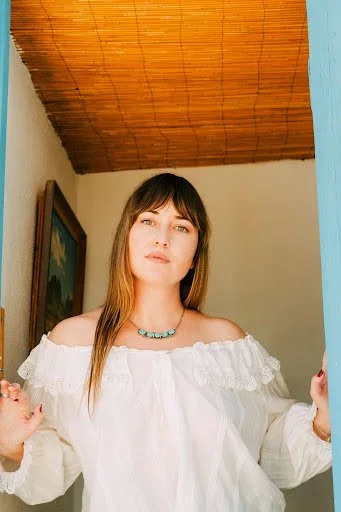
JESS WILLIAMSON IS A SONGWRITER’S SONGWRITER — Her sixth studio album, A Mile South of Heaven — out today via New West Records—is Williamson in peak form. The record covers a sprawling terrain, and from those expanses she crafts an album’s-worth of poignant vignettes, each laden with the sharp-eyed specificity and unabashed earnestness that has become so characteristic of her work.
When I got the chance to speak with Williamson ahead of the release, she joined the video call with the same infectious enthusiasm and warmth I’ve seen from her onstage, even as she sat alone in her Los Angeles living room. LA is where the Texan musician lives one half of her life. The other half is settled in Marfa, and this dual-city set up is central to the narrative of this new record.
I ask if she’s been doing tons of press, and she tells me that she did just hang up with another journalist right before our call, but “it’s such a joy to talk to people about this album. I’m thankful to get to talk about the music.” Williamson has been steadily releasing music since 2014. She’s an artist who’s worked extremely hard to get where she is, and it’s clear that she’s proud to be putting out this record — as she should be.
Williamson’s writing is heavily inspired by her reading habits, and it shows. There’s that “I read you Raymond Carver by the pool bar like a lady” hook from the title track of her heavily acclaimed 2023 album, Time Ain’t Accidental. She tells me she was reading Pam Houston’s 1992 short story collection, Cowboys Are My Weakness, while writing some of the songs that would make their way onto A Mile South of Heaven. Williamson describes the collection, set in the American West, as stories of “women who are in love with wild men. Or—unpredictable men.” She went on to say, “Something about the energy of that short story collection was inspiring to this album. It’s in there.” She also cites the fiction of Texas author Larry McMurtry, the writings of Carl Jung, and Alejandro Jodorowsky’s The Way of Tarot as consistently inspiring.
And of course, there’s Joan Didion. The new record opens with Williamson’s homage to the writer, a track entitled “Goodbye To All That.” She tells me about the morning she woke up to the feeling of being completely “done with LA,” and making the decision to move back to her home and family in Texas…for good. She started writing what she thought would be her own “Goodbye To All That,” a song in the tradition of Didion’s “leaving New York” essay by the same name where the author famously made clear, “it is distinctly possible to stay too long at the fair.”
“I wrote it pretty fast, all in an afternoon,” Williamson says. In writing the song, she reflected on her chapter in LA—the time she wasted “tiling a rental.” The friends she didn’t meet. The lonesomeness of it all. But then she got to the third verse.
She says she started to cry as she wrote the lyrics, “Goodbye to the dreamers, the poets, and their songs.” She was reminded of a show she’d seen a few nights before at The Troubadour—an artist (now friend of hers) named Loren Kramer —that completely blew her away. She realized she wasn’t ready to say goodbye to those poets and their songs. “I have a complicated relationship with LA,” she tells me. “It's not home. But there is something about it that feeds my artist self.”
Directed & Edited by Rocco Rivetti. Director of Photography: Gilles O’Kane
That song and its moment of decision (or lack thereof) set the tone for the rest of the record. From there, A Mile South of Heaven takes on the feeling of a road diary—one that memorializes the well-traveled stretch of highway connecting the dueling gravitational pulls in Williamson’s life: West Texas and Los Angeles. Within these stories, Williamson is our narrator pulled between two places, two ideals. She’s yearning for a sense of home and a love back in her native state of Texas, yet she’s insatiable in her desire for transience and independence. On “Hum of the City,” she sings, “I’m back in room 12, and I miss you like hell. But I feel so at home all alone in hotels.”
Recently, Williamson even adopted a two-mile stretch of that highway.” She wrote on her Instagram, “Two miles outside of Marfa, heading south on 2810, you’ll encounter a two-mile stretch that I hereby declare the unofficial Mile South of Heaven (it’s two miles, but you get the idea).”
I asked Williamson about the ways her life has changed in the three years between Time Ain’t Accidental and now. She speaks of the confidence she feels when she’s back in Marfa. “I wrote a lot of this album there, or inspired by that place. I feel good there; I feel like me,” she says.
She also gives credit to her experience touring with Time Ain’t Accidental, saying, “I toured as much as I could. I think it was the experience getting to play bigger rooms and people singing the songs back to me. I always go to the merch after the show and talk to people. It was so empowering to experience people connecting with my songs. When I started writing the next one, I think I just had more confidence.”
Plus, she acknowledges that on this new record, she moved away from the breakup material that fanned the flames of Time Ain’t Accidental. In her words, “I just had other material to work with.” And it’s true, she covers a lot of narrative ground. On “Tracking the Tropics” (my *current* favorite song on the record), she writes of a tumultuous touring experience set against the backdrop of an incoming hurricane. She remembers, “I was in a hotel lobby, eating the crappy breakfast. Drinking the bad drip coffee in the paper cup and going through some stuff—in my head about it. Then I looked up at the TV, and it said ‘Tracking the Tropics.’ And that’s how I was feeling. Like a hurricane was coming on.”
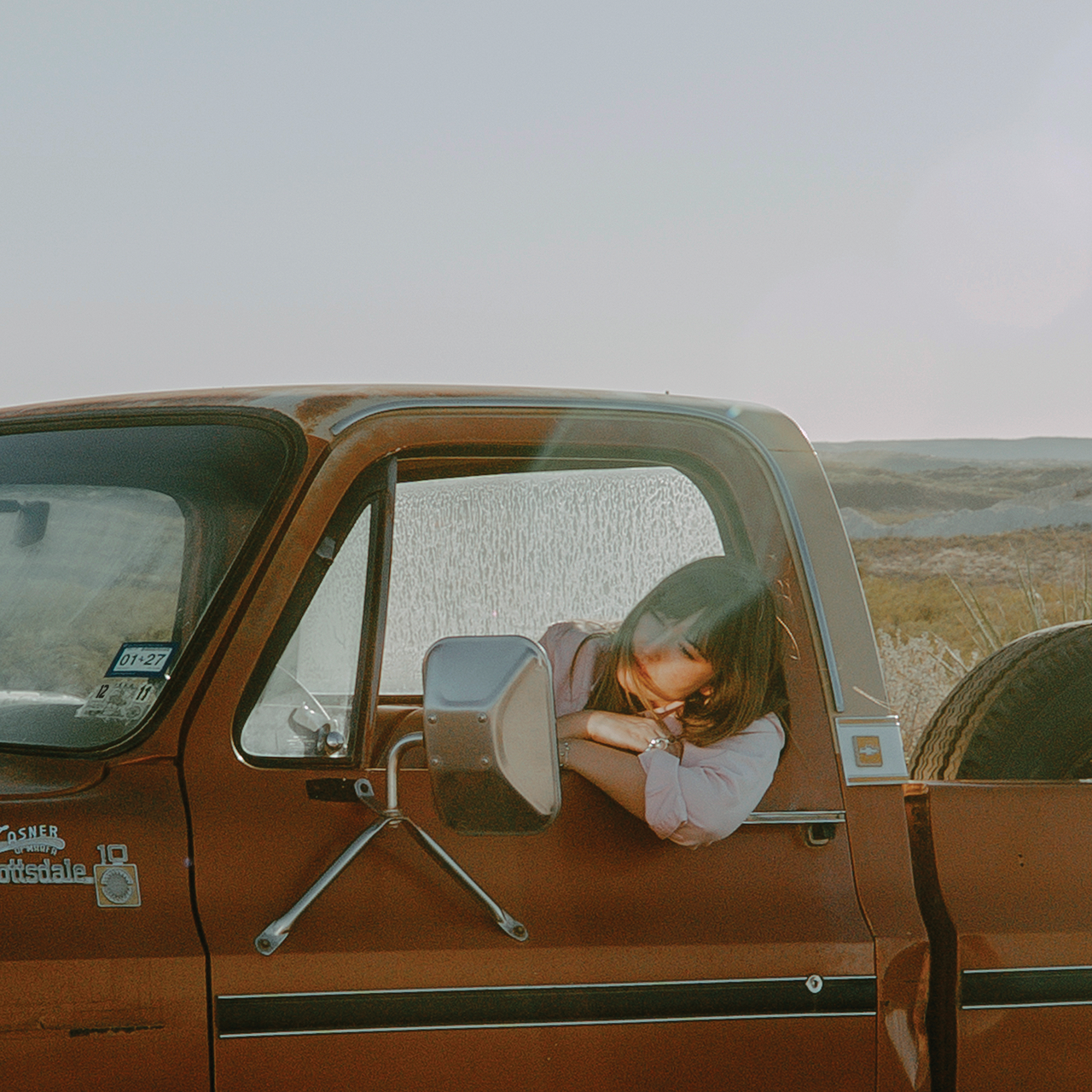
On the title track, Williamson sings, “Me and Jenny in the cab of her brand new truck. With the music loud, she was driving drunk.” It’s really memorable scene work, and she explains it as a vignette that combines memories of multiple different destructive friendships she’s had. “It’s Jenny’s truck,” she says. “She has the power, and I’m along for the ride, being carried along. The end of that verse says, ‘she had me tender as a bullet in a shadowbox.’ A bullet is something that has so much potential and power, but it’s castrated if it’s kept in a shadowbox. It’s a comment on a toxic relationship dynamic and a power imbalance.”
“A Dark Day in Dallas” opens with the lines, “I remember how you worked like money could save us, and how you weren’t so wrong about that,” which Williamson reveals is her talking to her mom. “The whole song is about the sacrifices she made and how hard she worked to take care of me. She lives in Dallas, and one day it'll be a dark day if I can’t go home, because it's not home anymore if she's not there.”
And of course, Williamson sings plenty about romantic love and longing, too. My favorite torch-holding moment comes on “Someone Else’s Horses,” the sexy, Badlands-style track when Williamson croons the refrain, “Hang me like a chain of precious metal round your neck. Tuck me in your shirt at night and take me to your bed. I know there is no substitute, I’ll take what I can get. Sleep upon your beating heart, covered in your sweat.”
A Mile South of Heaven stands as Williamson’s twangiest, most traditional country-forward record yet, and the Dallas-born songwriter sounds right at home here. The album was produced by Shooter Jennings, the Grammy Award-winning producer whose resume includes albums for Charley Crockett, Brandi Carlisle and Tanya Tucker, amongst a decade-worth of other collaborations. Williamson describes their creative partnership as one built on the utmost trust, so much so that at the end of their recording process, she let him completely take the reins on what would become their closing track, “The Gem and Mineral Show.”
“That’s a song I’d been living with for a while, playing it live on some of my solo tours,” she says. “It kept changing before I went into the studio. I even re-recorded my demo of that one with a drum machine, and I was like, ‘I think this is actually a bop.’ But I also had the previous demo where it was slow, and I showed Shooter both.”
Jennings proposed they take on the song with a “Bridge Over Troubled Water” approach, which Williamson admits was the last thing she was thinking. But she trusted her instinct to follow Jennings’ lead. “A song can go so many different directions in the studio, and there's no right or wrong, necessarily,” she says. “Now that I sit with that one, I realize it needed to be a slow song. And it needed to be the last song.”
And it did. “The Gem and Mineral Show” fades out with the album’s parting words, sung atop a gorgeous, sustained fiddle line, “You don’t have to tell me, I already know. I am a tourist here; I come, and I go.”
