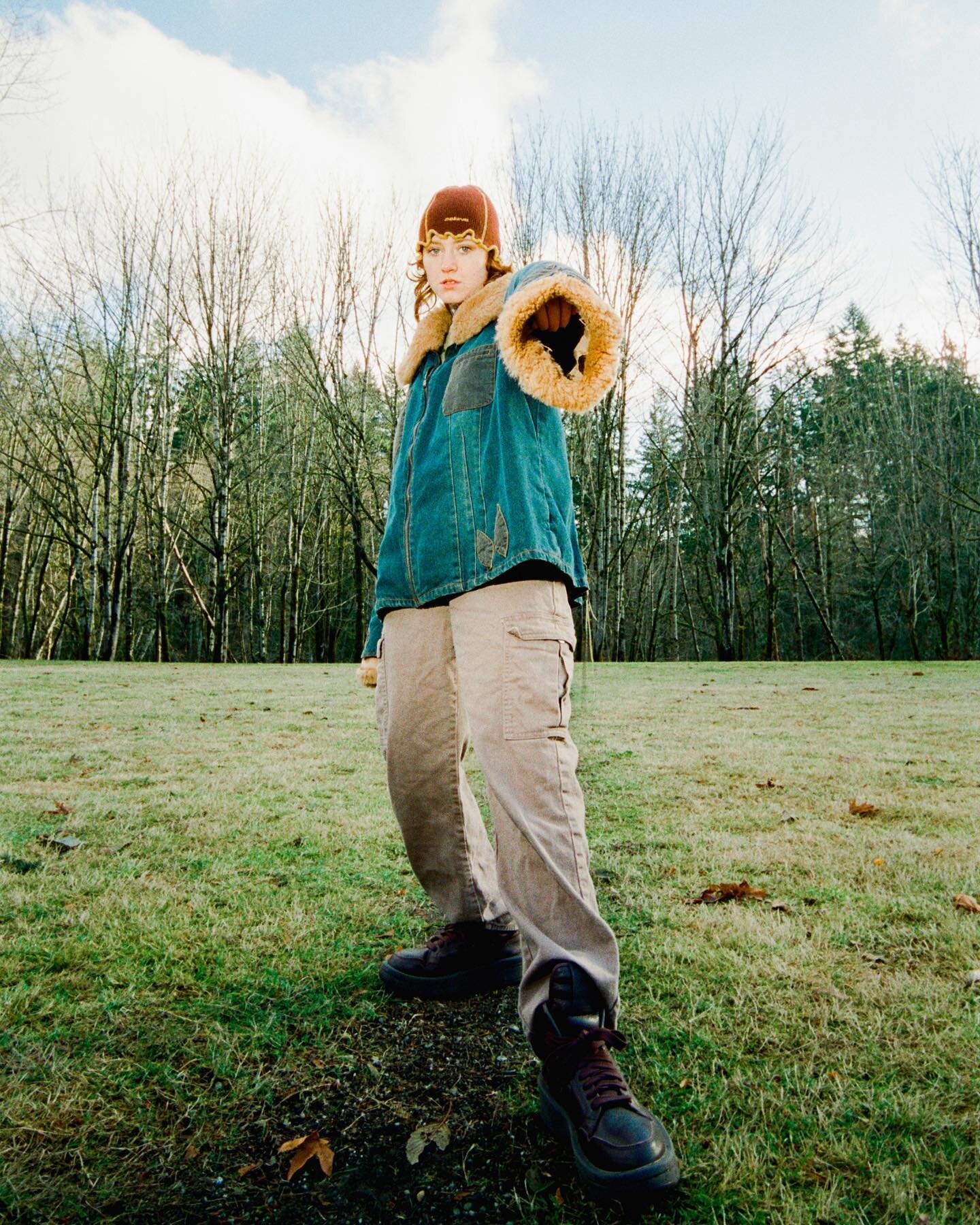
SPOTLIGHT: How Mei Semones Redefines Jazz With Lightning Precision

STANDING PRIMLY LIKE A LIGHTNING ROD ON STAGE — Mei Semones’ energy is palpable. Electricity flies from her fingers as she plays the guitar.
Most of the time, her gaze is averted to the strings of her instrument, a testament to how seriously she takes her performance. A few minutes before opening the show, Semones speaks to me about acclimating to the limelight.
“I used to get super nervous when singing in front of people, but that’s gradually gotten better,” she shares.
When she does look out at the crowd, energy floods out, like her eyes are a reserve and her lids are the gates. “Now I’m able to actually look at people, and see … ‘Are they having a good time? Do they like what I’m doing?’” she says. “I also like talking to people after the show. It’s nice to know my music is making people happy.”
Music has become the way Semones conveys who she is innately and what she feels to the outside world; her discography is composed of deeply vulnerable lyrics in both English and Japanese, about love in its various forms: unrequited, short-lived, and unconditional. The two songs on her latest EP, “Shinjuku” and “Okashi,” showcase dual perspectives on love.
Semones can only envision one life for herself, though — she can’t imagine doing anything other than music. “I’ve been playing guitar since I was in fifth grade,” she explains. “And playing piano since I was four. High school was when I realized I wanted to pursue music, and I haven’t really had any other interests.”
In addition to her dad playing the euphonium, Semones became inspired to play the guitar after listening to Chuck Berry in Back to the Future.
The musician professes that music has always been a driving force, bringing love and radiance to her life.
Fittingly, the Ann Arbor native attended Berklee College of Music and graduated with a bachelor’s in professional music, her concentration in guitar performance with a jazz focus.
Enrolling at Berklee seems to be divisive — many students find the academic setting stifling and consequently drop out. But Semones found the four years hugely instrumental in her development as a musician.
“I got a lot better at guitar when I went there,” she says. “I learned to practice more, learned a lot more about harmony. [I] improved my ear. I found that the academic setting actually helped me think of new ideas. In my classes, I feel like I was able to apply things I learned to my own art.”
It’s been nearly a year since Semones moved to Brooklyn to continue her career as a musician. A few months after settling in, she collaborated with John Roseboro, who had moved to NYC with the same intentions. The two released a cover of “Águas de Março,” a song by one of the jazz greats, Antônio Carlos Jobim.
The making of the “Waters of March” cover, however, pushed Semones to perform outside of her own comfort zone. “Working with John and his engineer, Hunter… they’re willing to just capture the moment — it doesn’t need to be perfect,” she describes. “It doesn’t need to be, like, completely in tune or completely in time. If it sounds good as it is, they can accept that. Whereas with me, I’m like, ‘If this is a millisecond late, it really bothers me.’”
As a jazz musician, Semones’ artistic behaviors and philosophy seem counterintuitive. When one thinks of jazz musicians, they might think impromptu sophistication and charming chaos. The genre has always been an ongoing give and take between musicians and the larger community, providing the framework for solos to bleed into group improvisations. Every syncopated rhythm is like an electric charge being delivered directly to the heart. Jazz declares it is alive, over and over again.
Semones’ charisma, however, lives in her meticulousness. “I feel like when I make music, I’m really picky,” she admits. “I really focus on the details and the specifics, and being like, ‘That needs to be auto-tuned.’” The harmony of her work is predetermined, exemplifying her dedication to the craft and controlling what she can to ensure that every piece is optimized to its best.
She crosses the two-way street of jazz with a different pep in her step; her music becomes an offering to the community. It’s not so much a conversation, but a contribution to those around her. It’s about who she is, what she feels, and what she wants to give to people.
“I feel like I’ve been really helped by it [music], both by playing and listening to it,” she says. “That’s what I want to give to people. They obviously are giving me something by supporting me.”
Through the encouragement of her community, Semones feels that her music has only gotten better with time. “I think the overall production quality has gone up, and we have more access to better, organized spaces and resources,” she explains. “And my comfortability as an artist… I’m releasing more of my songs. I think I’ve also become a better singer and have a band I feel confident performing with.”

Photo by Jennalynn Fung
Elsewhere Zone 1 seemed to serve as a benchmark of maturity for Semones’ musical career, too. Although jazz is characterized by improvisation, this show seemed to ask for too much autoschediasm.
Semones’ band was composed of Claudius Agrippa, Sun Leong, and Ransom McCafferty, who were flying into New York from Boston. Their flight had been delayed, and initially they thought they wouldn’t make it. Neither soundcheck nor rehearsal happened, meaning all of the musicians were completely reliant on the skills they had built up over the years.
Backstage, Semones is candid about the situation, expressing frankly, “It’s been really stressful.” She shares that the setlist for the show will be only songs that they’re comfortable with, things they have played before.
“For this show, I’m avoiding playing new songs because we didn’t rehearse.” Her words are tinged with disappointment.
Things change, though, as she plays a few songs on stage. She opens with “Kodoku,” her most popular release from her first EP, Tsukino, which is composed of a variety of vocal textures and strings, Brazilian rhythms, fingerpicking, drum brushes, and bouncy bossa nova beats. Her face is downcast for most of this song, as she adjusts to being in the limelight yet again.
Semones strums her guitar with purpose, making no mistake. She wears a shirt with camo details, as though she is on the hunt for perfection here, even when circumstances aren’t promising. While her soft grunge aesthetic seems to be antithetical to her sharp and exacting philosophy on music production, her voice reveals her vulnerability. Lyrics such as “’Cause I don’t wanna be another thing / That you will forget about / I don’t wanna be one of those names / That you can never recall” strike a chord within every listener.
There are cheers from the crowd after the song concludes, and eventually, she mentions that her parents are also present. “Tell them I’m a good musician,” she says to the crowd with a sheepish smile. Even before she had started singing, they stood in the back, clearly proud of their daughter.
With courage, Semones sings two unreleased songs that have a beautiful rock influence intertwined carefully with her signature, alternative jazz sound, as though a continuation of the heightening melodies found in Semones’ 2023 single release with KAI, “red.” In the middle of her show, she takes it upon herself to inform the audience that the band hadn’t had the opportunity to do soundcheck. But if she had never said anything, the crowd would be none the wiser.
They say lightning never strikes the same place twice. Semones (and science) disproves this myth.
Semones has been preparing for a scenario like Elsewhere Zone 1 all her life. The nerves and the stress she had been feeling are like rain droplets in the face of all her years of practice — a bolt. They evaporate immediately.
Semones stands like a pillar on stage, ready to take what she has been struck with and turn it into energy of her own. In her eyes, you can see the glowing wires; when she faces the crowd, there is a tangible feeling of warmth and admiration that grows among them. This is her jazz; this is her conversation — she is a conductor for human connection, a metal rod that aims straight for the sky and the heart.
Like the clock tower in Back to the Future, there is more than just one opportunity for lightning to strike. For Semones, she has rehearsed and refined her own work with such precision. She is ready for the lightning so that she can drive forward into the future and reinvent what we know as modern jazz.