
INTERVIEW
INTERVIEW
☆ BY EMMI SHOCKLEY ☆
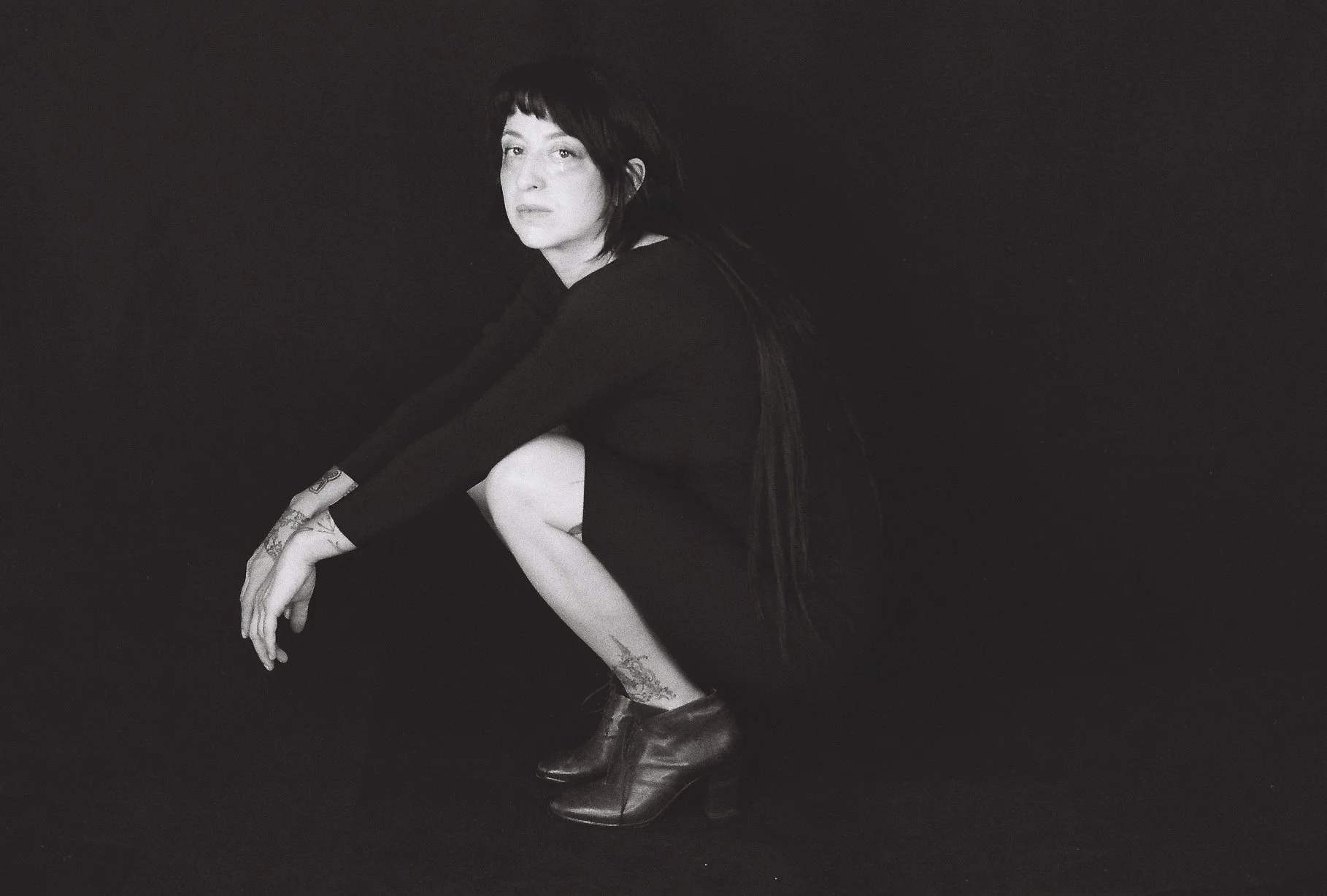
Photo by Alexa Black
MARCH 13TH MARKS THE RELEASE OF ORA COGAN’S NINTH ALBUM, HARD-HEARTED WOMAN—It stands as some of the Canadian experimental folk artist’s most fully-realized, boldly directed and liberated work to date. The artist herself has said of her current creative state that, “Something clicked where I really stopped giving a shit, and then things got really fun. The stakes are both high and nowhere at the same time. I can do whatever I want, and that has opened the floodgates.” This self-trust speaks for itself on the record. It’s well-earned, and it suits Cogan well.
I first encountered Ora Cogan’s music in 2023 upon the release of her eighth record, Formless. An old friend recommended her to me, and I can vividly remember sitting in front of my laptop screen, watching the “Dyed” music video for the first time. Put simply, I was spooked. Not spooked in a dread-inducing way, but in a way that startled up my undivided attention. I was completely enmired in the world she was crafting—this eerie, carnivalesque, riverbed ritual. Across all of Formless, I was entranced by her voice and presence. A fruitful deep dive into her complete discography (spanning back to 2013) ensued, and I’ve been listening ever since.
Cogan is self-invented in the truest sense. She admits she’s “always had a little bit of brattiness” as it relates to credentials. She dropped out of high school at fifteen to apprentice as a silversmith. She then carried herself on an array of odd jobs as she toured with various acts through the US and Europe, before anchoring herself in Vancouver’s noise and experimental scene. She’s a self-taught guitarist and fiddler, as well as a complex, intricate songwriter despite (or perhaps as a result of) never receiving formal music training.
Her trajectory hasn’t been linear either; she walked away from music for a few years in her twenties and turned her attention to boots-on-the-ground environmental advocacy and community organizing, before eventually moving into photojournalism. Her work as a photographer included some particularly striking coverage of young community organizers and their brutal arrests at the Fairy Creek Protests in 2021, published by outlets including Vice and Teen Vogue.
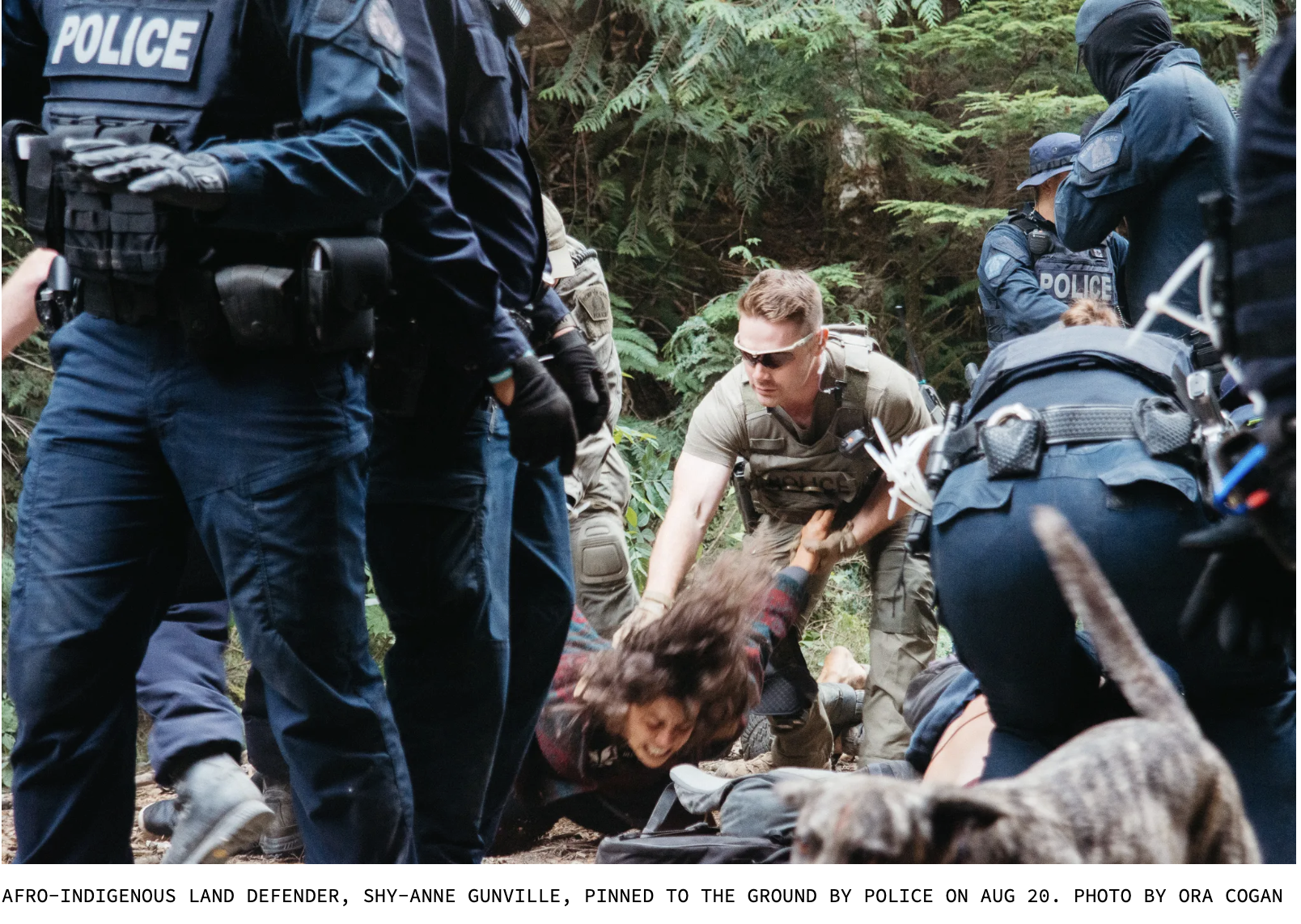
Ora Cogan photography via Vice
Hard-Hearted Woman, perhaps more so than any of Cogan’s other releases to date, reflects this aspect of her spirit. The album’s title feels like an intentional subversion, as the entire work rings out as a defiant refusal to grow hardened by the cruelty of our times. There’s a pervasive darkness that runs through the record, as is Cogan’s style, but the openness in her songwriting is the quality that continually cuts through the shadows.
Cogan has described 2023’s Formless as an album initiated by the grief of losing her father, and the work really does sound like an alchemized mourning. It’s exploratory and reflective, wandering through all the strange forms of bereavement—all the forms we’re forced to take on as we process. Where Formless introspects, reflects and works things out, Hard-Hearted Woman turns outward and opens up. Where Formless dances in the shadows, Hard-Hearted sounds like a blood-red daybreak.
“Division,” which contains the energetic core of Hard-Hearted Woman, conjures a rallying plea, but never a preach, as Cogan refrains, “Please, don’t listen. / Don’t give into the division.” The album further establishes Cogan’s songwriting breadth as she moves effortlessly from the slinking, incantatory “Bury Me,” with its relentlessly marching drumbeat and sticky, hypnotic lead guitar line, to the pastoral “Limits,” underscored by delicate finger-picking and birdsong field recordings. The record hits an unexpected highpoint when Cogan and her band lift into “Love You Better,” a swooning, twangy torch song where she croons a love-sick question, “You wouldn’t compromise for love, so where the hell would I fit in?”
From a production standpoint, Cogan’s vocals sound more upfront across these mixes than in some of her past releases, allowing her lyricism to ring through the reverb. One of my favorite lines on the record appears in “River Rise,” when Cogan muses, “You are like a shadow of the love I had in mind.”
Even after listening to Ora Cogan for these past few years, I’ve found it difficult to compare her to any other artists, contemporary or canonical. It’s a brilliant challenge for a music writer to run up against and another reason why my respect for this musician runs so deep. Sure, there’s a line to be traced between Cogan and Hope Sandoval as it relates to ethereal, celestial vocals (Cogan even opened for Mazzy Star in 2018), but still, that comparison feels surface-level. While both are otherworldly, Cogan’s otherworld is one of a darker, boggier mire.
I think the most apt connection should be made (and has been made by others, well before me) between Ora Cogan and Karen Dalton. Echoes of Dalton can be heard in the strangeness of Cogan’s soprano, and certainly in their shared storytelling sensibilities that snake between winking mischief and understated, gut-twisting utterings of grief. This line of comparison reminded me that both artists recorded covers of the same folk standard, “Katie Cruel,” in the early days of their careers. “Katie Cruel” is an Appalachian ballad from the perspective of a once-desired woman (often interpreted as a sex worker), now discarded and pushed to the outskirts of her former community. The song opens with the lyrics: “When I first came to town, they called me the roving jewel. / Now they've changed their tune, they call me Katie Cruel.”
The standard originally came into the American folk canon as a little, Revolutionary War-era “Diddle-ay, oh diddle-i-oh-day” marching jaunt, but it becomes exceedingly eerie in Dalton’s voice (for whom the story of Katie Cruel unfortunately now rings quite premonitory), and later when reimagined by Cogan’s psychedelic, doomfolk sensibilities. Ora Cogan’s rendition of “Katie Cruel” was the first single released from her debut full-length album Ribbon Vine in 2013, then appeared again in a new iteration a decade later on Formless. Across her discography, Cogan has covered a good number of centuries-old folk standards, including “Waterbound,” “Motherless Child,” and “I Wish My Baby Was Born,” but “Katie Cruel” is the standout: an emblematic, recurring, and transforming motif in Cogan’s body of work. On Hard-Hearted Woman, Cogan invokes Katie once again in “Honey,” when she introduces the record’s titular character. “You’re just a hard-hearted woman, gunmetal smile. / Guarding your heart, guarding your style. / Stars on your jacket, fishnet and heels.”
But even with her incorporation of centuries-old folk traditions, Ora Cogan isn’t an artist who harkens back. She manages to exist on an inventive, genre-defying plane all her own, marking Hard-Hearted Woman a clear standout against the outpouring of folk-inspired, alt-country indie rock of recent years.
The record is a serious accomplishment, but Cogan herself reminds us not to take her too seriously. When I got the chance to speak with her in the month leading up to her album release, her love for her bandmates and collaborators, as well as her pride in the fruits of their labor, was palpable through the Zoom call. She beamed from her sunny, plant-filled kitchen in Nanaimo, British Columbia: her beloved, artist-filled, chosen hometown on the east coast of Vancouver Island. She was in the midst of rehearsals, in the process of “figuring out what kind of ridiculous stuff” she and her band would wear on stage. Historically, Cogan is known to take the stage quite playfully: adorned with sequins and face glitter, alternating between guitar and fiddle next to an assless chaps-clad bass player, and surrounded by a band just as open to experimentation as she is.
Read on for Luna’s interview with Ora Cogan.
LUNA: What are your emotions this close to the release?
COGAN: I feel really excited to be back on the road with my band. I’m feeling a little bit vulnerable, too. It’s always a little vulnerable putting something out into the world. Especially this f*cking world.
LUNA: Are your band members and your circle of collaborators mostly based locally to you? Or do they travel in?
COGAN: They’re mostly here in Nanaimo. The city is really rich in musicians and artists. I work with Kris Bowering [on synth], who also plays with Orville Peck. He’s this force. And there’s Ida Maidstone, this dreamy, next-Julee Cruise angelic being. And there’s Nancy [Pittett, bass], and Finn [Smith, drummer]. Finn is twenty-five. He’s one of the best drummers I’ve ever heard in my life. He’s from New Jersey but ended up, by some magical chance, settling down here in Nanaimo. He went to jazz school here, and he farms. It was an anomaly for us. “Who’s this kid from Jersey who just showed up out here in the boonies?” He coarranged songs on the last two records of mine. He’s really engaged in the creative process. And Nancy is my ride-or-die buddy, our bass player. She’s the lesbian icon of the band, usually in assless chaps. She’s an incredible musician, and we love being onstage together.
It’s a big band, a five-piece, so there’s definitely been some flux of people coming in and out for tours. But the magic behind that, the truth of it, is that I believe this small city’s got this wealth of weirdos that are savant musicians. I’ve gone all over the place, but it’s here that I met the people who have made me a better musician.
LUNA: I had never heard of Nanaimo before this interview, but now I’m fascinated.
COGAN: It’s a failed mining town, and kind of like Twin Peaks. Well, it’s actually really like Twin Peaks. It's got a shit reputation. I think that’s mostly just classist. People will say Nanaimo sucks. And it's like, well, Nanaimo is working class. And it doesn't suck; it's beautiful. It's right on the water. You can get out into these beautiful, old-growth forests. Then there's this hodgepodge, awesome little music scene that brought me here. There’s a sense of community. I've been kind of hunkered down here for about four years, and that's when I started writing my best work and getting more settled. After being a bit of a road dog and restless for a lot of my life, it was hard for me to calm down enough to focus in the way that I needed to. And that’s what I'm doing here now.
LUNA: Would you say your community has been the fuel for this new artistic chapter?
COGAN: I’d say community and solitude. I’ve been a bit isolated out here and spending a lot of time wandering around in the woods with my dog, reading and not going out, not being distracted. Just being kind of lonely and mopey and brooding and writing.
LUNA: Did this album come to you by way of steady work, or did it come in more of a flood?
COGAN: A bit of both. I treat writing as a dedicated practice. I’m always writing and trying to be around for whatever comes up. But a lot of it came from the time just before the recording session, and the last throes of scrambling to feel ready for the deadline. All nighters in my room, crying and playing guitar. Having things fall apart to build them back together in the studio. Just, classic. But I love the pressure. I love getting all squirrely and weird.
LUNA: Which song off the record do you feel most excited to take out and play live right now?
COGAN: “Bury Me.” It’s so fun because we’ve already been playing it live. We can take it to a lot of different places. That's another nice thing about the people I work with—everybody is down to go off on tangents and pull energy into different directions and improvise. There's a lot of room in that one. It’s got some fire to it.
LUNA: Talk me through the inspiration behind “Honey” and your decision to lead with that song, both as the first single and the opening track on the record.
COGAN: It’s got mother vibes. The kids—they’ve been saying “mother” a lot. And I really like it. In my mind, the song holds a “don’t let them f*ck with you” energy. The sentiment is, “don’t let them f*ck with your head,” because it’s hard to do anything when your head’s messed up. I was trying to make something calming and fun, and not avoidant. Everything is terrifying and messed up, but there is some kind of witchcraft, or at least energy [in this song], that I hope feels grounding. I think about the ways I’ve seen people turn things around in the face of cops being brutal, this energy that I’ve seen at blockades all over the place, where people can stand up for themselves and say, “You are not the powerful one in this equation. You’re sad, disrespectful and weak.” That’s the energy [of this song] for me.
LUNA: That comes through. I feel the same way when I listen to “Division.” It sounds like a summoning of sorts. Or at least that’s the first word that comes to my mind. I hear this song and I picture people like, riding out from the hills. Was there a specific moment that moved you to sit down and write this song?
COGAN: I don’t think it was a specific moment. It was something I was brooding on for a while— just how easy it seems for people to lose their humanity. And to forget that mutual respect and dignity for the human and nonhuman world are so necessary for sustaining any of our lives. What’s that beautiful [Rumi] quote? It's something about “moving the way love makes you move, not the way that fear makes you move.” And just trying to lean towards justice and dignity and collective liberation in whatever form.
LUNA: I know you had a chapter of your life when you distanced yourself from music and shifted your focus to more on the ground environmental justice and human rights-focused work. That aspect of you feels so present on this record. Do you want to talk a bit more about that time?
COGAN: I was going through some kind of existential crisis, and I got rid of all my stuff and bought a motorcycle and started living on it and going wherever the wind took me. I remember sitting in this park smoking cigarettes, because I still smoked cigarettes, feeling really cagey because something else had gone wrong with this motorcycle. I was supposed to go on a solo trip down to New Orleans or something, then a friend texted me to say that they were short on pullers for this tribal canoe journey. The chief of their nation said it was okay for me to come along. It’s an awesome, powerful, cultural movement where people paddle from one community to another down the coast. So instead of going south on my motorcycle, I ended up going north with all these new friends and got into another canoe. And then we got to this feast in this little village called Hartley Bay, and it's very remote. We were at their community hall where people were talking about the Northern Gateway pipeline and how that would affect the coast if there was another oil spill. I think that experience got my head out of my ass. I was being pretty selfish up until then, and really focused on music and art, which isn't necessarily selfish, but you can get lost and forget that the house is on fire. So I felt this pull away from music.
I made a short documentary. I started volunteering, helping to organize—you know, grassroots kind of stuff. And then got into doing media and communications. I worked for an organization called Sacred Earth Solar that focuses on renewable energy and energy sovereignty led by indigenous communities. After stepping away from media and communications, I decided to follow in my dad's footsteps and move into independent journalism. I'd already had a lot of experience as a DIY musician, organizing community events, working with the press, doing all sorts of stuff that's actually weirdly transferable. I started going out to these blockades here on Vancouver Island during the Fairy Creek Protests. It felt right to put down the guitar and do something practical or helpful.
LUNA: What brought you back?
COGAN: When my dad died, it felt like the right time to start writing music again. I got more serious, and Formless came out of that. That felt like the first time I made an album where people were really drawn to it. It felt meaningful. Then I started writing Hard Hearted Woman from there, and here we are.
LUNA: Would you say there’s an overarching narrative to this record?
COGAN: I think this album is an extension of my own journey to move towards love and compassion and resilience and community. And absurdity.
