
Q&A: Red Head Redemption Are Throwing a Party at the End of the World
INTERVIEW
INTERVIEW
☆ BY DANIELLE HOLIAN ☆
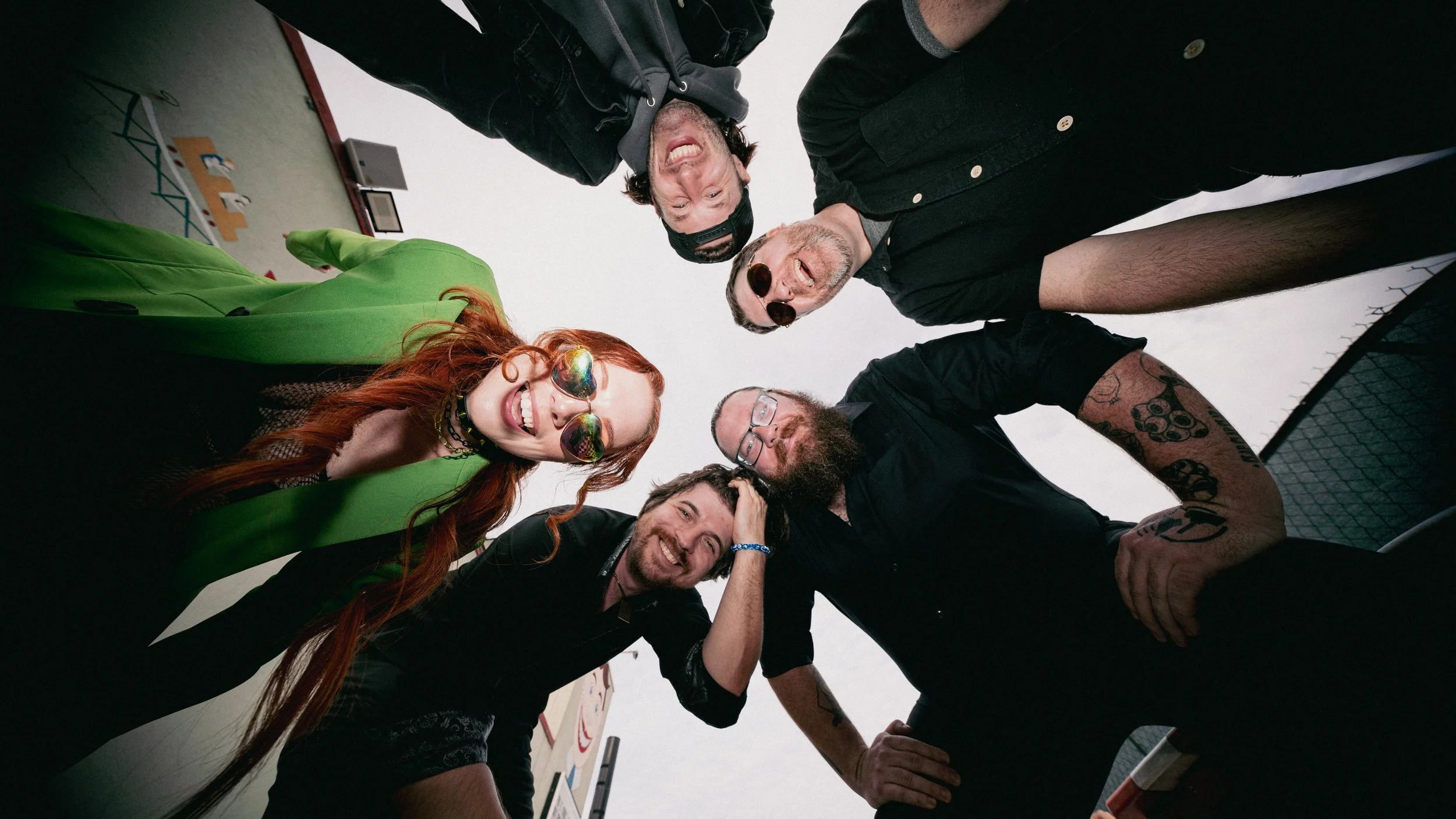
THERE IS SOMETHING INHERENTLY ABSURD — about trying to make sense of the end of the world. The headlines become apocalyptic, the language of crisis routine, alongside the climate warnings, technological upheaval and political instability, ordinary life stubbornly continues. We still go to work. We still fall in love. We still dance, make records, build friendships and worry about what to have for dinner. For New Jersey rock band Red Head Redemption, that contradiction is not something to escape, but something to turn the volume up on. Their answer is “End of the World Rock,” a combustible collision of rebellion, humor, anxiety and unapologetic rock n’ roll.
Their latest EP, Sunny With A Chance Of Fallout, exists within a space between catastrophe and celebration. Red Head Redemption’s songs confront corporate power, environmental collapse, technological acceleration, political instability and the creeping dread of a future, but they refuse to let those subjects drain the life from the music. There is satire here, but underneath the jokes is a deeply sincere belief that joy, love, art and human connection are worth defending.
That philosophy is best embodied by “Armageddon Beach Party,” a song whose irresistible hooks and tongue-in-cheek dystopian imagery conceal a much darker observation about the world around us. Red Head Redemption imagines a future in which even disaster can be monetized, where fallout warnings arrive alongside advertisements and survival itself becomes another opportunity for corporate branding. Their fictional Nile Tech Industries, complete with the slogan “We Own Everything,” gives the EP a surreal corporate villain worthy of a comic book, while reflecting a reality that feels difficult to parody because reality itself has become so strange. The band meets that absurdity with mockery, but their laughter is never detached.
Across Sunny With A Chance Of Fallout, that tension between the personal and the planetary becomes central. “Race Against Time” turns the apocalypse inward, confronting the quieter terror of reaching the end of a life without having truly lived it, while “Jolene” finds something almost rebellious in the simple desire to love and be loved despite everything happening beyond the self. Together, these songs suggest that Red Head Redemption’s apocalypse is not ultimately about destruction. It is about deciding what remains meaningful when the structures around us begin to feel unstable.
Luna caught up with Red Head Redemption to unpack the philosophy behind their “End of the World Rock,” the personal experiences that shaped the EP, the fictional mythology of Nile Tech Industries and their New Jersey roots.
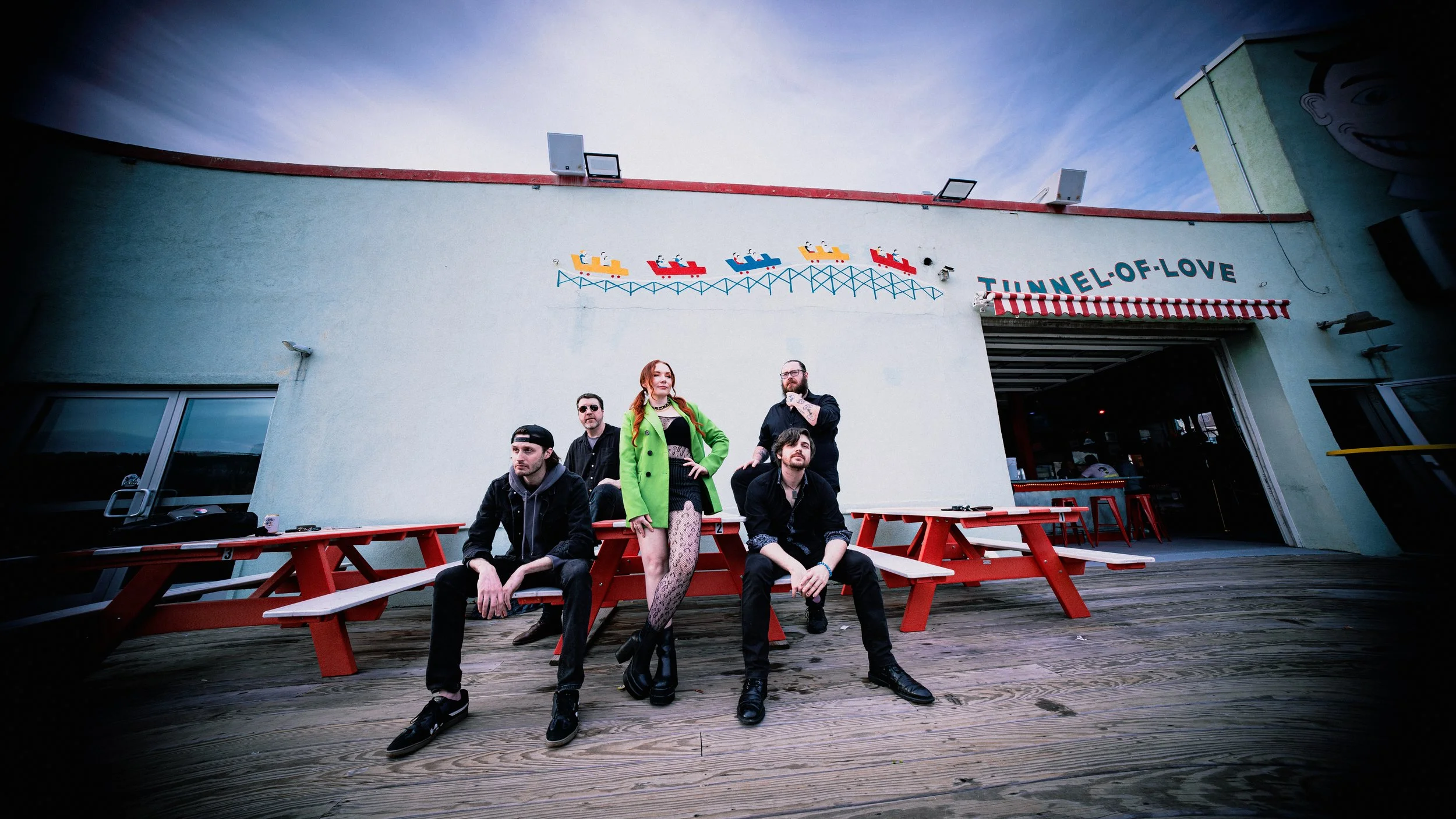
LUNA: You describe your sound as “End of the World Rock.” When did that phrase become more than just a description and start feeling like an identity for Red Head Redemption? What does it allow you to say or explore that a more conventional genre label doesn’t?
RHR: It was after we wrote the EP where our sound started to shift towards this feeling of rebellious celebration in the face of end-stage capitalistic collapse. When we wrote our first EP, Fatal Femme, we were in a space of writing a different fictional reality that leaned more femme fatale/film noir. It worked well, but what dug at me as we continued making music while simultaneously watching the world get much harder to live in was having an anthem worth singing to strangers that confronts what we all feel every morning when we wake up: Will the world be ending soon? Should I be enjoying my life more and worrying about shareholder value less? Rock and alternative often pushes you into a crowd where you feel alive. Facing Armageddon? That pushes you into a crowd and makes you fight like hell to save what’s worth saving. Both are adrenaline, and it’s feeling like a superhero that helps us all feel like we can do something to stop the impending doom.
LUNA: At the heart of Sunny With A Chance Of Fallout is a pretty bleak contradiction: the world can feel increasingly unstable, yet you still have to wake up, go to work, fall in love, make music and figure out what your life means. Was there a particular moment, experience or realization that sparked that idea for the EP?
RHR: It feels like a series of events happening very quickly that stoked the coals. The rapid intensity of AI adoption, the looming threat of nuclear war, the constant genocides happening around the world in plain view, food supplies becoming unstable and power grids coming under threat while the world continues its rapid warming toward food crop failure. When you live in a shore town, and you wake up everyday to see the ocean, but the fear you feel is intensifying inside you all at once—that’s real.
Every moment of our lives we are choosing who we want to be and how awake we want to feel to the atrocities happening at the hands of evil elites. Confronting that and bringing it to the front felt like a necessity with how out of control the power-hungry people are getting.
LUNA: “Armageddon Beach Party” is catchy, funny and almost celebratory on the surface, while its subject matter is deeply unsettling. How deliberately do you use infectious hooks and humor to make difficult political and social ideas easier, or perhaps more uncomfortable, for listeners to confront?
RHR: There is no choice but to confront the reality of watching [the world]collapse. Most people read or hear doom and gloom and hit a wall where the numbness sets in and you just can’t take anymore. Our music aims [to] bring that awareness back into view, to revitalize people so they can keep fighting, keep hoping for a better future, even with the odds stacked against us. When listeners look out at the ocean, I want them to feel moved by its beauty and want to fight to protect it. When they find the thing that brings them joy—a lover, a new friendship, having a child—they need to use that as the center to ground themselves to fight for a better world for everyone.
Our lead singer breaks down the phrase: “Taste of my sunshine, now that you’re all mine, world on a thin vine, act like it’s all fine. The first two are the acknowledgement that I finally had the courage to chase my dreams of pursuing music after sacrificing to the corporate machine for many years out of necessity and finding pretty good success at it. Then suddenly, the instability of the world comes in like a wrecking ball threatening to take it all away, and then I look around and everyone’s still pretending like this is normal. It’s not normal. And I have something worth fighting for and I don’t want to lose it all because some cartoon villains want to run the world into the ground.”
LUNA: The fictional “Nile Tech Industries” introduces a whole dystopian universe around the EP, complete with the slogan “We Own Everything” and gas-mask coupon codes during a fallout warning. Where did this fictional corporation come from, and how much of the band’s worldview is hiding inside the joke?
RHR: Nile Tech was inspired by scrolling on IG and seeing a cute puppy post followed by a highly stylized fallout warning post and then an ad for clothing all in the span of one swipe. It was creepy, funny and absolutely soul-crushing all at once. Immediately we got to work on creating a mirror of one of the actual big corporations.
Instead of [the] largest forest, we went with the longest river. We took the fallout warning word for word (so it’s actual advice you can follow) and then, of course, like all the doomsdayers and news organizations reporting on why the world is toast, they also still have to make money, so let’s slap an ad on it for something that would be necessary to stay alive in a post-apocalyptic world. It’s commentary about how screwed up it is that the new goal is to become a walking billboard, even if you’re reporting the worst news possible or giving life saving advice. Let’s be so real—if we did live in Armageddon times, they would monetize it to the very end.
LUNA: There’s an interesting tension in the EP between satire and genuine anxiety. How do you decide when a subject needs to be mocked, when it needs to be confronted seriously or when the best response is simply to write a loud rock song about it?
RHR: I think something we all feel collectively in the 99% is a helplessness at times to the fast track the evil elite have put us on. Mockery puts them on the back foot and reminds us that they too are human, and can be struck down if enough people rise up and decide the world is worth saving. They are not gods. They are (mostly) men in suits with a god complex and self-righteousness that needs to be corrected by the people who hold the majority.
I think we tie in mockery of the established norms, tie it into a call to action: “They’ll never take our souls,” which means even if they win, they couldn’t corrupt our hearts, our beliefs for a better world. And then the loud rock aspect is just the way we draw people in to listen to what we believe. We are a jester of the end—come be entertained, keep thinking and believing, don’t give up hope. The fate of the world is not yet written, even in a one in 10 chance the world ends because of AI or climate change. That's still 90% that there might be a better world.
LUNA: “Race Against Time” turns the apocalypse inward, focusing less on society collapsing and more on the fear that you might reach the end of your own life without actually living authentically. What did writing that song force you to confront personally?
RHR: Everyone in the band has faced their own unique questions about mortality. While I was writing the lyrics, for me it was confronting the feeling of trying not to just let my life be absorbed by corporate America.
I had spent decades becoming, by societal standards, a successful working professional. And by 30, I realized I was miserable and that I wanted something more meaningful. I still confront that feeling every moment. Am I doing enough? Am I happy enough? I could be hit by a bus tomorrow and what did I do with the time I had? Will people remember me for the things that mattered to my spirit? So many questions boiled into this feeling of trying to outrun the clock that is ticking down to zero for us all each and every day.
LUNA: “Jolene” takes the record in a more romantic, surf-rock direction, which almost feels like an act of rebellion against the EP’s darker themes. Was that contrast intentional? Do you see love, desire and human connection as part of the survival story you’re telling?
RHR: Love has always existed, even during The Black Plague, the absolute worst conditions in the worst parts of time and history imaginable. This was kept because it feels like that desperate want to hold onto love even in the face of global meltdown. On an individualized level, if the powers that be told you the world would end in 10 years (and they kinda have said that's a maybe) you would wake up tomorrow and still want to be loved with the time you had left. You would fight maybe even harder to hold onto that love.
There is desperation in the way “Jolene” was written by the forever icon, Dolly Parton. Love is the whole point. So we're confronting reality outside of ourselves, confronting the fear within ourselves and confronting the most human desire of all: the need to feel and protect love at all costs. It rounds out the relatable feelings we all are having right now, no matter how old you are or what beliefs you hold. All of these are tangible and we wanted to write something that makes you feel it at 100% strength.
LUNA: The EP draws from strong female artists, all of whom combine attitude with memorable songwriting. What have you taken from those influences, not just musically, but in terms of how you want Red Head Redemption to occupy space as a rock band?
RHR: It's all about energy when it comes to our major influences. Taylor Momsen is INCREDIBLE live. My very good friend, Ken Clark (not to be confused with Clark Kent) is a massive fan of The Pretty Reckless and echoes the sentiment: she is lively, interacts with the audience and puts on a SHOW. That has always been the goal with RHR; give the people a party and show them how you expect them to behave. Our lead singer is dancing, moving, chanting, going into the crowd. Avril Lavigne holds a similar energy where everyone is captivated into having a blast. We all want to forget the hard parts of being human when we listen to rock live, and that's our ultimate goal.
LUNA: There are five credited songwriters across the project, with Kim Modica, Chris Reith, Bryan Carroll, Ken Rapsas and Phil Curtis contributing to different aspects of the band's sound. How does songwriting actually work inside Red Head Redemption? Does a song arrive as a lyric, a riff, a rhythm or through everyone throwing ideas into the room until something catches fire?
RHR: A lot of our songs are written as a group. Phil typically comes in with a riff idea, we all spend a few practices noodling on it, adding to it, defining sections, transitions, etc. Ken is really good about infusing killer bass line ideas, like the one in “Armageddon Beach Party” where the tempo slows. Then I take the written draft with all the instrumental parts, sit with it and write the lyrics and vocal melodies in the basement of my house [which] is a home studio.
LUNA: Doug Gallo produced the EP. What did he hear in Red Head Redemption that you perhaps couldn't hear yourselves, and was there anything about the production process that pushed the songs, or the band, to a place you hadn't originally intended?
RHR: Doug Gallo is PHENOMENAL—he's worked across so many projects, not just RHR. One of our personal favorite adds for “ABP” was the layered vocal repetition of the last chorus. Doug told Kim to be SUPER bratty sounding and it was A. Fun for her to step into a character while recording and B. It ended up sounding so perfect with the overall tonality of the song. He also helped take the idea for the intro track into the next realm, adding in sirens, etc. Doug is a visionary, not just a producer.
LUNA: The songs deal with political instability, environmental decline, corporate power and technofascism, but the EP never sounds like a lecture. How important is it to you that people can experience the record purely as energetic, rebellious rock music even if they don't immediately engage with the deeper commentary?
RHR: People hear enough of what they should be doing, need to be doing, how they have to educate themselves. It's constant. It's overwhelming. And often, it leads to a feeling of numbness and hopelessness. It's not for us to dictate what people SHOULD do. It's on us to say "Hey, you're a human experiencing all this hard uncertainty being thrown at you every moment of the day and we ALSO feel that way." We are here to write music that confronts how things are without telling people "You need to do more." If you want to enjoy this song at face value, do it. If you want to connect with a message we all feel everyday, we have that too.
We (the everyday people) don't necessarily need to do more, we do enough. More than a human was ever meant to do in a lifetime usually. In actuality, wealthy elites need to stop being greedy and evil. Most of the anger people showcase online pointed at one another should just collectively point up, but we just want people to know: we see you, we feel you and we're here even if the world ends to help you have a good time while things out of our control happen. Don't give up hope. And we are going to keep mocking the shit out of evil elites who identify as cartoon villains with zero introspection. The billionaire class is gross and they all deserve to be made fun of and, if you wanna join, we have anthems for you. If that vibes with you, you're gonna love singing along. If it doesn't concern you, you'll like the riffs anyway and maybe one day it WILL concern you and you'll make the connection.
LUNA: New Jersey has an enormous musical history and a particularly strong tradition of loud, direct, character-driven rock. How much does being a New Jersey band shape Red Head Redemption’s attitude, songwriting, live energy or sense of identity?
RHR: Being from New Jersey as a musician is like striving to become a Michelin star chef out of Paris. We are SO well known for producing some of the most iconic rock icons of all time. The bar is incredibly high, especially in Asbury Park, New Jersey. We are the home of Bruce Springsteen. We are [the] home of My Chemical Romance. We are home to many legendary figures that shape the way we do music and approach daring to dream. Thinking about Gerard Way existing in NJ and deciding to get a band together in his 20s to impact the world in a bigger way gives me hope that it's never too late to go for the big leagues. My Chemical Romance changed my brain chemistry when I was young, and shaped the way I see the world. I never would have dared to try rock music if not for Three Cheers for Sweet Revenge.
LUNA: Your music seems to argue that creating art and having fun aren't distractions from a collapsing world, they can actually be forms of resistance. Do you see rock ‘n’ roll itself as a kind of survival mechanism, and what do you hope people carry with them after seeing Red Head Redemption live?
RHR: Art as a whole inspires rebellions. Look at Banksy and the way political art inspires people to see the world in a new way. Look at figures like Macklemore who are using their platform right now to advocate for a better world. I think a secondary motivating factor behind the push for AI is they want to take the fire out of art. When one creates, they pour a piece of their soul into something. AI sterilizes that process, so it's more important than ever to make art that resists. Influence is only one piece of what happens when your art connects with a global audience, but it's an important one not to waste.
In the chance we actually find that platform some day, we want to look back and say "See? We've been talking about and confronting the corruption of the world since we started." We always want people to walk away feeling like they had a good time, and maybe also tapped into the part of their spirit that wants to fight for a better world.
LUNA: The EP’s fictional storyline is set to continue through upcoming music videos. Without giving away too much, how far have you built out this world? Is Nile Tech Industries simply a visual device, or are you developing an entire mythology around Red Head Redemption that could eventually extend beyond these four songs?
RHR: We definitely want to keep Nile Tech alive for the RHR universe. We are writing music right now that emphasizes a protagonist superhero, and he's fighting the bad guys. The bad guys in our music will always be corporate interest and capitalism. Those images and messages are never going to change.
LUNA: If Sunny With A Chance Of Fallout is ultimately a rallying cry, what are you rallying people toward? When someone finishes the EP and steps back into a world that still feels chaotic, uncertain and absurd, what do you want them to believe is still worth fighting for?
RHR: Fight because we know the bad guys shouldn't win. Fight because you only have one short life to be happy and you deserve to spend it finding yourself. Fight because you deserve to have love worth defending. Fight because hope is only lost if we let it be.
