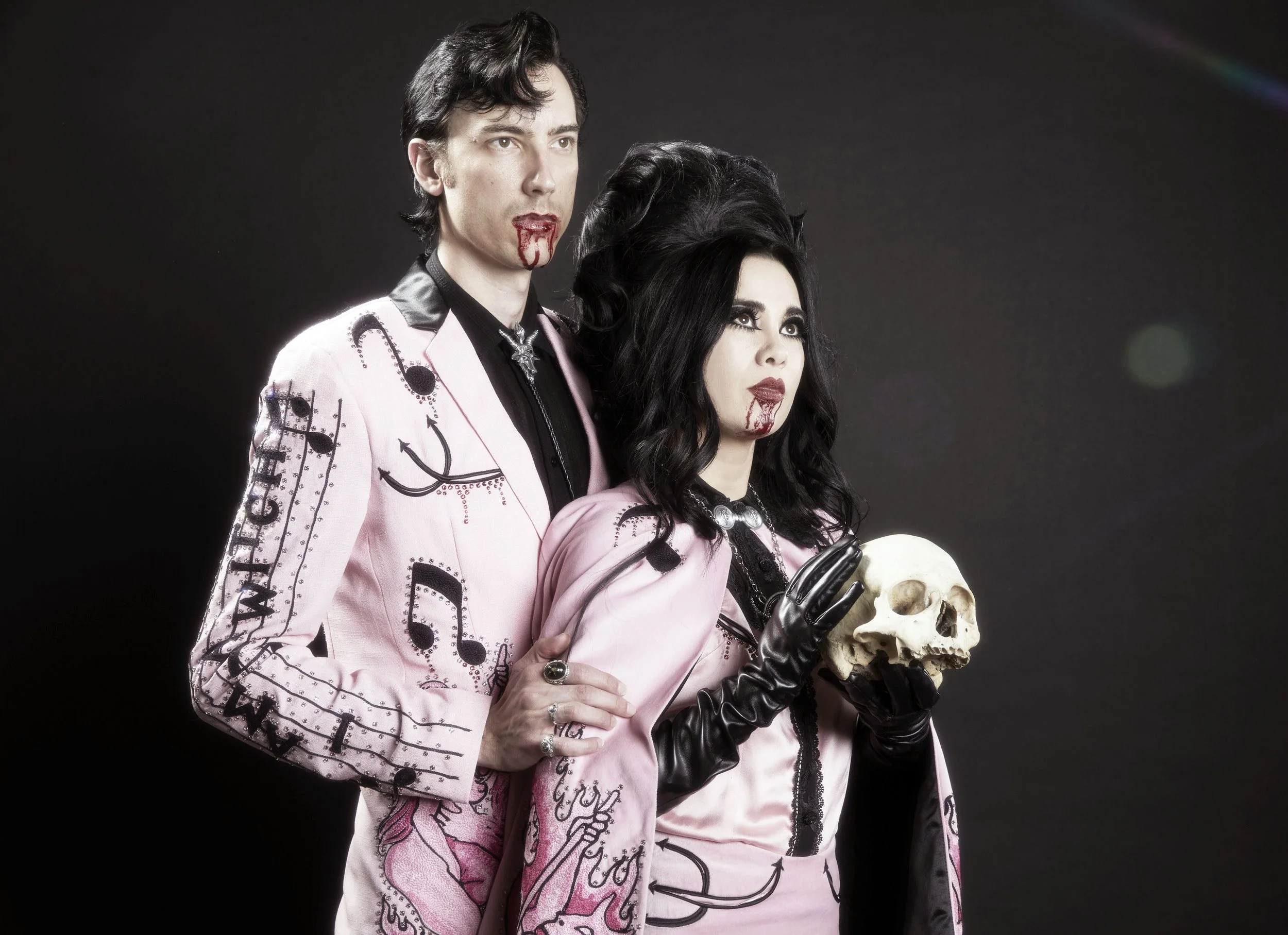
SPOTLIGHT: Twin Temple are in Love With the Darkness in ‘DOOMED LOVERS’
REVIEW
REVIEW
☆ BY KIMBERLY KAPELA ☆
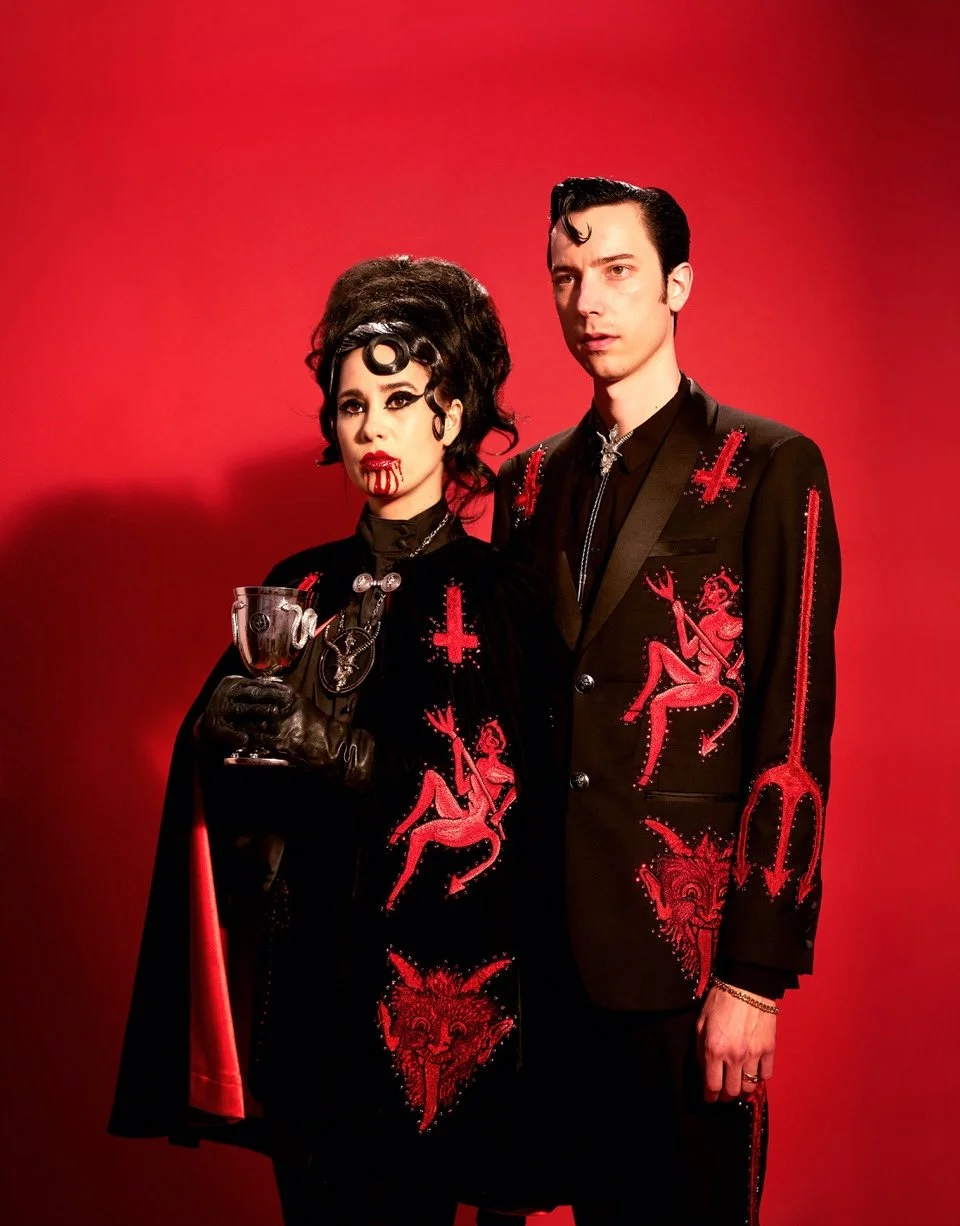
Travis Shinn
FOR TWIN TEMPLE, LOVE IS ALL-ENCOMPASSING — It consumes, transforms, and, at its most devastating, takes over completely. At its most intense, love becomes something you surrender to, a force that can devour you whole. For Twin Temple, that duality has always been part of the appeal. Romance and ruin have never been mutually exclusive; sometimes, they are two sides of the same coin.
On DOOMED LOVERS, their third studio album, the husband-and-wife duo Alexandra and Zachary James confront the darker shadows of devotion and finding salvation in the very thing that threatens to destroy them. It is Twin Temple at their most ambitious, expanding their signature brand of Satanic doo-wop into a lush, orchestral landscape without losing the wicked charm that has made them one of music's most distinctive acts.
Recorded with producer Shooter Jennings at the legendary Studio 3 at Sunset Sound in Hollywood, DOOMED LOVERS marks a bold new chapter for the duo. Rooted in the warmth and authenticity of classic analog recording, the album draws from the sweeping romanticism of Roy Orbison, The Ronettes, and The Shangri-Las, with touches of Countrypolitan production woven throughout. A 37-piece orchestra, alongside contributions from musicians Matt Chamberlain and Jay Bellerose, lends the record a cinematic scale that heightens its emotional stakes.
“We think we're about carrying the culture and the spirit of classic recording techniques forward,” Alexandra tells Luna.
Twin Temple’s music feels both nostalgic and subversive, familiar enough to invite listeners in before revealing the darkness lurking beneath its polished surface. On DOOMED LOVERS, that contrast becomes more personal than ever.
The album was written and recorded during one of the darkest periods of Alexandra and Zachary's lives, as they navigated grief, addiction and depression. Rather than retreating from those experiences, they allowed them to shape the record, transforming deeply personal pain into songs that confront the full spectrum of human emotion.
“The new record is also about romance, because I think the thing that got us through that time was love,” Alexandra says. “It's about all of those emotions: betrayal, grief, anger, despair, jealousy, disillusionment and depression. We also were going through a lot of health issues, so it was a really, really dark time for us in every way. Making this record helped us heal everything that we went through by getting it out onto this record.”
As the duo have described it, the experience reconnected them to why they fell in love with music in the first place. What emerged was not simply a collection of songs, but their most emotionally revealing work to date.
Beyond the music itself, Twin Temple have built a following by embracing the provocative potential of art. Their Satanic doo-wop aesthetic is more than a visual identity or a clever inversion of mid-century nostalgia. It is an expression of personal liberation, individuality, and artistic freedom, one that has placed the duo at the center of broader conversations about religion and censorship.
Too bold for some and irresistible to others, they have consistently refused to soften their vision for the sake of easy acceptance. Their work occupies a space where the sacred and the profane collide, where pleasure and darkness coexist, and where controversy can become an invitation to question the cultural expectations surrounding art.
DOOMED LOVERS reveals another dimension of that defiance. Beneath the theatricality and macabre imagery is a deeply human story about enduring difficult experiences and finding a reason to keep creating. The darkness here is not merely an aesthetic; it is something lived through, confronted, and ultimately transformed.
For Alexandra and Zachary, love became the thread that carried them through that darkness.
“I think love is transcendent,” Alexandra says. “For me, I don't do anything in halves. I'm very all or nothing. I'm very romantic. I think romance and love is very close to grief and fear, closer than most people want to admit. When you love someone that deeply, it can get taken away at any time, and it destroys you.”
Love can consume us, but it can also return us to ourselves. It can expose our most vulnerable places while giving us the courage to face them. It can be devastating without being meaningless, and imperfect without being any less profound.
In Twin Temple's world, love is never entirely innocent. It can be tender and transcendent, but it can also be obsessive, volatile and destructive. DOOMED LOVERS captures love in all of its messy, beautifully macabre glory.
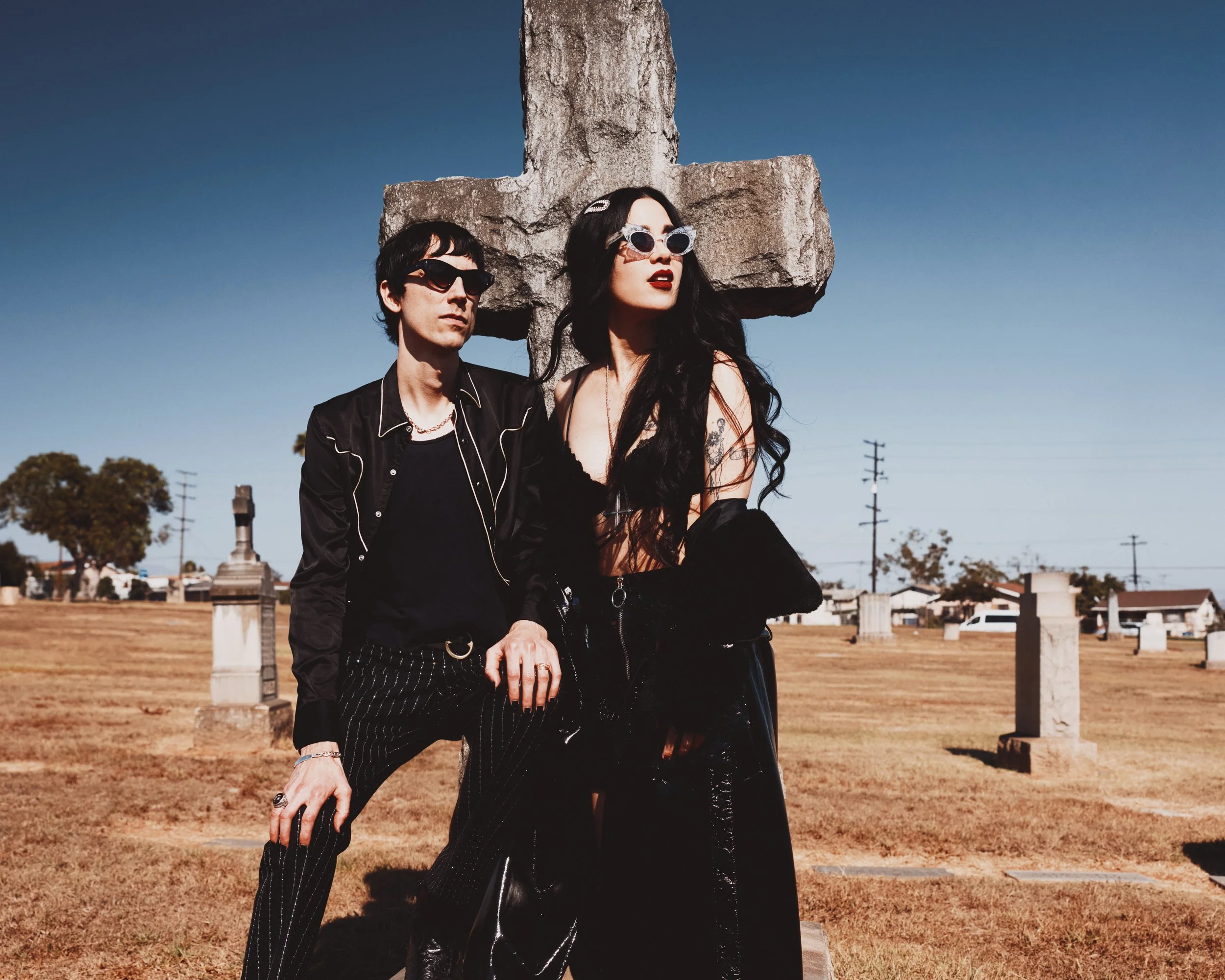
LUNA: Thank you for talking to Luna. Our readers would love to get to know you and your music more. For any readers who aren’t familiar with you yet, what kind of atmosphere or emotional space do you aim to create for your listeners?
ZACHARY: Otherworldly. Many worlds in one album.
ALEXANDRA: It depends. Every song has a different mood or emotion that was the seed for the song, so it ranges.
LUNA: You’ve described DOOMED LOVERS as your most intimate and emotionally revealing album yet. What emotions or inspirations did you feel compelled to explore for your third album?
ALEXANDRA: Probably the shadow side of life. In the last few years, we've just been through so much. We got sober. We lost people that were really close to us. We lost our son, who was a pug named Ziggy, and we were marred with professional setback after professional setback. I think the biggest one being we were caught in A&R hell with a record label where we completed God Is Dead actually in the fall of 2019 and then we weren't able to put it out until 2023. It was years of not being able to put music out, and we made another record in that time that we weren't able to put out. It crushed us as artists to not be able to do what we do, and we'd never really experienced being held back by the industry like that before at that scale where we just could not put our record out. So all of those things combined, we struggled with all of that.
The new record is also about romance, because I think the thing that got us through that time was love. It's about all of those emotions: betrayal, grief, anger, despair, jealousy, disillusionment and depression. We also were going through a lot of health issues, so it was a really, really dark time for us in every way. Making this record helped us heal everything that we went through by getting it out onto this record.
LUNA: You’ve spoken candidly about making this album during a period of grief, health struggles, addiction and depression. Was there a particular moment during the recording process when you realized that making music was helping you find your way back to yourselves?
ZACHARY: It was laced through the whole process. I think there were a lot of moments that were reminders of this is one of the reasons why we do this and how cathartic creative art can be.
ALEXANDRA: Having Shooter [Jennings] support throughout the process made us realize that creative collaborators, it's not just about the final product. It's not just about the sounds you find or the finished record. It's really about everything along the way, and having him be such a loyal and ardent supporter to us made us realize how important those creative partnerships are with a trusted collaborator. Shooter definitely was such a supporter throughout the entire process, and it went a long way.
When we started this record, we didn't have a label, we didn't have anything, we didn't even know if or how we were going to be able to put music out ever again. Shooter was like, “doesn't matter, just come to the studio.” He even gave us the keys to Sunset Sound for a week when he was away. He's so committed to the love of music, community and supporting artists that it really, I think, healed us after going through so many people who seemed like they just wanted to suppress and exploit and ruin artists' careers. It was the complete opposite.
I do actually remember one moment where we were just going through so much, and Shooter made that gesture, and all of a sudden it just felt like Christmas. I was excited to wake up in the morning, and I had a reason to get out of bed, which I think is pretty critical in healing depression. Just doing stuff even if you don't want to, or don't feel like it, or feel like you should lay in a dark room all day long. He gave us that reason to be like, let's go make music. It meant a lot, you know. Shooter’s an incredible producer. He's got tons of Grammys under his belt. He's in this incredible historic studio. We're like kids in a candy store with vintage U 47 mics, the piano that Prince played on, the room the Rolling Stones recorded in. We got to visit the reverb chambers that “California Dreamin’” was run through. It was just really magical and so cool. Like Zach said, there were just so many moments of wonder and beauty that it definitely gave us a reason to keep going.
LUNA: I would love to touch more on the creative process behind DOOMED LOVERS. What was it like working with Shooter Jennings, and how did his perspective as a producer challenge or expand your original vision for DOOMED LOVERS?
ALEXANDRA: Shooter really operates out of a place of absolute trust and love in the artist, so it really became a record about all our shared musical loves and our friendship. He had just moved into Sunset Sound when we started the record, so we were all really excited with getting to play with the studio and using it.
ZACHARY: It was the first time we brought in a full orchestra as well, so that was a big shift for this record, which was a nightmare come true. It is a very, very thrilling experience to hear an entire orchestra perform your music.
LUNA: You said that making the album at Sunset Sound helped reconnect you with why you fell in love with music in the first place. What did returning to that feeling look like for you?
ALEXANDRA: It was feeling joy again.
ZACHARY: We do it for the love, and when you don't feel the love, it's a very depressing feeling. It's like you're cut off from your life source, so it's this feeling of being alive.
ALEXANDRA: Like we need to do this. It's as crucial to me as breathing, and so when someone comes and cuts you off, it does feel like a total loss of self to not be able to do what gives our life meaning, purpose, joy, connection, community, everything. We go to sleep thinking about it, and we wake up thinking about it, and we've decided that this is our true will. This is why we're here, and it's great because me and Zach have this weird understanding. It's like we're married and we're each other's number one priorities, but the music is number one priority beyond us. We both agreed that we're dedicating our lives to this. I've never experienced the depression that crushing and not being able to breathe.
LUNA: This album expands your sound with a 37-piece orchestra while maintaining your commitment to analog recording. Why was having analog important for you and what did that look like?
ZACHARY: We just love records that were made that way. I don't personally care about preservation. We just love that music, and therefore we want to not really recreate it, but be a part of that creative process that we love so much. It's like you love the sound of a record, and then for us it's like we go and then research. Well, how is it made? That inspires the process. It's really this whole continuous obsessive delving deeper and deeper. I personally am not super concerned with preservation, it's more just a love for classic American music and how those records were made. When I love something, I just want to be close to it.
ALEXANDRA: You learn a lot. But I think ultimately, too, in terms of analog recording techniques, it's about capturing the raw humanity and the energy. It's a completely different experience than sitting alone in a laptop and making 70 digital tracks. There's a community. There's a magic that happens when people come together. It's not perfect, and that's what makes it so beautiful is that it's raw humanity. On one hand, it's funny because I think we love classic American music, and while we are trying to carry that conversation forward, we're also very much subverting it and tearing down what's come before and trying to fuck it up a little bit. A lot of the classic American music that we admire didn't necessarily touch on some of the topics that we're interested in our lives, so I think it's both a tearing down and a carrying forward. And ironically, in my mind, paradoxically, you have to tear it down in order to carry it forward.
I think we're about carrying the culture and the spirit of classic recording techniques forward. We're not opposed to technology either. A lot of times, we record to tape and dump it down into Pro Tools. I think the focus is not necessarily creating records exactly like they used to, but more capturing the spirit of humanity that those records exude, and I think subconsciously people can feel the difference when something was made by humans with real instruments in a beautiful room, as opposed to a bunch of MIDI tracks. No shade on artists who are really interested in exploring electronic sounds. But I think for us, it's more about the process as well, and that's what recording in the way we record does. The last record we did in our studio alone. Every instrument on that record, me and Zach played. It wasn't with a band or a producer, just us during COVID doing it. So ultimately, we always change up the recording process. The first record was all live to tape. We did it in two days, a completely different process from the other two records, but ultimately, I hope they capture a sense of rawness, imperfection and humanity.
LUNA: Do you have a personal favorite song on DOOMED LOVERS — one that feels closest to your heart or most revealing of who Twin Temple is right now?
ZACHARY: “Doomed Lovers” the title track. I feel like that's the record firing on all cylinders.
ALEXANDRA: That's a special one for sure. I feel like we're calling it the philosophical center piece of the album. I think it hits a lot of emotional notes that we're feeling. It's tragic. It's mythic. I like that it's set within these literary tropes of Tristan and Iseult and Romeo and Juliet and these lovers whose love was so big they were doomed to tragedy, and sometimes that's how I feel. It's ultimately a love song too. I feel like some of the other songs on the record are just more depressing, or more focused on the anger, or the betrayal, or the grief. I hope all of them have an element of romance or love interwoven between them because I really do feel like love is the other side of the shadow. You can't really separate the shadow side from the rest of life, and so even in moments like the deepest despair, there's still moments of sun breaking through the clouds. Of moments with Zach and realizing I was so lucky to have a partner to help get through this period together.
LUNA: If “Love You to Death” is about devotion taken to its most dangerous extreme, what do you think DOOMED LOVERS ultimately says about love itself?
ALEXANDRA: I think love is transcendent. For me, I don't do anything in halves. I'm very all or nothing. I'm very romantic. I think romance and love is very close to grief and fear, closer than most people want to admit. When you love someone that deeply, it can get taken away at any time, and it destroys you. It's like Roy Orbison said, “love hurts, but it's beautiful.” That's how I see that song.
LUNA: How do you hope listeners can connect with or find power in this new era of music from you? What emotions or messages do you want to leave with them?
ALEXANDRA: I don't know if we ever have had a preconceived notion of what we want to say per se. Twin Temple has always been a vehicle to express ourselves fully and authentically, and then the fun part is seeing what people connect to or what they take away or how it makes them feel, and it's a lot of times it's maybe different from what we were feeling or what we imagine for the song. It's always exciting and surprising to see what happens when it connects to other people, when they listen to it, when they experience it, and integrate it into their own unique life experiences. I don't know if we have a particular message. More just we want people to enjoy it, and if they can find a moment of forgetting about their problems, or transcendence, or maybe feeling healed, or even just an escape, or just a moment of pleasure, or even if they just enjoy the sounds. It's all a win for us just to have someone listen and integrate it into their own lives and experiences.
ZACHARY: I like to see people hear people's interpretations, but if anything, I hope they can hear the beauty and the darkness.
LUNA: What is fueling your fire right now that’s pushing you into this new era of your career?
ZACHARY: Musically, just our obsession with classic American music that continues to power me forward, push me forward. I just follow the muse and it keeps singing similar songs.
ALEXANDRA: We gravitated towards the same stuff since we're kids. It's one of those things where you just follow the winding road down where it leads you.
ZACHARY: Preserving the rawness, but also making sure that the beauty is also there.
LUNA: How are you feeling in this current era of your career and what does the rest of the year look like that you would like to share with Luna?
ZACHARY: We just started touring, so we're on the road after much rehearsal and preparation, so we're excited. You'll be hearing more from Twin Temple over the next year or two.
ALEXANDRA: We have quite a few plans in the works for the next year. But probably the most exciting is that the record is finally coming out on October 9, and it's actually secretly going to be distributed to stores, and so they'll be in stores worldwide October 23, which is also really exciting. We've got a few tricks up our sleeve that we can't quite announce yet, but this year is going to be pretty busy.